Type in JavaScript
In JavaScript, the concept of "type" is fundamental to understanding how data is represented and manipulated within the language. Types define the nature of data, influencing how it can be used and interacted with in code. JavaScript is a dynamically typed language, meaning that variables can hold values of any type without explicit type declarations. This flexibility allows for powerful and adaptable code but also requires careful management to avoid errors.
Primitive Types
JavaScript provides several primitive types that are essential to the language's operation:
- String: Represents textual data.
- Boolean: Represents logical entities with values
trueorfalse. - Number: Represents both integer and floating-point numbers.
- Symbol: A unique and immutable primitive value.
- Null: Represents the intentional absence of any object value.
- Function: While not a primitive type in the traditional sense, functions are first-class objects in JavaScript.
- Undefined: A variable that has been declared but not assigned a value.
These types are intrinsic to JavaScript and can be enhanced with object wrappers like String and Number for additional functionality.
Benefits of Type Systems
Compiler Assistance
A type system can significantly enhance the development process by allowing a compiler to trace through code and identify inconsistencies in the inputs and outputs of functions. This capability helps catch errors without executing the code, preventing bugs that might arise from type coercion or incorrect function usage.
Checking Invariants
Type checking can automatically verify invariants, which are assertions that must always hold true during the lifecycle of an object. For instance, a type system can ensure that a block's difficulty value does not exceed a certain limit.
Type Annotations and Nominal Typing
Type annotations provide a way to specify the expected types of variables and function parameters. This is illustrated in the following example of a proof-of-work algorithm with type information:
const proofOfWork = (block: Block): Block => {
   const hashPrefix: string = ''.padStart(block.difficulty, '0');
   do {
      block.nonce += nextNonce();
      block.hash = block.calculateHash();
   } while (!block.hash.toString().startsWith(hashPrefix));
   return block;
}

function nextNonce(): number {
   return randomInt(1, 10) + Date.now();
}

function randomInt(min: number, max: number): number {
   return Math.floor(Math.random() * (max - min)) + min;
}
In this example, the function proofOfWork is typed as Block => Block, indicating it takes a Block object and returns a Block object. This clear contract helps build correct expectations for API usage and catch potential errors early.
Class Type Annotations
Nominal typing can also be applied to class methods and fields, as shown in the Block class example:
class Block {
   index: number = 0;
   previousHash: string;
   timestamp: number;
   difficulty: Difficulty;
   data: Array<mixed>;
   nonce: number;

   constructor(index: number, previousHash: string,
            data: Array<mixed> = [], difficulty: Difficulty = 0) {

      // ...
   }

   isGenesis(): boolean {
      //...
   }
}
The type system ensures that the properties of this class are used properly and assigned correct values.
Object Literal Typing
Object literals can also be typed by describing their structure or shape. For example, the Money constructor function returns an object with specific properties:
type MoneyObj = {
   currency: string,
   amount: number,
   equals: boolean,
   round: MoneyData,
   minus: MoneyData,
   plus: MoneyData
}

const money: MoneyObj = Money('₿', 0.1);
money.amount;  // 0.1
If a property is mistyped, the type checker will immediately flag the error.
Type Inference and Error Detection
Type systems can infer types and detect errors, as demonstrated in the following example:
const fn = 'foo';
success.map(fn).get();
Here, the type system infers that fn is a string and flags an error when attempting to use it as a function.
Figures Illustrating Type Flow
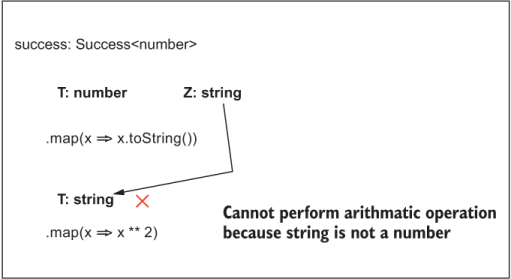 Figure B.1 The sequence of map calls, tracing the flow of types to find an invalid operation (exponentiation) being performed on a string
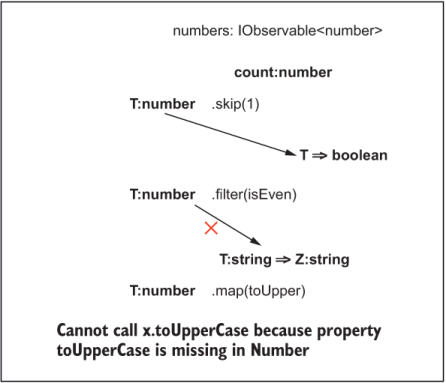 Figure B.2 Tracing the flow of types through the observable stream. Mapping toUpper causes a violation, as the expected event type is number.
Union Types
Union types allow for modeling logical OR scenarios, describing two disjointed control flows. This is visually represented in the following figure:
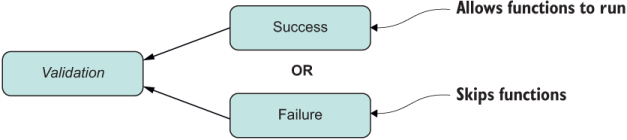 Figure B.3 Union type annotations model a logical OR describing two disjointed control flows.
Union types can be used directly or indirectly in classes, such as the Block class, to handle multiple potential types for a variable or parameter.
Type in Functional Programming
In the context of function pipelines, the concept of "type" refers to the data type of inputs and outputs of functions. Understanding and managing types is crucial for ensuring that functions can be effectively chained together in a pipeline. This is because type compatibility is essential for the seamless operation of function chains.
JavaScript, being a dynamically typed language, offers a high degree of flexibility when it comes to types. This means that variables in JavaScript can hold values of any type without explicit type declarations. However, this flexibility also necessitates a clear understanding of the expected types for function inputs and outputs to maintain clarity and prevent errors in function pipelines.
In functional programming, ensuring that the output type of one function matches the input type of the next function in the pipeline is key to creating robust and maintainable code. This practice helps in avoiding runtime errors and makes the code more predictable and easier to debug.
Type in C3 Chart Configuration
In the context of C3, a popular charting library, the term type is used to specify the kind of chart that is being rendered. This is a crucial part of the chart configuration as it determines the visual representation of the data. The type is defined within the data section of the chart configuration.
Chart Types
C3 supports various types of charts, each suited for different kinds of data visualization needs. The primary chart types include:
- Line Chart: Ideal for displaying data trends over time.
- Bar Chart: Useful for comparing quantities across different categories.
- Pie Chart: Effective for showing proportions and percentages.
- Scatter Chart: Suitable for displaying relationships between two variables.
By specifying the type in the configuration, users can easily switch between these chart types to best represent their data. For example, setting the type to line will render a line chart, while setting it to bar will render a bar chart.
This flexibility allows for dynamic and interactive data visualizations, making C3 a powerful tool for developers and data analysts.
| Book Title | Usage of type | Technical Depth | Connections to Other Concepts | Examples Used | Practical Application |
|------------|---------------|-----------------|-------------------------------|---------------|-----------------------|
| [The Joy of JavaScript](https://www.manning.com/books/the-joy-of-javascript) | Discusses primitive types, type systems, and type annotations. | In-depth discussion on type systems, type inference, and error detection. | Connects types to compiler assistance, invariants, and nominal typing. | Provides code examples for type annotations and object literal typing. | Emphasizes practical use of types in error prevention and API design. [more](https://livebook.manning.com/book/the-joy-of-javascript/appendix-b/17) |
| [Functional Programming in JavaScript](https://www.manning.com/books/functional-programming-in-javascript) | Focuses on types in function pipelines and their importance in chaining functions. | Discusses the flexibility and challenges of dynamic typing in JavaScript. | Highlights the importance of type compatibility in function pipelines. | No specific examples provided, but discusses general principles. | Stresses the role of types in creating robust and maintainable code. [more](https://livebook.manning.com/book/functional-programming-in-javascript/chapter-4/43) |
| [Data Wrangling with JavaScript](https://www.manning.com/books/data-wrangling-with-javascript) | Uses 'type' to specify chart types in C3 chart configuration. | Basic explanation of chart types and their configuration. | Connects 'type' to data visualization and chart configuration. | Examples of different chart types like line, bar, and pie charts. | Practical application in data visualization and chart customization. [more](https://livebook.manning.com/book/data-wrangling-with-javascript/chapter-10/151) |
FAQ (Frequently asked questions)
What are the primitive types in JavaScript?
Do JavaScript primitive types have properties?
How can a compiler help prevent bugs in JavaScript?
What issues can a compiler detect in JavaScript code?
What is the role of type checking in JavaScript?
How does a type system ensure object invariants in JavaScript?
What does 'type' refer to in function pipelines?
Why is type compatibility important in function pipelines?
How does JavaScript's dynamic typing affect function pipelines?
What does 'type' refer to in C3?
Where is the 'type' specified in a C3 chart?
What is the purpose of specifying 'type' in a C3 chart?