Waterfall
Overview
The term "waterfall" in the context of JavaScript application design can refer to two distinct concepts: a method for storing configuration and a method for executing tasks sequentially using the async library.
Waterfall for Configuration Management
The waterfall method for storing configuration involves prioritizing different sources and merging them to maintain a single access point within an application. This approach allows configuration data to be distributed across various locations, such as plain text files, encrypted files, and environment variables. By doing so, it provides flexibility in managing configuration settings and ensures that the application can access the most relevant and up-to-date configuration data.
Example
A practical example of using the waterfall method for configuration is to store basic settings in a JSON file, such as NODE_ENV and PORT. These settings can then be overridden by command-line arguments or environment variables, depending on the priority. This allows for a dynamic and flexible configuration management system that can adapt to different environments and requirements.
Waterfall in the Async Library
In the async library, the waterfall method is used for the sequential execution of tasks. Each task in the sequence passes its results to the next task, creating a cascade of operations. This method is particularly useful when tasks are tightly coupled and depend on the output of previous tasks. It ensures that each task is executed in order, with the necessary data passed along the chain.
Comparison with Other Strategies
The waterfall method in the async library can be compared to other strategies such as parallel and series execution. Figure 6.3 provides a visual comparison of these three alternatives:
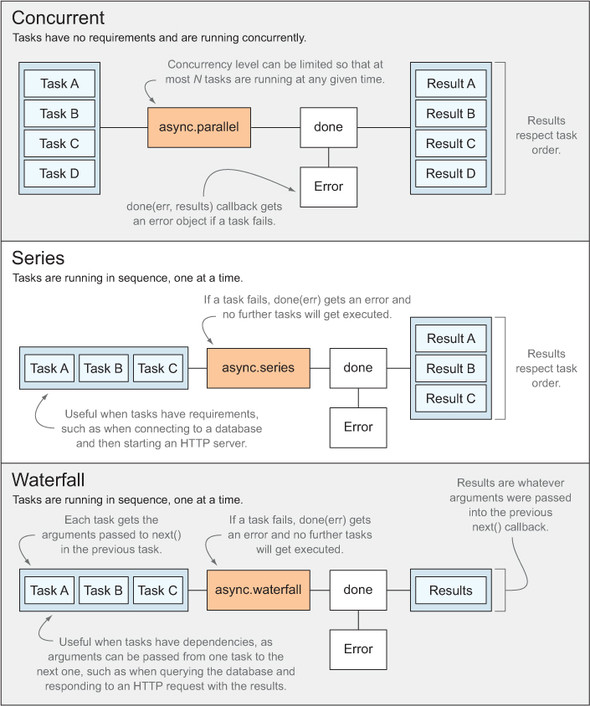 Figure 6.3. Comparison of parallel, series, and waterfall in the async library.
As depicted in Figure 6.3, there are subtle differences between these strategies. In parallel execution, tasks are executed simultaneously, which can be efficient but may not be suitable for tasks that depend on each other. Series execution, on the other hand, runs tasks one after the other without passing results between them, which can be less efficient if tasks are independent. The waterfall method strikes a balance by allowing sequential execution with result passing, making it ideal for dependent tasks.
FAQ (Frequently asked questions)
What is the waterfall method for storing configuration?
How can configuration be stored using the waterfall method?
What is the waterfall method in the async library?
How does the waterfall method compare to parallel and series in the async library?