Activation Function
Activation functions are a crucial component in the architecture of neural networks. They are mathematical functions applied to the output of a neuron, introducing non-linearity into the model. This non-linearity is essential as it allows the network to approximate complex, non-linear functions, which is a fundamental requirement for solving intricate problems in deep learning.
Overview
In the context of neural networks, activation functions are applied after linear transformations. These functions are nonlinear and differentiable, which is vital for enabling gradient computation during the training process. The ability to compute gradients is what allows neural networks to learn from data through optimization techniques like backpropagation.
Common activation functions include:
- ReLU (Rectified Linear Unit): This function outputs the input directly if it is positive; otherwise, it outputs zero. It is widely used due to its simplicity and effectiveness in practice.
- Sigmoid: This function maps input values to an output range between 0 and 1, making it useful for binary classification problems.
- Tanh (Hyperbolic Tangent): Similar to the sigmoid function but maps input values to an output range between -1 and 1, often used in hidden layers of neural networks.
Examples
Hardtanh
An example of an activation function is torch.nn.Hardtanh, which is implemented in PyTorch. This function caps output values to a specific range. For instance, it can be set to output 0 for any input below 0 and 10 for any input above 10. This capping mechanism can be useful in scenarios where output values need to be restricted within a certain range.
ReLU
The ReLU function is another example of an activation function used in various models, such as the NetDepth and NetRes models. Its simplicity and efficiency make it a popular choice in many deep learning architectures.
Visual Representation
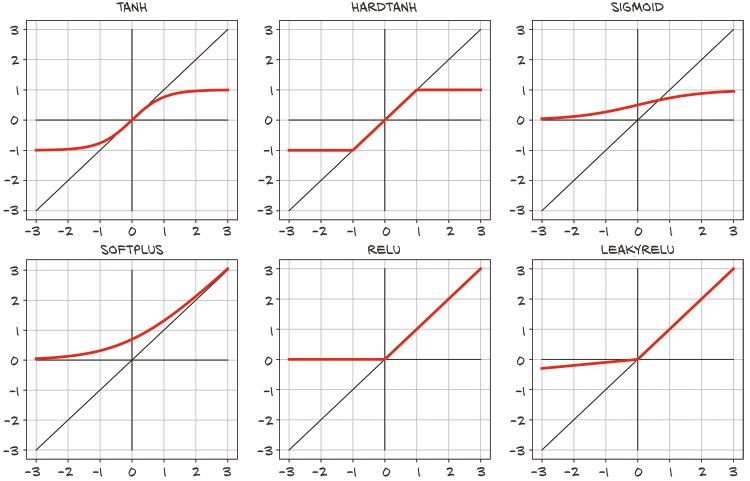 Figure 6.5 A collection of common and not-so-common activation functions.
Figure 6.5 provides a visual representation of various activation functions, both common and less common ones. This illustration helps in understanding the behavior and characteristics of different activation functions, aiding in the selection of the appropriate function for specific tasks in neural network design.
FAQ (Frequently asked questions)
What activation function is used in the NetDepth and NetRes models?
What is the purpose of activation functions in neural networks?
What are some common activation functions?
Where can I find a collection of common and not-so-common activation functions?
What is an example of an activation function that caps output values?
How does the torch.nn.Hardtanh activation function work?
What role do activation functions play in neural networks?