Boundary
In the context of manifolds, a boundary refers to the set of points that can be approached from both inside and outside a given set. This concept is crucial in understanding the structure and properties of various mathematical sets. For instance, consider the set ( A_c \equiv 0 \leq x \leq 1 ). In this case, the boundary points are ( x = 0 ) and ( x = 1 ). These points mark the limits of the set and can be approached from within the set (e.g., ( x \to 0^+ ) or ( x \to 1^- )) as well as from outside the set (e.g., ( x \to 0^- ) or ( x \to 1^+ )).
The concept of boundaries extends beyond one-dimensional sets to higher dimensions. For example, consider the set of 2D points belonging to the unit disc ( S \equiv x^2 + y^2 < 1 ). This set is an open set, meaning it does not include its boundary. If we add the boundary, which is the circle ( S_c \equiv x^2 + y^2 = 1 ), the set becomes closed. This transformation from an open set to a closed set by including the boundary is visually represented in Figure 12.5.
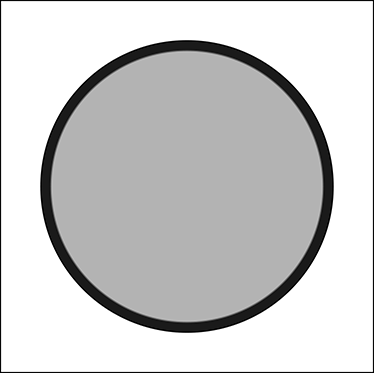 Figure 12.5 The open set, disk without a boundary is shown in gray. The boundary is shown in black. Gray+black is the closed set.
In Figure 12.5, the open set, which is the disk without its boundary, is depicted in gray. The boundary itself is shown in black. When the gray area (the open set) is combined with the black boundary, the result is a closed set. This illustration helps to clarify the distinction between open and closed sets and the role of boundaries in defining these properties.