Cartesian Coordinate
Cartesian coordinates are a fundamental concept in geometry, used to specify the position of points in a two-dimensional space. This system employs two perpendicular axes, typically labeled as x and y, to define the location of a point through a pair of numerical values. The Cartesian coordinate system is widely utilized in various fields, including computer graphics, physics, and engineering, due to its straightforward representation of spatial relationships.
Definition
In the Cartesian coordinate system, a point is represented by a pair of real numbers, typically denoted as \((x, y)\). These numbers indicate the point's position relative to two perpendicular axes: the x-axis, which is usually horizontal, and the y-axis, which is vertical. The intersection of these axes is known as the origin, represented by the coordinates \((0, 0)\). This system allows for precise location of points in a plane by using these two values.
For more details, refer to the Geometry for Programmers and Exploring Math for Programmers and Data Scientists.
Representation
The Cartesian coordinate system is typically visualized with the x-axis running horizontally from left to right and the y-axis running vertically from bottom to top. This setup provides a clear and intuitive way to represent points in a two-dimensional plane. The conventional names for these axes are x and y, and they intersect at the origin point \((0, 0)\).
Example
Consider the point \((0.5, 1.5)\) in Cartesian coordinates. This point is located 0.5 units along the x-axis and 1.5 units along the y-axis. Another example is the point \((4, 3)\), which specifies a position 4 units along the x-axis and 3 units along the y-axis. In both cases, the points are positioned relative to the origin, with the x-axis and y-axis providing a reference framework.
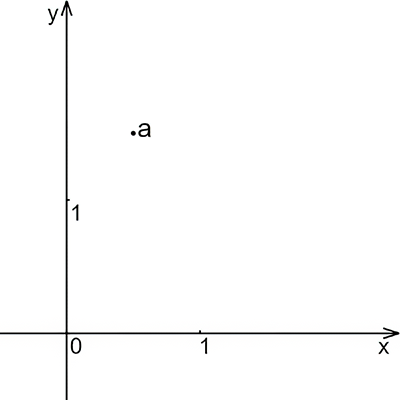 Figure 2.1 A point in Cartesian coordinates: a = (0.5, 1.5)
Conventions and Variations
While the standard convention is to place the x-axis horizontally and the y-axis vertically, there are scenarios where different conventions are used. For example, on a computer screen, coordinates typically start from the top-left corner rather than the bottom-left corner. Additionally, when dealing with digital displays, we often work with pixels instead of real points. Pixels are the smallest addressable elements in a display device and are represented by integer coordinates. Unlike geometric points, pixels have dimensions (width and height).
On a 1-to-1 scale, the point \((0.5, 1.5)\) in Cartesian coordinates would correspond to a pixel \([0, 1]\).
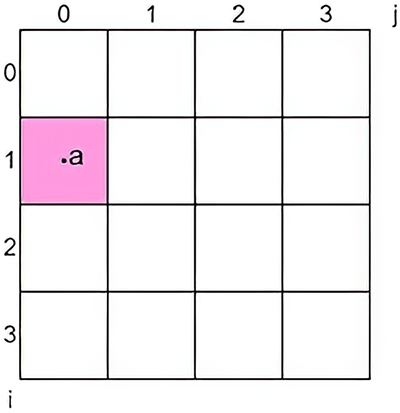 Figure 2.2 A pixel representation of point a
For further reading, see Geometry for Programmers.
| Book Title | Usage of Cartesian Coordinate | Technical Depth | Connections to Other Concepts | Examples Used | Practical Application |
|------------|-------------------------------|-----------------|------------------------------|---------------|-----------------------|
| [Geometry for Programmers](https://www.manning.com/books/geometry-for-programmers) | Discusses Cartesian coordinates as a fundamental system in geometry, used in fields like computer graphics, physics, and engineering. [more](https://livebook.manning.com/book/geometry-for-programmers/chapter-2/12) | Explains the representation of points in 2D space and variations in conventions, such as pixel representation on screens. [more](https://livebook.manning.com/book/geometry-for-programmers/chapter-2/65) | Connects to concepts like pixel representation and screen coordinates. [more](https://livebook.manning.com/book/geometry-for-programmers/chapter-2/65) | Provides examples like the point (0.5, 1.5) and its pixel representation. [more](https://livebook.manning.com/book/geometry-for-programmers/chapter-2/12) | Discusses practical scenarios like computer screen coordinates and pixel dimensions. [more](https://livebook.manning.com/book/geometry-for-programmers/chapter-2/65) |
| [Exploring Math for Programmers and Data Scientists](https://www.manning.com/books/exploring-math-for-programmers-and-data-scientists) | Defines Cartesian coordinates as numerical values specifying a point's position in a plane. [more](https://livebook.manning.com/book/exploring-math-for-programmers-and-data-scientists/chapter-2/239) | Focuses on the basic definition and usage of Cartesian coordinates in a 2D space. [more](https://livebook.manning.com/book/exploring-math-for-programmers-and-data-scientists/chapter-2/239) | Primarily focuses on the Cartesian plane without extensive connections to other concepts. [more](https://livebook.manning.com/book/exploring-math-for-programmers-and-data-scientists/chapter-2/239) | Uses simple examples like the point (4, 3) to illustrate the concept. [more](https://livebook.manning.com/book/exploring-math-for-programmers-and-data-scientists/chapter-2/244) | Provides a basic understanding of locating points in a 2D space. [more](https://livebook.manning.com/book/exploring-math-for-programmers-and-data-scientists/chapter-2/244) |
FAQ (Frequently asked questions)
What are Cartesian coordinates?
What is an example of a point in Cartesian coordinates?
How is a point represented in Cartesian coordinates?
Can you give an example of Cartesian coordinates?
What are Cartesian coordinates?
How do Cartesian coordinates specify a point's position?
Can you give an example of Cartesian coordinates?
What does the point (4, 3) represent in Cartesian coordinates?