Continuity
Continuity is a fundamental concept in mathematics, particularly in the study of functions and their behaviors. It is essential in ensuring smooth transitions and avoiding abrupt changes in various applications, such as interpolation and graphics.
Definition
Continuity means that the function on the left of a breaking point has the same value as the function on the right. This ensures that there are no sudden jumps or gaps in the function's graph.
Example of Continuity
An illustrative example of continuity is provided by a piecewise function:
- For ( x < 0 ), the function is defined as ( f(x) = x^2 + 1 ).
- For ( x \geq 0 ), the function is defined as ( f(x) = 1 - x^2 ).
At the point ( x = 0 ), both parts of the function have the value 1, making the function continuous at this point. This means there is no abrupt change in the function's value as ( x ) crosses zero.
Continuity in Interpolation
In interpolation, continuity refers to the smooth transition between data points. It ensures that the interpolated function does not exhibit abrupt changes or discontinuities, which is crucial for maintaining the integrity and visual appeal of the interpolated data.
Bitmap Interpolation
In the context of bitmap interpolation, continuity is achieved by ensuring that the interpolated values align perfectly with neighboring pixels. This results in a smooth transition of colors across the image, avoiding any visible seams or artifacts that could disrupt the visual experience.
Visual Representation
Continuity can be visually represented by a piecewise function that is both smooth and continuous, as shown in the following figure:
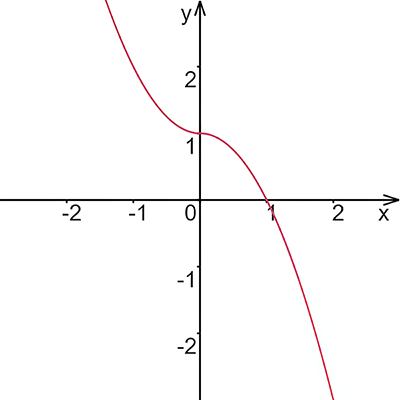 Figure 5.11 A piecewise function, smooth and continuous
This figure illustrates how a function can be constructed to maintain continuity across different segments, ensuring a seamless transition without any breaks or jumps.
FAQ (Frequently asked questions)
What does continuity mean in the context of functions?
What is depicted in Figure 5.11?
Can you provide an example of a continuous piecewise function?
What does continuity mean in interpolation?
How is continuity achieved in bitmap interpolation?