Convolution in Deep Learning
Convolution is a core operation in deep learning, especially within Convolutional Neural Networks (CNNs). It is a mathematical operation that processes data with a grid-like topology, such as images and videos, by applying a kernel or filter to extract features. This operation is crucial for tasks like image processing, video motion detection, and feature extraction in neural networks.
Convolutional Operations
One-Dimensional Convolution
In one-dimensional convolution, a kernel slides over an input array, multiplying and summing the overlapping elements to produce an output array. This is often used for tasks like smoothing and edge detection, where it helps identify patterns within the data. Learn more about 1D Convolution.
Two-Dimensional Convolution
Two-dimensional convolution extends the concept to 2D input arrays, such as images. A 2D kernel slides over the image, computing a weighted sum of the input elements covered by the kernel at each position. This process is essential for image processing tasks, including smoothing and edge detection. Learn more about 2D Convolution.
Three-Dimensional Convolution
Three-dimensional convolution is used for processing video data, where the input is a sequence of frames. This involves using 3D kernels to capture spatio-temporal patterns across successive frames. In PyTorch, 3D convolution is implemented using the Conv3d layer. Learn more about 3D Convolution.
Transposed Convolution
Transposed convolution, also known as fractionally strided convolution, is used to upsample data. It involves multiplying the output of a convolution by the transposed weight matrix, effectively distributing the output back to the input space. This operation is often used in tasks that require data upsampling, such as image generation and super-resolution. Learn more about Transposed Convolution.
Key Concepts of Convolution
Locality and Translation Invariance
Convolution operations are characterized by their locality and translation invariance, focusing on local neighborhoods of the image and being invariant to translations. This allows the model to detect patterns irrespective of their position in the image. 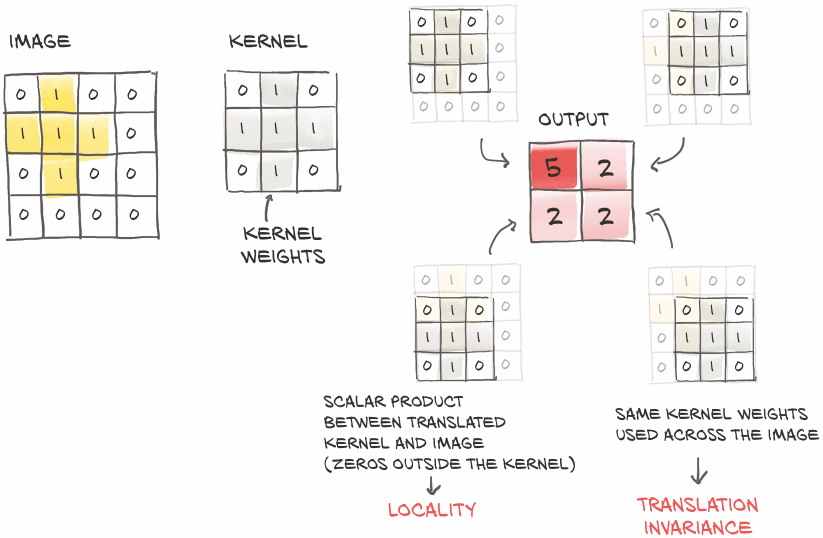 View Figure 8.1.
Feature Detection
Convolutions detect features by applying learned filters to input data, highlighting specific patterns such as edges and textures. 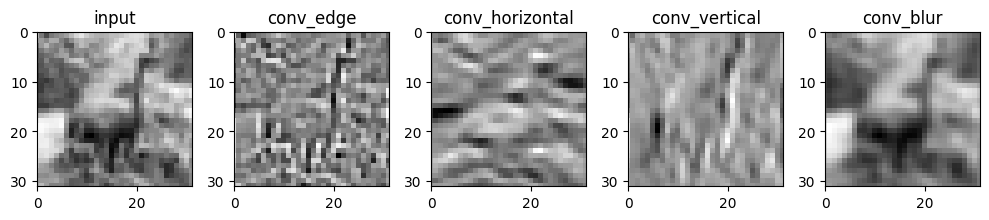 View Figure 8.6.
Padding
Padding is used in convolutions to maintain the output size after applying the convolution, adding extra pixels around the input image. Learn more about Padding.
Pooling and Downsampling
Pooling is a downsampling operation that reduces the spatial dimensions of feature maps, retaining the most important features while reducing computational complexity.  View Figure 8.9.
Receptive Fields
The receptive field of an output pixel in a convolutional network is the region of the input image that influences that particular output pixel. It grows with the depth of the network and the size of the convolutional kernels used. Learn more about Receptive Fields.
Implementing Convolution in PyTorch
In PyTorch, convolutional layers are implemented using torch.nn.Conv2d() for 2D convolutions and torch.nn.Conv3d() for 3D convolutions. These layers are typically part of a neural network class that subclasses torch.nn.Module. The layers are instantiated in the __init__() function and can be chained using torch.nn.Sequential to build complex network architectures. Learn more about Implementing Convolution in PyTorch.
Adding Convolution Layers to Networks
To add convolution layers to a network in PyTorch, define them within a class that subclasses torch.nn.Module. The layers are initialized in the __init__() method and can be organized using torch.nn.Sequential. Learn more about Adding Convolution Layers.
Visualizing Convolution Effects
The effect of convolution on an image can be visualized by comparing the original and modified images. 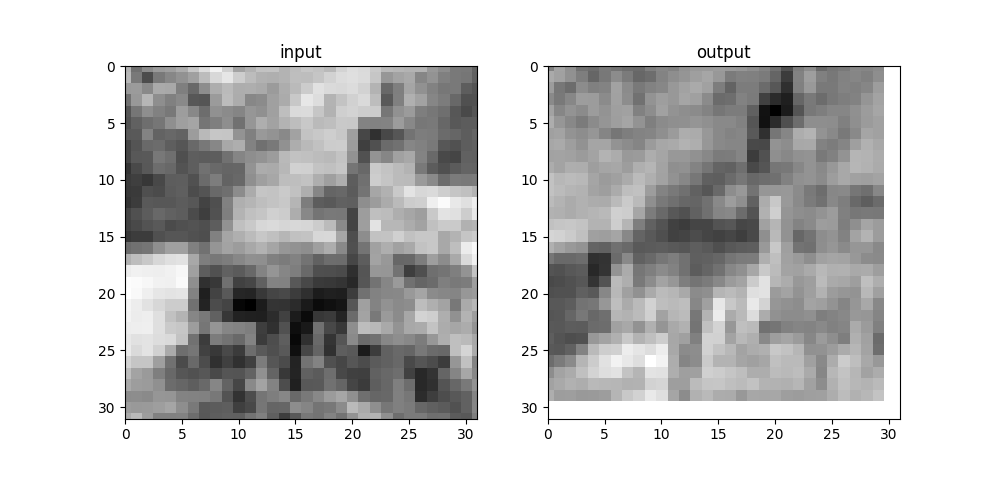 View Figure 8.2.
For further reading, explore the Math and Architectures of Deep Learning and Deep Learning with PyTorch, Second Edition.
| Book Title | Usage of Convolution | Technical Depth | Connections to Other Concepts | Examples Used | Practical Application |
|------------|----------------------|-----------------|-------------------------------|---------------|-----------------------|
| [Math and Architectures of Deep Learning](https://www.manning.com/books/math-and-architectures-of-deep-learning) | Discusses convolution as a fundamental operation for processing grid-like data, such as images and videos, with a focus on feature extraction and local pattern recognition. [more](https://livebook.manning.com/book/math-and-architectures-of-deep-learning/chapter-10/1) | Covers 1D, 2D, and 3D convolutions, transposed convolutions, and their implementation in PyTorch. [more](https://livebook.manning.com/book/math-and-architectures-of-deep-learning/chapter-10/94) | Links convolution to tasks like image processing, video motion detection, and neural network feature extraction. [more](https://livebook.manning.com/book/math-and-architectures-of-deep-learning/chapter-10/185) | Provides examples of convolution operations in PyTorch, including code snippets for implementing convolutional layers. [more](https://livebook.manning.com/book/math-and-architectures-of-deep-learning/chapter-10/233) | Highlights practical applications in image generation, super-resolution, and video motion detection. [more](https://livebook.manning.com/book/math-and-architectures-of-deep-learning/chapter-10/197) |
| [Deep Learning with PyTorch, Second Edition](https://www.manning.com/books/deep-learning-with-pytorch-second-edition) | Describes convolution as a local, translation-invariant operation crucial for pattern recognition in images, reducing parameters compared to fully connected layers. [more](https://livebook.manning.com/book/deep-learning-with-pytorch-second-edition/chapter-8/1) | Explores key concepts like locality, translation invariance, feature detection, padding, pooling, and receptive fields. [more](https://livebook.manning.com/book/deep-learning-with-pytorch-second-edition/chapter-8/25) | Connects convolution to CNNs, emphasizing its role in image processing and classification. [more](https://livebook.manning.com/book/deep-learning-with-pytorch-second-edition/chapter-8/58) | Includes visual examples and code snippets for convolution operations in PyTorch, demonstrating effects on images. [more](https://livebook.manning.com/book/deep-learning-with-pytorch-second-edition/chapter-8/1) | Focuses on practical applications in image classification and processing, with detailed examples of convolutional layer creation in PyTorch. [more](https://livebook.manning.com/book/deep-learning-with-pytorch-second-edition/chapter-8/1) |
FAQ (Frequently asked questions)
What does depth mean in convolutional neural networks?
How does increasing depth affect a convolutional neural network?
What is convolution in the context of image processing?
Why is convolution important in neural networks?
What does Figure 8.1 illustrate about convolution?
How is an element of the output image computed using convolution?
What is the purpose of convolution in image processing?
Why is convolution useful for pattern recognition in images?
What role do convolutions play in neural networks?
Why are convolutions essential for image processing tasks?
What does Figure 8.6 demonstrate about kernels?
What does the convolution example in the listing illustrate?
What do the numbers in the Conv2d function represent?
What is padding in convolutions?
Why is padding used in convolutional operations?
How do convolutions detect features in input data?
Why are feature detection capabilities of convolutions important?
What is pooling in convolutional networks?
How does pooling benefit convolutional networks?
What is downsampling in convolutional networks?
Why is downsampling used in convolutional networks?
What is the receptive field in a convolutional network?
How does the receptive field change with network depth?
Why are convolutions fundamental in neural networks?