Coordinate
In the context of mathematics and computer science, a "coordinate" is a set of values that specify the position of a point or vector in space. Coordinates are fundamental in various fields, including geometry, computer graphics, physics simulations, and data visualization. They provide a systematic way to describe locations and directions in both two-dimensional (2D) and three-dimensional (3D) spaces.
3D Coordinates
In a three-dimensional space, coordinates are typically represented by a triple of numbers (x, y, z). These numbers provide a unique way to locate a point or vector within the 3D environment. The x and y coordinates indicate the position on a plane, while the z coordinate indicates depth. For example, the point (4, 3, 5) in 3D space is specified by moving +4 units in the x direction, +3 units in the y direction, and +5 units in the z direction. This method of using three numbers to define a point is fundamental in various applications, such as computer graphics and data visualization.
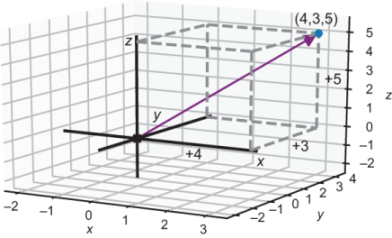 Figure 3.8 The three coordinates (4, 3, 5) give us directions to a point in 3D.
3D Vectors
3D vectors are also represented using three coordinates (x, y, z). These vectors are essential in representing directions and magnitudes in 3D space. The coordinates of a vector specify a unique point, with the x and y values indicating the position on a plane and the z value indicating the depth. This representation is crucial for tasks such as rendering 3D models, calculating forces in physics engines, and performing spatial transformations.
Projective Coordinates
In geometry, coordinates are a fundamental concept used to represent points in space. In projective space, coordinates are represented as tuples with an additional denominator. For example, in 2D projective space, a point is represented as a tuple (x, y, w). This representation is particularly powerful as it allows for the representation of points at infinity and simplifies various geometric transformations.
- Tuple Representation: In 2D projective space, a point is represented as (x, y, w).
- Points at Infinity: The additional denominator allows for the representation of points at infinity, which are essential in projective geometry.
- Simplified Transformations: Projective coordinates simplify the mathematical operations involved in transformations, making them more efficient and robust for computational purposes.
By using projective coordinates, programmers and mathematicians can work with a more comprehensive and flexible system that accommodates a wider range of geometric scenarios, including those involving infinity and complex transformations.
For more detailed information, you can refer to the following resources:
| Book Title | Usage of Coordinate | Technical Depth | Connections to Other Concepts | Examples Used | Practical Application |
|------------|---------------------|-----------------|-------------------------------|---------------|-----------------------|
| [Exploring Math for Programmers and Data Scientists](https://www.manning.com/books/exploring-math-for-programmers-and-data-scientists) | Discusses coordinates in the context of 3D space, specifying positions of points or vectors using a triple of numbers (x, y, z). [more](https://livebook.manning.com/book/exploring-math-for-programmers-and-data-scientists/chapter-3/25) | Covers the fundamental use of coordinates in 3D graphics, physics simulations, and data visualization. [more](https://livebook.manning.com/book/exploring-math-for-programmers-and-data-scientists/chapter-3/26) | Connects to concepts like 3D vectors and spatial transformations. [more](https://livebook.manning.com/book/exploring-math-for-programmers-and-data-scientists/chapter-3/26) | Provides examples like the point (4, 3, 5) in 3D space. [more](https://livebook.manning.com/book/exploring-math-for-programmers-and-data-scientists/chapter-3/14) | Practical applications in rendering 3D models and calculating forces in physics engines. [more](https://livebook.manning.com/book/exploring-math-for-programmers-and-data-scientists/chapter-3/26) |
| [Geometry for Programmers](https://www.manning.com/books/geometry-for-programmers) | Explores coordinates in projective space, using tuples with an additional denominator for points at infinity. [more](https://livebook.manning.com/book/geometry-for-programmers/chapter-4/165) | Delves into projective coordinates, emphasizing their role in simplifying geometric transformations. [more](https://livebook.manning.com/book/geometry-for-programmers/chapter-4/165) | Links to projective geometry and the concept of homogeneity. [more](https://livebook.manning.com/book/geometry-for-programmers/chapter-4/165) | Uses tuple representation (x, y, w) to illustrate points at infinity. [more](https://livebook.manning.com/book/geometry-for-programmers/chapter-4/165) | Useful for handling complex transformations and computational geometry tasks. [more](https://livebook.manning.com/book/geometry-for-programmers/chapter-4/165) |
FAQ (Frequently asked questions)
What are coordinates in projective space?
How do projective space coordinates simplify transformations?
What is the purpose of the additional denominator in projective space coordinates?
How are coordinates represented in 3D space?
What do 3D coordinates provide?
What do the coordinates (4, 3, 5) represent in 3D space?
How do the coordinates (4, 3, 5) specify a point in 3D space?
How are 3D vectors represented?
What do the x, y, and z coordinates indicate in 3D space?