Definite Integral
A definite integral is a fundamental concept in calculus that calculates the total change in a function over a specified interval. It is derived from the function's rate of change, or its derivative. The process involves summing up small changes to find the total change over a period, which is particularly useful in various applications such as physics, engineering, and data science.
Definition
The definite integral of a function is the sum of the instantaneous rates of change over a specified interval. This is approximated by breaking the interval into brief segments and assuming the rate is constant on each. Mathematically, it is represented by the integral symbol with specified bounds and results in a single cumulative value. The definite integral tells you the total change in a function on some interval from its derivative function. For instance, if ( f(x) ) is our function of interest and ( f'(x) ) is the derivative of ( f(x) ), then the change in ( f ) from ( x = a ) to ( x = b ) is ( f(b) - f(a) ), and it can be found by taking a definite integral.
Visual Representation
The concept of a definite integral can be visualized as shown in Figure 8.30. This figure illustrates how the definite integral takes the rate of change (derivative) of a function and a specified interval to recover the cumulative change in the function on that interval.
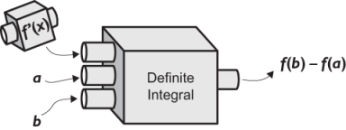 Figure 8.30 The definite integral takes the rate of change (derivative) of a function and a specified interval and recovers the cumulative change in the function on that interval.
Examples
Example 1: Volume Change Over Time
One practical example of a definite integral is calculating the volume change over a 10-hour period. This is done by breaking the time into smaller intervals and summing the changes, which is an application of definite integrals. This method allows for an accurate calculation of the total volume change by considering the rate of change at each interval.
Example 2: Riemann Sum
Another example involves calculating the change in volume from time 0 to time 4 hours using a Riemann sum. This approach results in an approximate total change of 3.5 barrels (bbls). The Riemann sum is a method of approximating the definite integral by summing up the areas of rectangles under the curve, which provides an estimate of the total change over the interval.
In summary, the definite integral is a powerful tool in calculus for determining the total change in a function over a specified interval, based on its rate of change. It is widely used in various fields to solve real-world problems involving continuous change.
FAQ (Frequently asked questions)
What is a definite integral?
How can definite integrals be applied to calculate volume change?
How is a definite integral represented?
What does a definite integral calculate?
What does Figure 8.30 illustrate about definite integrals?
How is a definite integral used to find volume change over time?
How is the definite integral of a function approximated?
What does the definite integral of a function represent?