Edge
In the context of various fields such as geometry, computer graphics, and deep learning, the term "edge" holds significant importance. It is a fundamental concept that is used to describe a boundary or a line segment that connects two points or vertices. This entry explores the concept of an edge in different domains, highlighting its applications and significance.
Edge in Geometry and Computer Graphics
In geometry and computer graphics, particularly when dealing with triangle meshes, an "edge" is a line segment that connects two vertices. For example, in a triangle ABC, the segments AB, BC, and CA are the edges of the triangle. Each edge in a mesh typically has at most two adjacent triangles, meaning it is shared by two triangles. This concept is crucial for defining the structure and connectivity of a mesh.
Half-Edge Data Model
The half-edge data model is an advanced representation of edges in a mesh. In this model, an edge is represented as two half-edges with opposite orientations, each belonging to a different triangle. This dual representation facilitates efficient traversal and manipulation of the mesh structure, which is essential for rendering and mesh processing tasks.
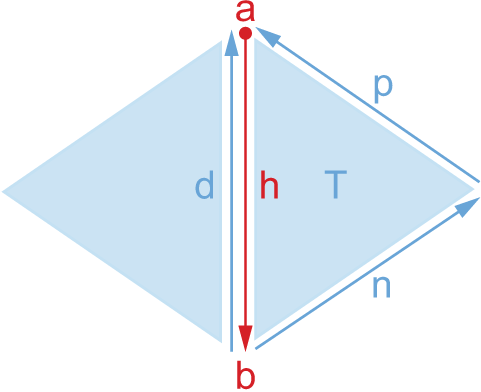 Figure 11.6 A half-edge and its references
The half-edge data structure is particularly useful in computer graphics and computational geometry because it allows for efficient edge traversal and manipulation, which are crucial for rendering and mesh processing tasks.
Edge Detection in Deep Learning
In the realm of image processing and deep learning, an edge is characterized by a sharp change in the values of an input array. This concept is crucial in convolutional operations, where detecting edges involves identifying these abrupt changes. Edges in images are typically regions with significant variations in color or intensity, providing more semantic information than flat, uniform regions.
Edge Detection Using Convolution
Edge detection is a fundamental technique in image processing, often executed using 2D convolution with specialized kernels designed to respond strongly to these changes. These kernels highlight transitions in pixel values, making the edges more pronounced and easier to analyze.
1D Convolution
In one-dimensional convolution, edge detection can be performed using an edge-detection kernel. This kernel is applied to the input data to identify points where there is a significant change in value.
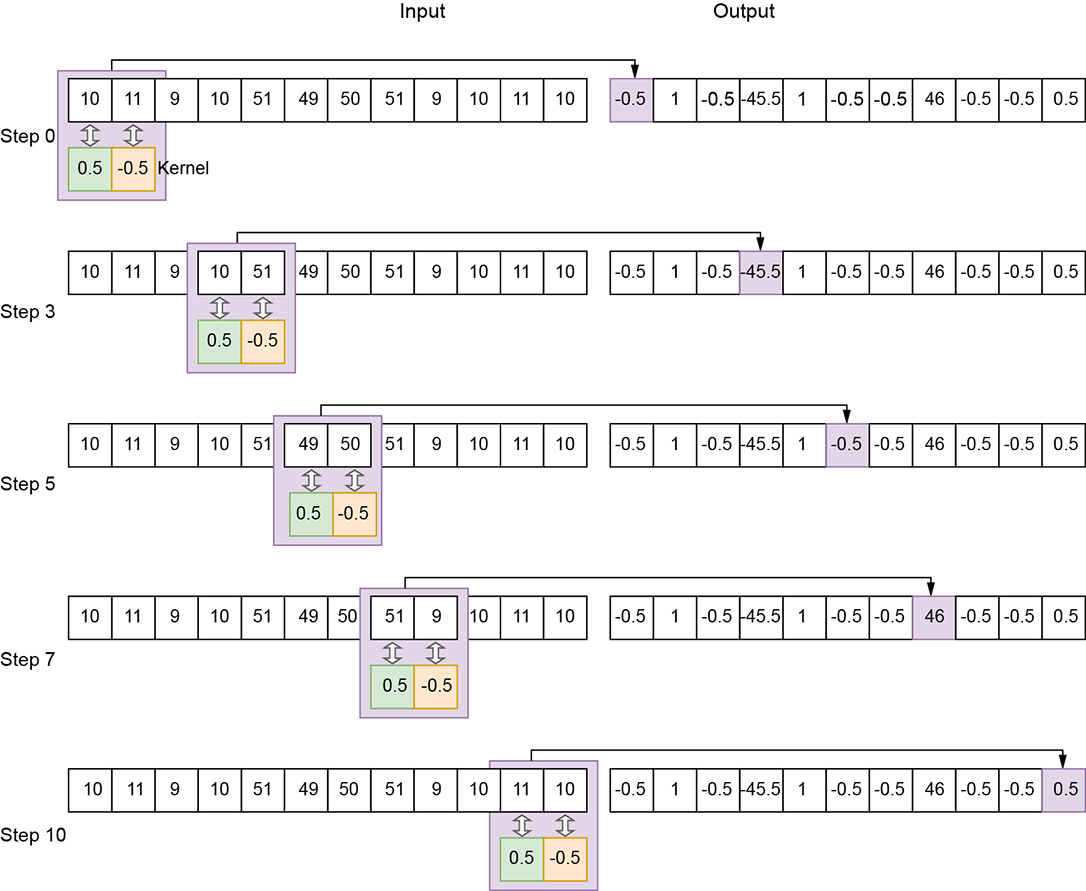 Figure 10.3 1D convolution with an edge-detection kernel of size 2, stride 1, valid padding. Not all slide stops (that is, steps) are shown.
2D Convolution
In two-dimensional convolution, edge detection is similarly achieved by applying an edge-detection kernel across the input image. The kernel size, stride, and padding are crucial parameters that influence the outcome of the convolution operation.
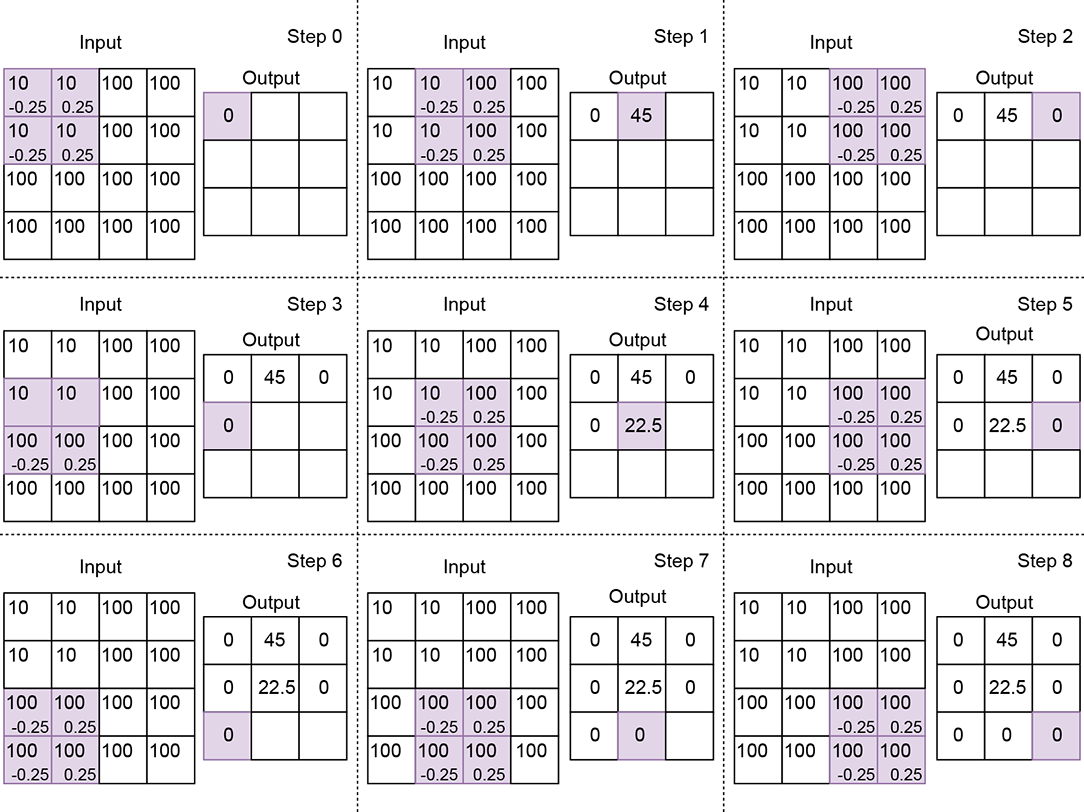 Figure 10.9 2D convolution with an edge-detection kernel of size 2, stride 1, and valid padding. Not all slide stops that is, steps) are shown. Notice how the output is zero at a uniform location but spikes when one-half of the kernel falls on low values while the other half falls on high values.
In this figure, the output of the convolution is zero at uniform locations but spikes when the kernel encounters a transition from low to high values, effectively highlighting the edges in the image.
Edge detection is a pivotal process in image analysis, providing essential semantic information that aids in the understanding and interpretation of images. By employing convolutional techniques with edge-detection kernels, deep learning models can effectively identify and utilize edges to enhance image processing tasks.
| Book Title | Usage of Edge | Technical Depth | Connections to Other Concepts | Examples Used | Practical Application |
|------------|---------------|-----------------|-------------------------------|---------------|-----------------------|
| [Geometry for Programmers](https://www.manning.com/books/geometry-for-programmers) | Discusses edges as line segments connecting vertices in triangle meshes. Introduces the half-edge data model for efficient mesh representation. [more](https://livebook.manning.com/book/geometry-for-programmers/chapter-11/59) | Explores the half-edge data model, a sophisticated representation for mesh edges, allowing efficient traversal and manipulation. [more](https://livebook.manning.com/book/geometry-for-programmers/chapter-11/59) | Connects to computational geometry and computer graphics, emphasizing mesh processing and rendering. [more](https://livebook.manning.com/book/geometry-for-programmers/chapter-11/59) | Uses figures to illustrate the half-edge model and its references. [more](https://livebook.manning.com/book/geometry-for-programmers/chapter-11/59) | Highlights applications in computer graphics and mesh processing tasks. [more](https://livebook.manning.com/book/geometry-for-programmers/chapter-11/59) |
| [Math and Architectures of Deep Learning](https://www.manning.com/books/math-and-architectures-of-deep-learning) | Defines edges as sharp changes in input arrays, crucial for convolutional operations in image processing. [more](https://livebook.manning.com/book/math-and-architectures-of-deep-learning/chapter-10/41) | Details edge detection using 1D and 2D convolution with specialized kernels. [more](https://livebook.manning.com/book/math-and-architectures-of-deep-learning/chapter-10/41) | Links edge detection to image understanding and semantic information extraction. [more](https://livebook.manning.com/book/math-and-architectures-of-deep-learning/chapter-10/41) | Provides figures demonstrating 1D and 2D convolution operations with edge-detection kernels. [more](https://livebook.manning.com/book/math-and-architectures-of-deep-learning/chapter-10/41) | Applies edge detection in deep learning models to enhance image processing tasks. [more](https://livebook.manning.com/book/math-and-architectures-of-deep-learning/chapter-10/41) |
FAQ (Frequently asked questions)
What are the edges of a triangle?
How many adjacent triangles can an edge have?
What is an edge in the context of triangle meshes?
How is an edge represented in the half-edge data model?