Embedding in Large Language Models (LLMs)
Embeddings are a fundamental concept in the field of machine learning and deep learning, particularly in the context of natural language processing (NLP). They serve as a bridge between discrete data, such as words or characters, and continuous vector spaces that neural networks can process. This transformation is crucial for enabling models to capture semantic relationships and perform efficiently on various tasks.
Overview of Embeddings
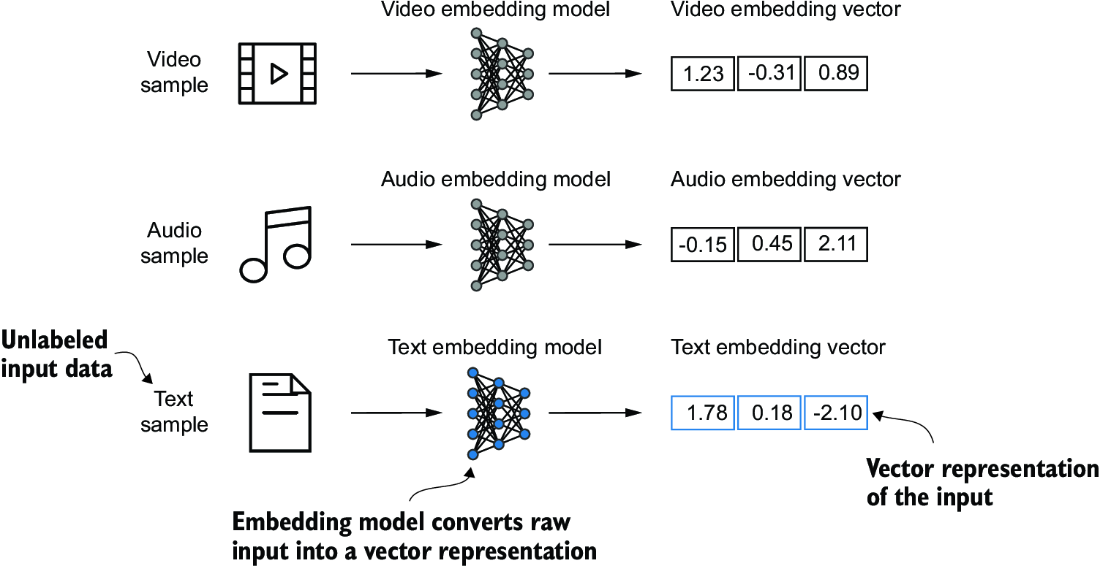
Embeddings map discrete objects, such as words, images, or documents, into points in a continuous vector space. This conversion is essential because deep learning models cannot process raw data formats like text, audio, or video directly. Instead, embeddings transform this data into dense vector representations that are more suitable for neural network architectures. This process is illustrated in Figure 2.2, which shows the conversion of raw data into a three-dimensional numerical vector.
Embedding Models
Different types of data require distinct embedding models. For instance, text embeddings differ from those used for audio or video data. The concept of embedding involves using specific neural network layers or pretrained models to convert various data types into vector formats. This transformation is crucial for enabling deep learning models to process and understand complex data structures.
Word Embeddings
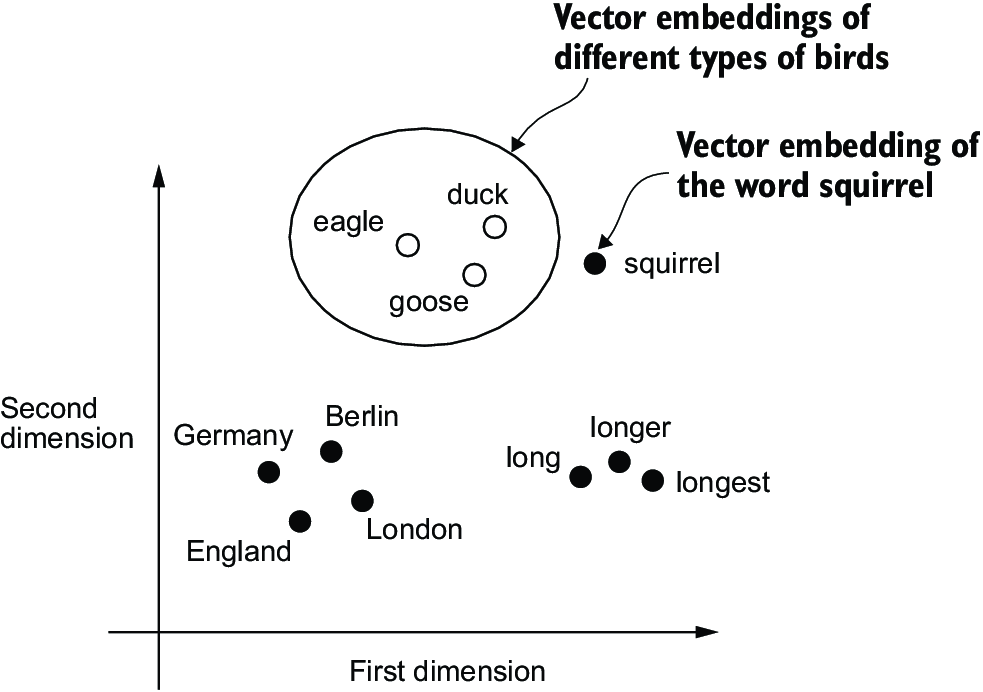
Word embeddings are a specific type of embedding used to represent words in a vector space. Techniques like Word2Vec train neural networks to generate these embeddings by predicting the context of a word given a target word or vice versa. The main idea is that words appearing in similar contexts have similar meanings, which is reflected in their proximity in the embedding space. This concept is visualized in Figure 2.3, where similar words cluster together.
Embeddings in Deep Learning Models
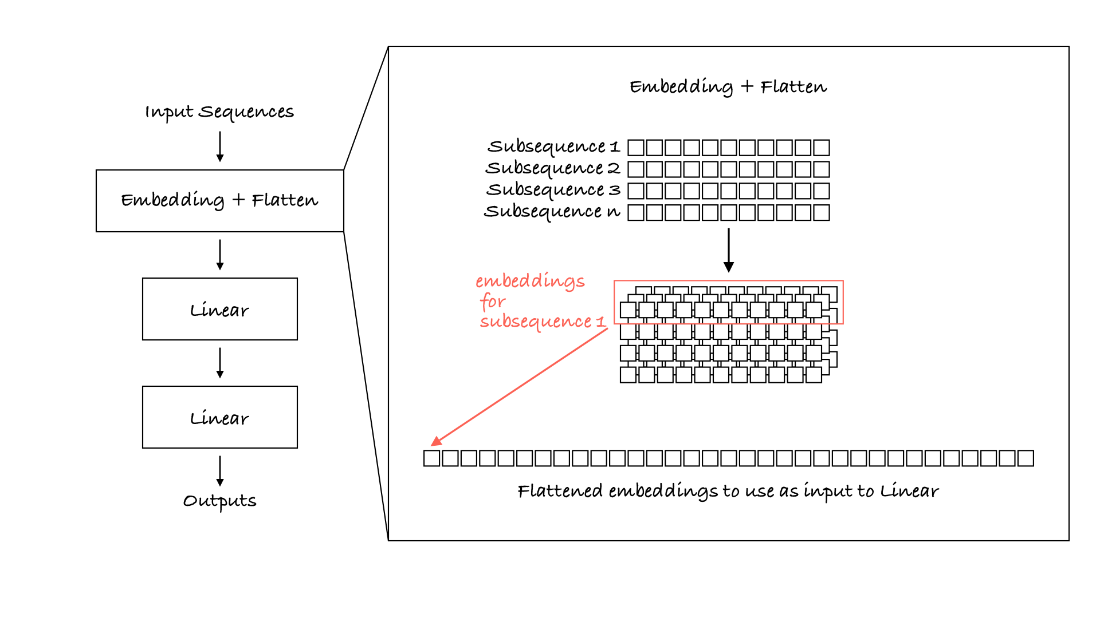
Embeddings are integrated into deep learning models to enhance their ability to learn from sequential data. For example, in a character-level language model, embeddings convert each subsequence into a list of embeddings, which are then processed by linear layers to predict the next character. This process is depicted in Figure 9.5.
Visualization of Embeddings
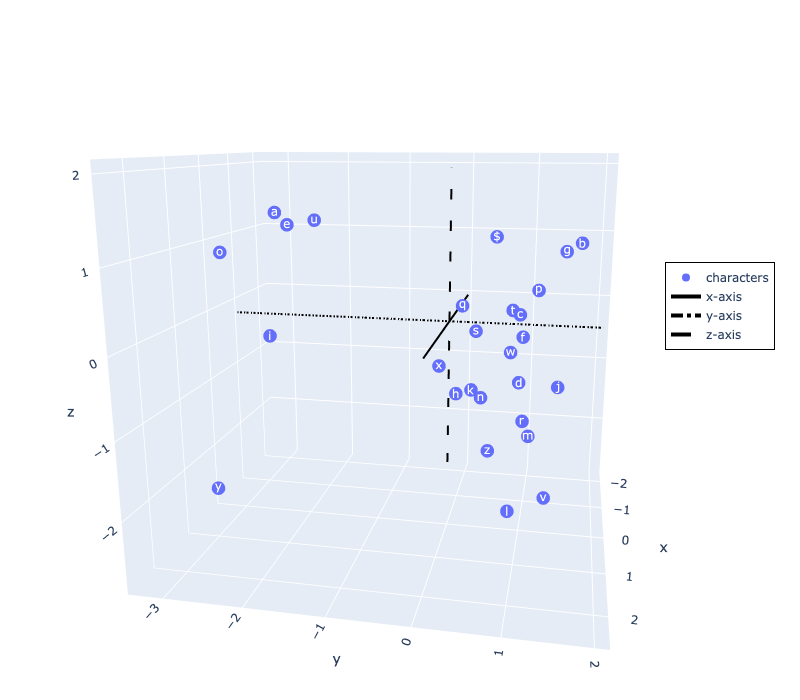
The impact of training on embeddings can be visualized, often requiring dimensionality reduction techniques due to the high dimensionality of embeddings. For instance, in a 3D visualization, embeddings for vowels might cluster together, while consonants form a separate cluster, reflecting the model's understanding of character relationships. This is shown in Figure 9.6.
Conclusion
Embeddings are a powerful tool in deep learning, providing compact and meaningful representations of data that enhance model learning and prediction capabilities. They are widely used in NLP, image recognition, and recommendation systems, among other applications, to capture semantic meanings, visual features, and user preferences. By reducing data dimensionality, embeddings improve model performance and computational efficiency.
| Book Title | Usage of Embedding | Technical Depth | Connections to Other Concepts | Examples Used | Practical Application |
|------------|--------------------|-----------------|-------------------------------|---------------|-----------------------|
| [Deep Learning with PyTorch, Second Edition](https://www.manning.com/books/deep-learning-with-pytorch-second-edition) | Discusses embeddings as a technique to represent discrete data as continuous vectors, capturing semantic relationships. [more](https://livebook.manning.com/book/deep-learning-with-pytorch-second-edition/chapter-9/59) | Provides detailed explanation of PyTorch's `nn.Embedding` module and its use in deep learning models. [more](https://livebook.manning.com/book/deep-learning-with-pytorch-second-edition/chapter-9/62) | Connects embeddings to NLP tasks and model performance improvements. [more](https://livebook.manning.com/book/deep-learning-with-pytorch-second-edition/chapter-9/59) | Includes code examples and figures illustrating embedding processes and model integration. [more](https://livebook.manning.com/book/deep-learning-with-pytorch-second-edition/chapter-9/63) | Shows practical use in character-level language models and visualization of embeddings. [more](https://livebook.manning.com/book/deep-learning-with-pytorch-second-edition/chapter-9/59) |
| [Build a Large Language Model (From Scratch)](https://www.manning.com/books/build-a-large-language-model-from-scratch) | Describes embeddings as a method to map discrete objects into continuous vector space for neural network processing. [more](https://livebook.manning.com/book/build-a-large-language-model-from-scratch/chapter-2/11) | Discusses different embedding models for various data formats like text, audio, and video. [more](https://livebook.manning.com/book/build-a-large-language-model-from-scratch/chapter-2/11) | Highlights the use of Word2Vec for generating word embeddings and clustering similar terms. [more](https://livebook.manning.com/book/build-a-large-language-model-from-scratch/chapter-2/11) | Provides visual examples of word embeddings and their clustering in a 2D space. [more](https://livebook.manning.com/book/build-a-large-language-model-from-scratch/chapter-2/11) | Focuses on transforming raw data into dense vector representations for deep learning. [more](https://livebook.manning.com/book/build-a-large-language-model-from-scratch/chapter-2/11) |
| [Math and Architectures of Deep Learning](https://www.manning.com/books/math-and-architectures-of-deep-learning) | Defines embeddings as vector representations that capture essential features of input data. [more](https://livebook.manning.com/book/math-and-architectures-of-deep-learning/chapter-10/208) | Explains the role of embeddings in reducing data dimensionality and improving model efficiency. [more](https://livebook.manning.com/book/math-and-architectures-of-deep-learning/chapter-10/208) | Discusses applications in NLP, image recognition, and recommendation systems. [more](https://livebook.manning.com/book/math-and-architectures-of-deep-learning/chapter-10/208) | No specific examples provided. [more](https://livebook.manning.com/book/math-and-architectures-of-deep-learning/chapter-10/208) | Emphasizes the enhancement of model learning and prediction capabilities through embeddings. [more](https://livebook.manning.com/book/math-and-architectures-of-deep-learning/chapter-10/208) |
FAQ (Frequently asked questions)
What are embeddings in the context of NLP?
How are embeddings generated?
What is the purpose of using embeddings in NLP tasks?
What does Figure 4.7 in the book illustrate?
Why is generating random floating-point numbers for word embeddings not ideal?
What is an ideal solution for generating word embeddings?
How do embeddings help in representing text data?
What is the role of PyTorch's nn.Embedding module?
What does Figure 9.4 in the book show?
How is an embedding layer implemented in PyTorch?
What does the example code demonstrate about embeddings?