Fine-Tuning
Fine-tuning is a crucial process in the development and adaptation of large language models (LLMs). It involves taking a pretrained model and adjusting it to better fit a specific task or dataset by continuing the training process on new data. This process allows the model to learn new features while retaining previously learned knowledge, making it highly adaptable to various applications.
Overview of Fine-Tuning
Fine-tuning is the process of adapting a pretrained model to a specific task by making certain layers trainable and adjusting the model's parameters based on task-specific data. This typically involves updating the model's weights to minimize a loss function, allowing the model to perform well on the new task. By doing so, the model can be tailored to perform specific tasks such as classification, translation, or even following human instructions in conversational applications.
Fine-Tuning in Practice
In practice, fine-tuning involves selecting which parts of the model to update. For instance, in the case of the GPT model, which includes 12 repeated transformer blocks, fine-tuning might involve setting the final LayerNorm and the last transformer block as trainable, while keeping the remaining 11 transformer blocks and the embedding layers nontrainable. This approach allows the model to adapt to new tasks without losing the general knowledge it has acquired during pretraining.
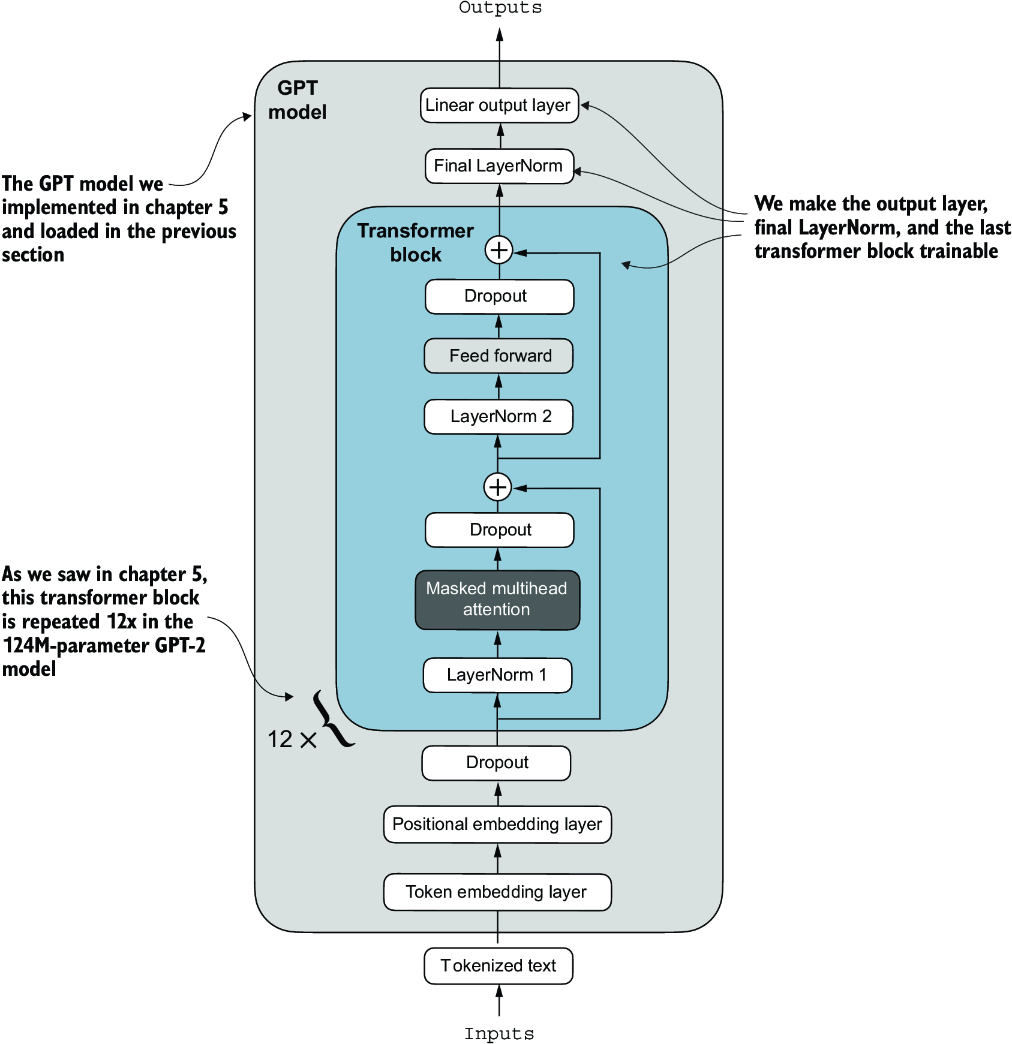 Figure 6.10 The GPT model includes 12 repeated transformer blocks. Alongside the output layer, we set the final LayerNorm and the last transformer block as trainable. The remaining 11 transformer blocks and the embedding layers are kept nontrainable.
Instruction Fine-Tuning
Instruction fine-tuning is a specific type of fine-tuning aimed at enabling LLMs to follow human instructions. This technique is particularly useful for developing LLMs for chatbot applications, personal assistants, and other conversational tasks. The process involves using an instruction dataset to guide the model in understanding and executing human instructions effectively.
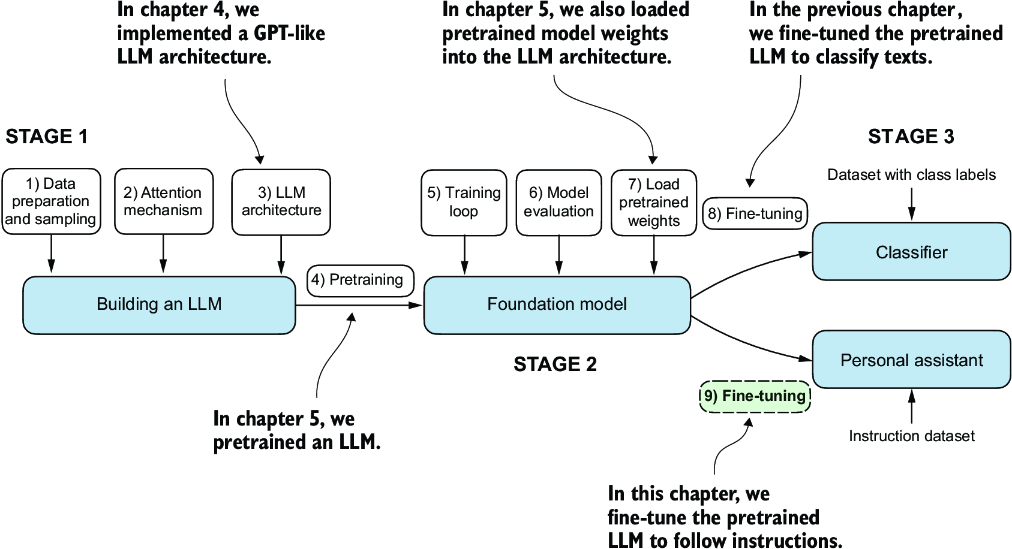 Figure 7.1 The three main stages of coding an LLM. This chapter focuses on step 9 of stage 3: fine-tuning a pretrained LLM to follow human instructions.
Suitable Datasets for Fine-Tuning
Publicly accessible datasets suitable for instruction fine-tuning include the Alpaca dataset, LIMA, UltraChat, and Alpaca GPT4. These datasets provide a rich source of task-specific data that can be used to further train and adapt LLMs for specific applications, ensuring that the models are well-equipped to handle the nuances of human language and instructions.