Identity Matrix
An identity matrix is a fundamental concept in linear algebra, often encountered in various fields such as mathematics, computer science, and engineering. It is a special type of square matrix that plays a crucial role in matrix operations, particularly in matrix multiplication. The identity matrix serves as the multiplicative identity, meaning that when any matrix is multiplied by the identity matrix, the original matrix remains unchanged.
Definition
An identity matrix is a square matrix characterized by having ones on its main diagonal and zeros in all other positions. This can be represented as:
[ I_n = \begin{bmatrix} 1 & 0 & 0 & \cdots & 0 \ 0 & 1 & 0 & \cdots & 0 \ 0 & 0 & 1 & \cdots & 0 \ \vdots & \vdots & \vdots & \ddots & \vdots \ 0 & 0 & 0 & \cdots & 1 \end{bmatrix} ]
where ( I_n ) denotes an identity matrix of size ( n \times n ). This matrix acts as the identity element in matrix multiplication, analogous to multiplying a number by one in arithmetic.
Examples
In two-dimensional (2D) and three-dimensional (3D) spaces, the identity matrices are commonly denoted as ( I_2 ) and ( I_3 ), respectively. These matrices are used to represent the identity transformation, which leaves vectors unchanged when multiplied.
2D Identity Matrix
The 2D identity matrix, ( I_2 ), is a 2x2 matrix:
[ I_2 = \begin{bmatrix} 1 & 0 \ 0 & 1 \end{bmatrix} ]
3D Identity Matrix
The 3D identity matrix, ( I_3 ), is a 3x3 matrix:
[ I_3 = \begin{bmatrix} 1 & 0 & 0 \ 0 & 1 & 0 \ 0 & 0 & 1 \end{bmatrix} ]
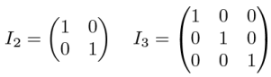 Identity matrices in 2D and 3D, denoted by ( I_2 ) and ( I_3 ), respectively.
Properties
-
Multiplicative Identity: The identity matrix acts as the multiplicative identity in matrix multiplication. For any matrix ( A ), the equation ( A \times I = A ) holds true, where ( I ) is the identity matrix of appropriate dimensions. This property is analogous to the role of 1 in multiplication for real numbers.
-
Unchanged Vectors: When a vector is multiplied by an identity matrix, the vector remains unchanged. For example, multiplying any 3D vector by the 3D identity matrix ( I_3 ) results in the same vector. This property is crucial in various applications, such as computer graphics and transformations, where maintaining the original vector's properties is necessary.
-
Diagonal Matrix: As a diagonal matrix, the identity matrix has non-zero elements only on its main diagonal, which are all ones. All off-diagonal elements are zeros.
The identity matrix is an essential tool in various mathematical computations and transformations, serving as the multiplicative identity in the set of all ( n \times n ) matrices.
For further reading, you can explore the Exploring Math for Programmers and Data Scientists and Geometry for Programmers books.
| Book Title | Usage of Identity Matrix | Technical Depth | Connections to Other Concepts | Examples Used | Practical Application |
|------------|--------------------------|-----------------|-------------------------------|---------------|-----------------------|
| [Exploring Math for Programmers and Data Scientists](https://www.manning.com/books/exploring-math-for-programmers-and-data-scientists) | Discusses identity matrix as a special type of square matrix with ones on the main diagonal and zeros elsewhere. It serves as the identity element in matrix multiplication. [more](https://livebook.manning.com/book/exploring-math-for-programmers-and-data-scientists/chapter-5/99) | Provides detailed properties such as multiplicative identity and unchanged vectors. [more](https://livebook.manning.com/book/exploring-math-for-programmers-and-data-scientists/chapter-7/227) | Connects to concepts like identity transformation in 2D and 3D spaces. [more](https://livebook.manning.com/book/exploring-math-for-programmers-and-data-scientists/chapter-5/14) | Includes examples of 2D and 3D identity matrices. [more](https://livebook.manning.com/book/exploring-math-for-programmers-and-data-scientists/chapter-5/14) | Highlights applications in computer graphics and transformations. [more](https://livebook.manning.com/book/exploring-math-for-programmers-and-data-scientists/chapter-7/227) |
| [Geometry for Programmers](https://www.manning.com/books/geometry-for-programmers) | Describes the identity matrix as a fundamental concept in linear algebra and geometry, crucial for matrix operations. [more](https://livebook.manning.com/book/geometry-for-programmers/chapter-4/165) | Explains the identity matrix as a nonmodifying element in matrix multiplication. [more](https://livebook.manning.com/book/geometry-for-programmers/chapter-4/165) | Discusses its role as a diagonal matrix and its analogy to 0 in addition or 1 in multiplication for real numbers. [more](https://livebook.manning.com/book/geometry-for-programmers/chapter-4/165) | Provides a general representation of identity matrices of size \\( n \\times n \\). [more](https://livebook.manning.com/book/geometry-for-programmers/chapter-4/165) | Emphasizes its use in mathematical computations and transformations. [more](https://livebook.manning.com/book/geometry-for-programmers/chapter-4/165) |
FAQ (Frequently asked questions)
What is an identity matrix?
How does the identity matrix function in matrix multiplication?
What is an identity matrix?
What does an identity matrix represent?
How are identity matrices denoted in 2D and 3D?
What do 2D and 3D identity matrices look like?
What role does the identity matrix play in matrix multiplication?
What is the structure of a 3D identity matrix?
What happens when you multiply a 3D vector by the identity matrix?