Image
In the context of machine learning and programming, an "image" is a digital representation of visual information, typically structured as a grid of pixels. Each pixel contains data that represents color and intensity, which can be processed and analyzed by algorithms for various applications such as classification, recognition, and manipulation.
Images in Deep Learning
Images are a fundamental type of input data in deep learning, especially for tasks like image classification. A well-known dataset used for training image recognition models is the ImageNet dataset, which includes over 14 million labeled images. This dataset is crucial for developing pretrained neural networks capable of performing diverse image-related tasks.
Representation of Images
Images are essentially collections of scalars organized in a grid format, where each pixel can have multiple scalars representing different features, such as color. In deep learning, these images are processed as tensors, with dimensions representing channels, height, and width. Proper handling of these dimensions is crucial for effective model training.
Color Channels
Color in images is often encoded using the RGB model, where each color is defined by three numbers corresponding to the intensity of red, green, and blue. Each of these color channels is a grayscale intensity map of the respective color. By combining these channels, full-color images can be represented.
Loading and Transforming Images
Loading image files into a format suitable for deep learning models is a critical step. For example, using the imageio library in Python, an image can be loaded and its shape checked:
import imageio.v2 as imageio

img_arr = imageio.imread('../data/p1ch4/image-dog/bobby.jpg')
img_arr.shape
This code snippet demonstrates loading an image and checking its shape, which in this case is 720 pixels in height, 1280 pixels in width, and 3 color channels (RGB).
Normalizing Image Data
Normalization of image data is a vital preprocessing step that involves converting pixel values to a floating-point format and scaling them to a specific range, such as 0 to 1 or -1 to 1. This process enhances the training performance of neural networks. One common method of normalization is dividing pixel values by 255.
Images in Geometry and Programming
In geometry and programming, images can be two-dimensional (2D) or three-dimensional (3D), each with unique characteristics and applications.
2D and 3D Images
A 2D image is an array of colored elements, known as pixels, forming a grid that represents the image. In contrast, a 3D image extends this concept into another dimension, forming an array of 2D images. These 3D images are composed of voxels, which are the 3D counterparts of pixels.
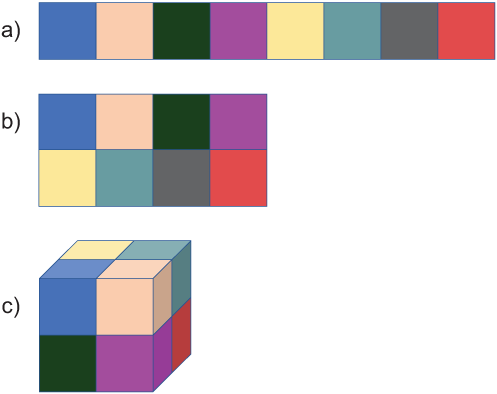 Figure 12.1 The same data (a) represented as an array of colors: a 2D 4×2 image made of pixels (b) and a 3D 2×2×2 image made of voxels (c)
Operations on Images
Various operations can be performed on images to enhance their quality and utility, such as dilation, erosion, cavity fill, and Boolean operations. These operations are essential for refining images by removing noise, smoothing borders, and filling unwanted gaps.
Images as Vectors
Images can be represented as vectors by considering each pixel as a point in a high-dimensional space. For a color image, each pixel is represented by three numbers corresponding to the RGB values. This vector representation allows for various vector operations, such as addition and scalar multiplication, to be applied to images.
Image Manipulation with Vector Operations
Images can be manipulated using vector operations by treating them as vectors in a high-dimensional space. Operations like addition and scalar multiplication can be applied to pixel values, enabling tasks such as averaging images or adjusting brightness.
Example: Averaging Images
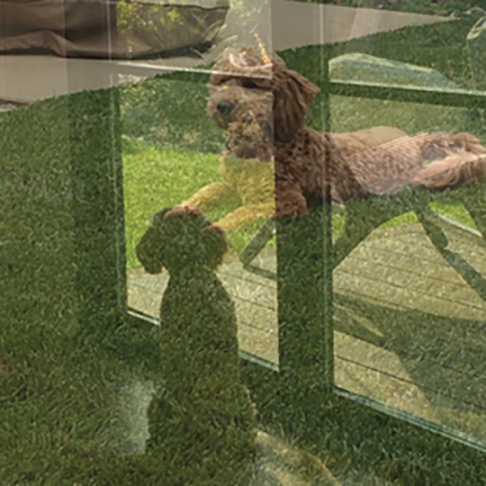 Figure 6.9 The average of two images of Melba as a linear combination
Image Classification
Image classification involves using a classifier to determine which category an image belongs to. For example, in digit recognition, an image is a representation of a handwritten digit, stored as a matrix of pixel values. Classifiers output a vector indicating the certainty of each category, and the category with the highest certainty is chosen as the classification result.
Dimensionality Reduction
Dimensionality reduction in images helps in compressing the image while maintaining its essential features. This process is crucial for efficient storage and processing of image data.
In summary, images in the context of machine learning and programming are versatile data structures that can be manipulated and analyzed in various ways to extract meaningful information and perform complex tasks.
| Book Title | Usage of Image | Technical Depth | Connections to Other Concepts | Examples Used | Practical Application |
|------------|----------------|-----------------|-------------------------------|---------------|-----------------------|
| [Deep Learning with PyTorch, Second Edition](https://www.manning.com/books/deep-learning-with-pytorch-second-edition) | Discusses images as input data for deep learning tasks, focusing on datasets like ImageNet. [more](https://livebook.manning.com/book/deep-learning-with-pytorch-second-edition/chapter-2/11) | Explores image representation as tensors, handling dimensions, and normalization. [more](https://livebook.manning.com/book/deep-learning-with-pytorch-second-edition/chapter-4/12) | Connects image processing to neural network training and model compatibility. [more](https://livebook.manning.com/book/deep-learning-with-pytorch-second-edition/chapter-4/27) | Provides code examples for loading and transforming images using Python libraries. [more](https://livebook.manning.com/book/deep-learning-with-pytorch-second-edition/chapter-4/21) | Focuses on preprocessing steps like normalization to enhance model performance. [more](https://livebook.manning.com/book/deep-learning-with-pytorch-second-edition/chapter-4/37) |
| [Math and Architectures of Deep Learning](https://www.manning.com/books/math-and-architectures-of-deep-learning) | Describes images as 2D arrays of pixel values, used in classification tasks. [more](https://livebook.manning.com/book/math-and-architectures-of-deep-learning/chapter-3/5) | Covers image scaling, 2D convolution, and geometrical views of classification. [more](https://livebook.manning.com/book/math-and-architectures-of-deep-learning/chapter-10/120) | Discusses image vectors and clustering in high-dimensional space for classification. [more](https://livebook.manning.com/book/math-and-architectures-of-deep-learning/chapter-3/8) | Uses examples like car-versus-giraffe classification to illustrate concepts. [more](https://livebook.manning.com/book/math-and-architectures-of-deep-learning/chapter-3/7) | Explains rasterization for converting images to vectors for model input. [more](https://livebook.manning.com/book/math-and-architectures-of-deep-learning/chapter-3/12) |
| [Geometry for Programmers](https://www.manning.com/books/geometry-for-programmers) | Explores images in the context of geometry, focusing on 2D and 3D representations. [more](https://livebook.manning.com/book/geometry-for-programmers/chapter-12/51) | Discusses operations like dilation, erosion, and cavity fill for image enhancement. [more](https://livebook.manning.com/book/geometry-for-programmers/chapter-12/51) | Relates 3D images to image stacks and voxel representation. [more](https://livebook.manning.com/book/geometry-for-programmers/chapter-12/51) | Provides visual examples of 2D and 3D image representations. [more](https://livebook.manning.com/book/geometry-for-programmers/chapter-12/51) | Focuses on image manipulation techniques to improve quality and clarity. [more](https://livebook.manning.com/book/geometry-for-programmers/chapter-12/51) |
| [Exploring Math for Programmers and Data Scientists](https://www.manning.com/books/exploring-math-for-programmers-and-data-scientists) | Describes images as vectors in high-dimensional space, enabling vector operations. [more](https://livebook.manning.com/book/exploring-math-for-programmers-and-data-scientists/chapter-6/197) | Covers vector operations like addition and scalar multiplication for image manipulation. [more](https://livebook.manning.com/book/exploring-math-for-programmers-and-data-scientists/chapter-6/193) | Connects image representation to vector operations and dimensionality reduction. [more](https://livebook.manning.com/book/exploring-math-for-programmers-and-data-scientists/chapter-6/346) | Uses examples like averaging images and dimensionality reduction. [more](https://livebook.manning.com/book/exploring-math-for-programmers-and-data-scientists/chapter-6/200) | Demonstrates practical applications in image classification and compression. [more](https://livebook.manning.com/book/exploring-math-for-programmers-and-data-scientists/chapter-16/27) |
FAQ (Frequently asked questions)
What are typical operations on 3D images?
What is the purpose of operations like dilation and erosion on 3D images?
How can images be represented as vectors?
What vector operations can be applied to images?
What does Figure 6.9 illustrate in the context of image manipulation?
How is an image represented as a vector in the provided class?
What operations can be performed on images using the ImageVector class?
How does the ImageVector class handle image size?
How can images be manipulated using vector operations?
How can images be compressed while retaining recognizable features?
How can the dimensionality of an image be reduced?
How are images of handwritten digits represented for classification?
How does image classification work for handwritten digits?
What is the purpose of using images in pretrained neural networks?
What is the ImageNet dataset?
How are images represented in deep learning?
What is the significance of processing images as tensors?
Why is it important to properly load, transform, and normalize image data?
How are colors encoded in images?
What is a color channel in an image?
How can you load an image file in Python using imageio?
What does the shape of an image array represent?
How do you change the layout of an image tensor in PyTorch?
Why is it necessary to rearrange image tensor dimensions for PyTorch models?
What is the purpose of normalizing image data?
How can you normalize pixel values in an image?
What are some methods for normalizing image data?