Linear Equation
A linear equation is a fundamental concept in mathematics, representing relationships where each term is either a constant or the product of a constant and a single variable. These equations are characterized by variables raised to the power of one, making them first-degree equations. Linear equations are pivotal in various fields, including geometry, computer graphics, and data science, as they describe lines in two-dimensional (2D) space and planes in three-dimensional (3D) space.
Overview
A linear equation can be expressed in the standard form ( ax + by = c ) for 2D space, where ( a ), ( b ), and ( c ) are constants. This form is particularly useful for finding intersections of lines. In 3D space, a linear equation takes the form ( ax + by + cz = d ), representing a plane. Linear equations can be generalized to higher dimensions, forming hyperplanes in ( n )-dimensional space.
Representation in Geometry
In 2D space, a linear equation such as ( ax + by = c ) represents a line. Extending this to 3D space, a linear equation like ( ax + by + cz = d ) represents a plane. These equations form the basis for understanding geometric shapes and their properties in different dimensions.
Systems of Linear Equations
Linear equations can be part of a system, where multiple equations are solved simultaneously. Such systems can be efficiently represented and solved using matrix operations. A system of linear equations can be expressed in the form of a matrix equation, where a matrix is multiplied by a column vector to yield another column vector. This representation is not only compact but also allows for the application of various matrix-solving techniques.
Example of a Linear Equation System
Consider the following system of linear equations:
[ \begin{align*} a_{11}x_1 + a_{12}x_2 + a_{13}x_3 &= b_1, \ a_{21}x_1 + a_{22}x_2 + a_{23}x_3 &= b_2, \ a_{31}x_1 + a_{32}x_2 + a_{33}x_3 &= b_3. \end{align*} ]
This system can be represented as a matrix equation and solved using matrix multiplication techniques.
Parametric Form and Ray Equations
Linear equations can also be expressed in parametric form, which is particularly useful in computer graphics and physics. For instance, a ray can be described by the equation:
[ \mathbf{P} + t \mathbf{d} = (1, 0, 0, 0) i + (0, 1, 0, 0) j + (0, 0, 1, 0) k ]
This expands into the following set of equations:
[ \begin{align*} td \cdot x_1 - i &= P \cdot x_1, \ td \cdot x_2 - j &= P \cdot x_2, \ td \cdot x_3 - k &= P \cdot x_3, \ td \cdot x_4 &= P \cdot x_4. \end{align*} ]
Solving Linear Equations
Solving systems of linear equations involves finding the values of the variables that satisfy the equation. In 2D space, this often means finding the point where two lines intersect. In higher dimensions, it involves finding the intersection of hyperplanes. Computational tools such as SymPy can be used to solve these equations efficiently.
Figure
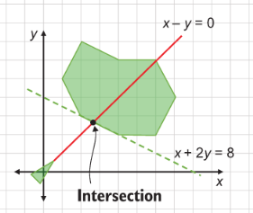 Figure 7.13 The laser hits the asteroid where the lines ( x - y = 0 ) and ( x + 2y = 8 ) intersect.
This figure illustrates the intersection of two lines, ( x - y = 0 ) and ( x + 2y = 8 ), in 2D space. The point of intersection is where the laser hits the asteroid, demonstrating the practical application of solving linear equations to find intersections.
| Book Title | Usage of Linear Equation | Technical Depth | Connections to Other Concepts | Examples Used | Practical Application |
|------------|--------------------------|-----------------|-------------------------------|---------------|-----------------------|
| [Geometry for Programmers](https://www.manning.com/books/geometry-for-programmers) | Discusses linear equations as fundamental in representing lines and planes in geometry. [more](https://livebook.manning.com/book/geometry-for-programmers/chapter-3/12) | Explores systems of linear equations and matrix operations. [more](https://livebook.manning.com/book/geometry-for-programmers/chapter-3/170) | Connects to geometry, computer graphics, and physics through parametric forms and ray equations. [more](https://livebook.manning.com/book/geometry-for-programmers/chapter-3/417) | Provides examples of systems of linear equations and their matrix representations. [more](https://livebook.manning.com/book/geometry-for-programmers/chapter-3/172) | Demonstrates solving linear equations using computational tools like SymPy. [more](https://livebook.manning.com/book/geometry-for-programmers/chapter-3/424) |
| [Exploring Math for Programmers and Data Scientists](https://www.manning.com/books/exploring-math-for-programmers-and-data-scientists) | Describes linear equations as representing lines in 2D and planes in 3D. [more](https://livebook.manning.com/book/exploring-math-for-programmers-and-data-scientists/chapter-7/1) | Covers solving linear equations in multiple dimensions, including intersections of hyperplanes. [more](https://livebook.manning.com/book/exploring-math-for-programmers-and-data-scientists/chapter-7/248) | Links to higher-dimensional geometry and intersections of hyperplanes. [more](https://livebook.manning.com/book/exploring-math-for-programmers-and-data-scientists/chapter-7/1) | Includes examples of 2D and 3D linear equations with visual figures. [more](https://livebook.manning.com/book/exploring-math-for-programmers-and-data-scientists/chapter-7/51) | Illustrates practical applications through intersection problems, such as a laser hitting an asteroid. [more](https://livebook.manning.com/book/exploring-math-for-programmers-and-data-scientists/chapter-7/53) |
FAQ (Frequently asked questions)
What is a linear equation?
What does the linear equation ax + by = c represent?
How do linear equations represent geometric shapes in different dimensions?
How can linear equations be solved using matrices?
What is an example of a system of linear equations?
How can a system of linear equations be represented?
How do you write a ray in parametric form?
How can SymPy be used to solve a system of linear equations?
What is an example of a linear equation in 2D?
What does a linear equation represent in 2D space?
What is the standard form of a linear equation?
How are linear equations used in finding intersections of lines?
Where do the lines x - y = 0 and x + 2y = 8 intersect?
What is an example of a linear equation in 2D space?
What is a linear equation of the first degree?
What is an example of a linear equation in 3D?
How can linear equations be generalized to higher dimensions?
What does solving linear equations in multiple dimensions involve?
How are linear equations written in standard form for lines and planes?