Max Pooling
Max pooling is a fundamental operation in convolutional neural networks (CNNs) used to downsample feature maps, reducing their spatial dimensions while retaining the most significant features. This operation is crucial for decreasing computational complexity and preventing overfitting in deep learning models.
How Max Pooling Works
Max pooling involves dividing the input feature map into non-overlapping regions, typically 2x2 tiles, and selecting the maximum value from each region to form a new, smaller feature map. This process ensures that the most prominent features detected by the convolutional layers are preserved, while less significant features are discarded. The operation is illustrated in Figure 8.8:
 Figure 8.8 Max pooling in detail.
Example of Max Pooling
In practice, max pooling can be applied using libraries such as PyTorch. The following code snippet demonstrates a 2x2 max pooling operation on an image tensor, reducing its spatial dimensions from 32x32 to 16x16:
# [[In[21]:](https://livebook.manning.com/book/deep-learning-with-pytorch-second-edition/chapter-8/49)](https://livebook.manning.com/book/deep-learning-with-pytorch-second-edition/chapter-8/49)
pool = nn.MaxPool2d(2)
output = pool(img.unsqueeze(0))

img.unsqueeze(0).shape, output.shape

# [[Out[21]:](https://livebook.manning.com/book/deep-learning-with-pytorch-second-edition/chapter-8/49)](https://livebook.manning.com/book/deep-learning-with-pytorch-second-edition/chapter-8/49)
(torch.Size([1, 3, 32, 32]), torch.Size([1, 3, 16, 16]))
Stacking Convolutions and Max Pooling
Max pooling is often used in conjunction with convolutional layers. By stacking multiple convolutions with max pooling in between, the network can effectively apply convolutions to increasingly smaller feature images. This approach allows the network to account for spatial relationships across larger portions of the input image as the depth of the network increases. Figure 8.9 illustrates this concept:
 Figure 8.9 More convolutions by hand, showing the effect of stacking convolutions and downsampling.
Application in RoI Pooling
Max pooling is also integral to Region of Interest (RoI) pooling, a technique used in object detection models like Fast R-CNN and Faster R-CNN. RoI pooling handles inputs of varying sizes by dividing the feature map into a fixed number of regions and performing max pooling within each region. This ensures that the output feature map has a consistent size, regardless of the input dimensions. Figure 11.18 demonstrates RoI pooling:
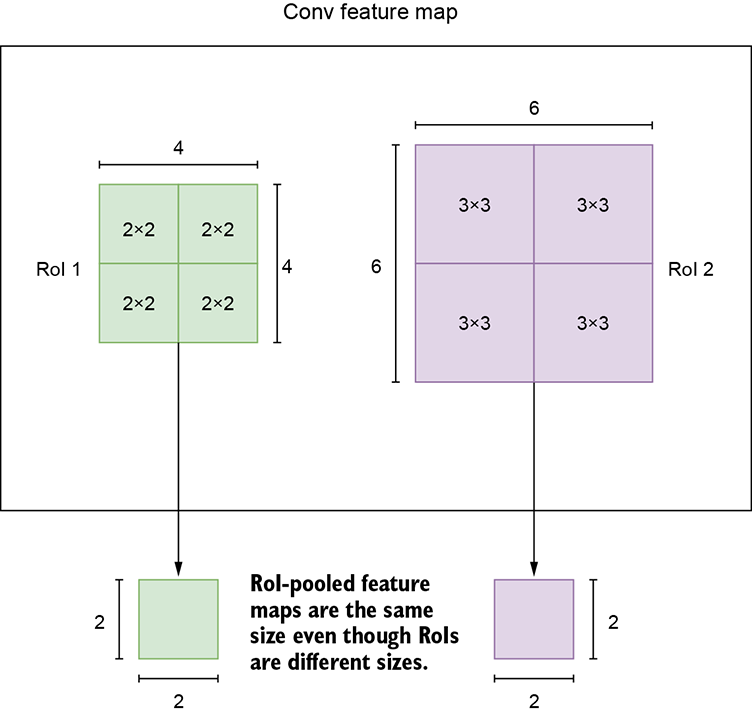 Figure 11.18 A conv feature map with two regions of interest of different sizes. RoI pooling extracts a fixed-sized output feature map (2 × 2 in this image) from each of the RoIs in a single pass via max pooling.
RoI pooling's flexibility lies in its ability to adapt to different input sizes while maintaining a consistent output size, which is crucial for efficient processing in object detection frameworks. Fast R-CNN and Faster R-CNN typically use a 7 × 7 fixed feature map size for this purpose.
For more detailed information, you can refer to the books Deep Learning with PyTorch, Second Edition and Math and Architectures of Deep Learning.
Here's a markdown table comparing how different 'llm' books discuss the term 'max pooling':
| Book Title | Usage of max pooling | Technical Depth | Connections to Other Concepts | Examples Used | Practical Application | |------------|----------------------|-----------------|-------------------------------|---------------|-----------------------| | Deep Learning with PyTorch, Second Edition | Describes max pooling as a downsampling operation in CNNs to reduce spatial dimensions and retain significant features. more | Provides detailed explanation of the max pooling process with figures and code snippets. more | Discusses stacking convolutions and max pooling to enhance feature extraction. more | Includes a PyTorch code example demonstrating max pooling on an image tensor. more | Highlights practical use in reducing computational complexity and preserving important features. more | | Math and Architectures of Deep Learning | Explains max pooling as a fundamental operation for downsampling in CNNs to reduce computational load and prevent overfitting. more | Discusses the mechanism of max pooling with a focus on its role in reducing input representation. more | Connects max pooling to RoI pooling in object detection models like Fast R-CNN. more | Provides a figure illustrating RoI pooling with max pooling in object detection. more | Describes its application in RoI pooling for consistent output size in object detection. more |
This table provides a concise comparison of how each book approaches the topic of max pooling, highlighting the unique aspects and practical applications discussed in each.
FAQ (Frequently asked questions)
What is max pooling in convolutional networks?
Why is max pooling used in convolutional networks?
Where can I find a detailed illustration of max pooling?
How does max pooling affect the shape of feature maps?
What is an example of using max pooling in PyTorch?
What is the effect of stacking multiple convolutions with max pooling?