Mesh
Overview
A mesh is a fundamental concept in computer graphics and 3D modeling, representing a collection of vertices, edges, and faces that define the shape of a 3D object. In particular, triangle meshes are a specific type of mesh composed entirely of triangles. These are widely used to approximate smooth surfaces in various applications, including games, computer-generated images, and 3D printing.
In the realm of computer graphics, a mesh serves as a polyhedral representation of an object, where the vertices are points in 3D space, edges are line segments connecting these points, and faces are the flat surfaces enclosed by these edges. Triangle meshes are particularly favored due to their simplicity and the efficiency with which they can be processed by modern hardware.
Applications
Computer Graphics and Gaming
Triangle meshes are crucial in applications where rendering speed is paramount, such as in games, augmented and virtual reality, and computer-generated imagery. The way modern hardware is designed makes triangle meshes an almost-exclusive choice for 3D modeling in these fields. They allow for the emulation of surface smoothness convincingly enough to meet the visual demands of these applications.
3D Printing
Traditionally, triangle meshes have been the standard in 3D printing, with the STL format being one of the most popular triangle-based formats. STL stands for stereolithography, a 3D-printing technique that relies heavily on triangle meshes. However, as 3D printers become more advanced and capable of handling curves more effectively, there is a shift towards using smooth-surface CAD data, especially in industrial manufacturing.
Visual Representation
The following figure illustrates the difference between a smooth surface and a triangle mesh representation of a torus:
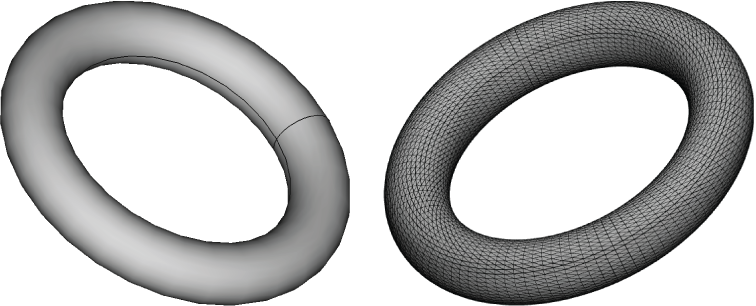 Figure 11.1 A torus described as a smooth surface (left) and as a triangle mesh of ~10,000 triangles (right)
This figure highlights how a complex shape can be approximated using a large number of triangles, demonstrating the mesh's ability to represent detailed and intricate forms.
FAQ (Frequently asked questions)
What is a mesh in 3D modeling?
What are triangle meshes used for?
What is a mesh in computer graphics?
What applications use triangle meshes?