Nonlinear Model
Overview
Nonlinear models are a fundamental component in machine learning, particularly when dealing with complex datasets where classes cannot be separated by a simple line or hyperplane. These models are essential for approximating complex and highly nonlinear functions required for classification or estimation processes. Unlike linear models, which assume a straight-line relationship between inputs and outputs, nonlinear models can capture more intricate patterns in data, making them suitable for a wide range of applications.
In machine learning, a nonlinear model incorporates nonlinearity into its architecture, often through the use of activation functions. This nonlinearity enhances the model's expressive power, enabling it to tackle more complex tasks compared to linear models. Nonlinear models are particularly useful when the relationship between inputs and outputs is not straightforward, allowing for the capture of more complex patterns in the data.
Example
An illustrative example of a nonlinear model is shown in Figure 1.4, where a curved separator is used to distinguish between classes. This demonstrates how nonlinear models can effectively handle situations where linear models fall short.
Implementation in PyTorch
Nonlinear models can be implemented in various ways, including the use of neural network architectures or by incorporating nonlinear terms directly into the model. In PyTorch, for instance, nonlinear modeling can be achieved by including nonlinear terms in the model's equations. Below is an example of nonlinear modeling using PyTorch:
Listing 3.4 Nonlinear modeling with PyTorch
params = [w0, w1, w2]
for step in range(num_steps):
   y_pred = params[0] + params[1] * x + params[2] * (x**2)
   mean_squared_error = torch.mean((y_pred -y_obs) ** 2)
   mean_squared_error.backward()
   update_parameters(params, learning_rate)

print("True function: y= 2 - x + x^2")
print("Learned function: y_pred = {} + {}*x + {}*x^2"
     .format(params[0].data[0],
             params[1].data[0],
             params[2].data[0]))
This code snippet demonstrates how a nonlinear model can be trained to approximate a quadratic function. The model parameters are updated iteratively to minimize the mean squared error between the predicted and observed values.
Convergence to True Function
Nonlinear models have the capability to converge to the true underlying function of the data. This is depicted in Figure 3.13, which shows how a nonlinear model can approximate the true function more accurately than a linear model.
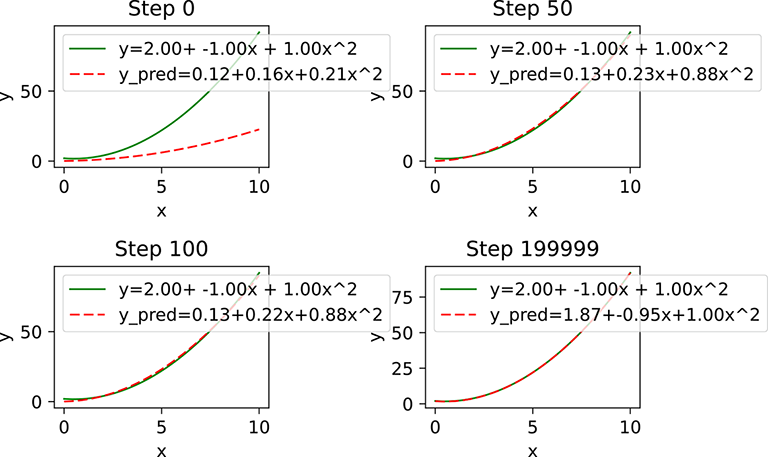 Figure 3.13 If we use a nonlinear model, it more or less converges to the true underlying function.
In summary, nonlinear models are indispensable tools in the field of machine learning, providing the flexibility and power needed to model complex relationships in data. Through the use of nonlinear architectures and activation functions, these models can achieve a level of expressiveness that linear models cannot, making them suitable for a wide array of applications.