Norm
A norm is a mathematical concept used to measure the size or length of a vector or matrix. In the context of machine learning and deep learning, norms are crucial for quantifying error magnitudes and understanding the behavior of vectors and matrices.
Vector Norms
For vectors, a norm represents the magnitude or length. The most commonly used norm in machine learning is the L2 norm, which is often employed to measure error magnitudes. The L2 norm of a vector is essentially the Euclidean distance from the origin to the point represented by the vector in space.
Matrix Norms
For matrices, norms can be more complex, as they can be viewed as amplifiers of vectors. Two important types of matrix norms are the spectral norm and the Frobenius norm.
Spectral Norms
The spectral norm of a matrix is related to the largest eigenvalue of the matrix's product with its transpose, denoted as ( A^TA ). The spectral norm is defined as the maximum possible value of the norm of ( A ) over all possible unit vectors. This is a measure of how much the matrix can amplify a vector. The spectral norm is given by the largest eigenvalue of ( A^TA ), which is also the square of the largest singular value of the matrix ( A ).
 Equation 4.4
Frobenius Norms
The Frobenius norm is another measure of the magnitude of a matrix. It is defined as the root mean square of all the matrix elements. This norm can also be expressed in terms of the singular values of the matrix. Specifically, the Frobenius norm is equal to the root mean square of the sum of all the singular values (eigenvalues of ( A^TA )) of the matrix.
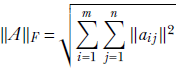 Equation 4.5
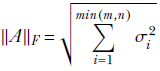 Equation 4.6
In summary, norms are essential tools in the analysis and application of vectors and matrices, providing insights into their magnitudes and behaviors in various mathematical and practical contexts.