Overspecified System
An overspecified system, also known as an overconstrained or overdetermined system, is characterized by having more equations than variables. This imbalance typically results in a system that does not have a solution, as the likelihood of all the equations intersecting at a single point is low. However, there are scenarios where such systems can indeed have solutions.
Characteristics of Overspecified Systems
In an overspecified system, the number of equations exceeds the number of variables. For instance, a system with three equations and only two variables is considered overspecified. This situation is visually represented in Figure 3.3.
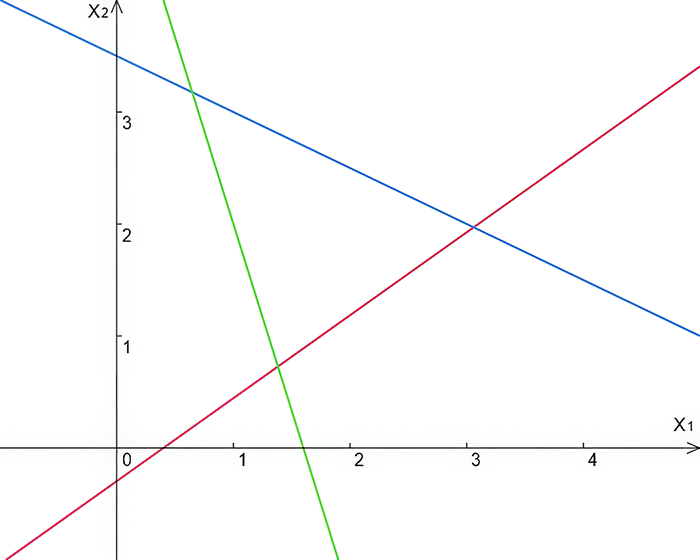 Figure 3.3 An overspecified system with three equations but two variables
Possibility of Solutions
While overspecified systems generally do not have solutions, there are exceptions. A solution is a point where all the lines (or hyperplanes, in higher dimensions) intersect. Although the chances of such an intersection are slim, it is not impossible. Figure 3.4 illustrates an overspecified system that, surprisingly, has a solution.
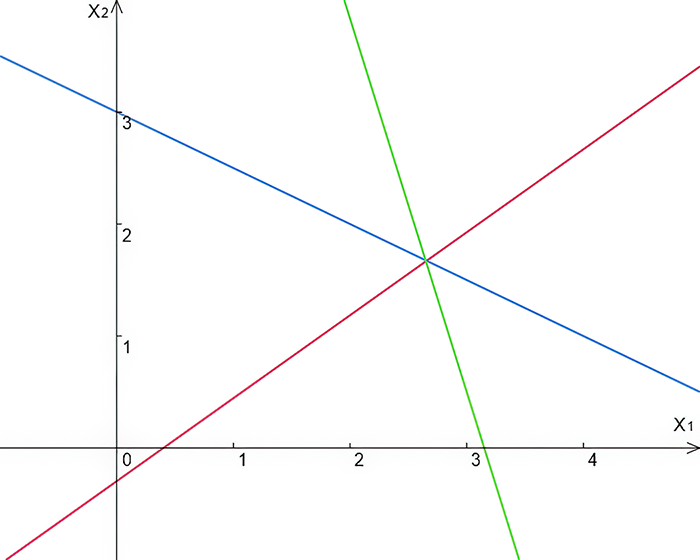 Figure 3.4 An overspecified system that oddly enough has a solution
Conditions for Solutions
An overspecified system may have a solution if some of the hyperplanes coincide or if their equations are linearly dependent. In such cases, the system might not only have a solution but potentially an infinite number of solutions. Additionally, numeric methods can sometimes find a pragmatic solution even if it is not geometrically correct. These methods work under the assumption that all the data points are close enough to a common solution, even if the hyperplanes do not intersect at a single point. This pragmatic solution, while not geometrically accurate, can still be valuable in practical applications.
FAQ (Frequently asked questions)
What is an overspecified system?
Do overspecified systems typically have a solution?
Can numeric methods find a solution for overspecified systems?
What does Figure 3.3 illustrate in the context of overspecified systems?
What is an example of an overspecified system?