Parameter
In the context of programming and machine learning, a "parameter" is a variable that is used to define a particular system or function. Parameters are essential in various domains, including programming languages like Python, machine learning frameworks like PyTorch, and large language models (LLMs). They play a crucial role in determining the behavior and performance of functions, models, and algorithms.
Parameters in Python
In Python, parameters are used in several contexts, such as string formatting, function definitions, and file handling. They allow for flexible and dynamic code execution by enabling the passing of values and configurations.
Parameters in String Formatting
The format method in Python is a powerful tool for string formatting, allowing for both positional and named parameters to replace placeholders in a format string.
-
Positional Parameters: These are specified using numbered placeholders such as
{0},{1}, etc. They correspond to the order of arguments passed to theformatmethod, allowing for flexible reordering of arguments without changing the format string itself.print("The {0} is {1}.".format("sky", "blue")) -
Named Parameters: These provide an alternative by allowing you to specify parameters by name, making the format string more readable and maintainable.
print('{food} is the food of {user}.'.format(food='Ambrosia', user='the gods'))
Parameters in Function Definitions
Parameters are fundamental in defining functions, allowing them to accept input values and perform operations based on those inputs. For example, the function power uses positional parameters x and y to calculate x raised to the power of y.
def power(x, y):
    r = 1
    while y > 0:
        r = r * x
        y = y - 1
    return r
Parameters in File Handling
When working with files, parameters can specify how the file should be opened and read. For instance, the newline parameter controls the treatment of newline characters.
input_file = open("myfile", newline="\n")
Parameters in PyTorch
In PyTorch, parameters are a fundamental component of neural network models. They are tensors optimized during the training process, typically including the weights and biases of the model's layers.
Accessing and Inspecting Parameters
Parameters can be accessed using the model.parameters() method, which returns a generator of all the parameters in the model. The named_parameters() method allows for identifying parameters by name, aiding in model inspection and debugging.
for name, param in seq_model.named_parameters():
    print(name, param.shape)
Keeping Parameters in Check
Regularization techniques such as L1 and L2 penalties are employed to ensure parameters do not grow too large, promoting a stable and generalizable model.
Parameters in Large Language Models (LLMs)
In machine learning models, parameters are the weights and biases learned during training. They are crucial for determining the model's predictions and are adjusted to minimize the error between predicted and actual outputs.
Parameter Efficiency with LoRA
LoRA (Low-Rank Adaptation) is a technique used to enhance the parameter efficiency of LLMs by introducing additional parameters in a controlled manner. This is achieved by adding LoRA layers, which consist of matrices A and B, and a scaling factor alpha.
class LoRALayer(torch.nn.Module):
    def __init__(self, in_dim, out_dim, rank, alpha):
        super().__init__()
        self.A = torch.nn.Parameter(torch.empty(in_dim, rank))
        torch.nn.init.kaiming_uniform_(self.A, a=math.sqrt(5))
        self.B = torch.nn.Parameter(torch.zeros(rank, out_dim))
        self.alpha = alpha

    def forward(self, x):
        x = self.alpha * (x @ self.A @ self.B)
        return x
Freezing and Replacing Parameters
Before applying LoRA layer upgrades, it is common to freeze the original model parameters to focus training on the newly introduced LoRA parameters, significantly reducing the number of trainable parameters.
for param in model.parameters():
    param.requires_grad = False
Visual Representation
The integration of LoRA layers and their impact on model architecture can be visualized in figures:
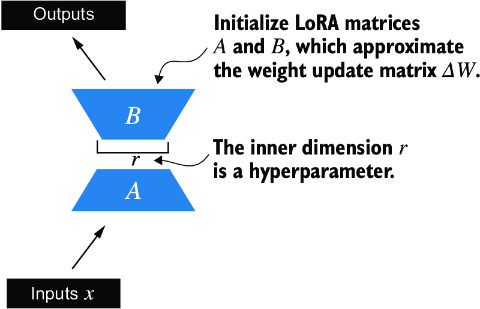 Figure E.2 The LoRA matrices A and B are applied to the layer inputs and are involved in computing the model outputs.
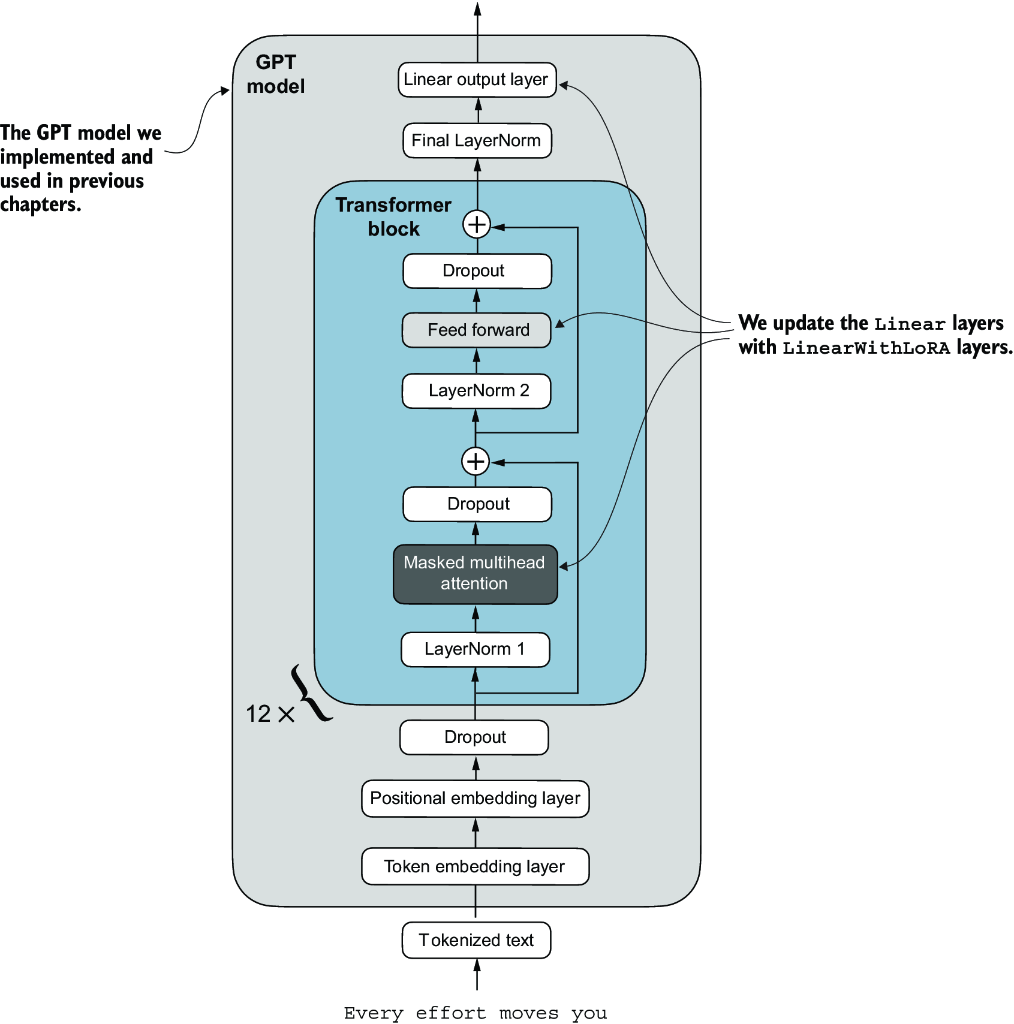 Figure E.4 The architecture of the GPT model with Linear layers upgraded to LinearWithLoRA layers.
These figures illustrate how LoRA matrices are integrated into the model, highlighting the specific areas modified for parameter-efficient fine-tuning.
| Book Title | Usage of Parameter | Technical Depth | Connections to Other Concepts | Examples Used | Practical Application |
|------------|--------------------|-----------------|-------------------------------|---------------|-----------------------|
| [The Quick Python Book, Fourth Edition](https://www.manning.com/books/the-quick-python-book-fourth-edition) | Discusses parameters in Python for string formatting, function definitions, and file handling. | Covers positional and named parameters in detail, including their use in string formatting and function definitions. | Connects parameters to string formatting, function definitions, and file handling. | Provides examples for string formatting and function definitions. | Practical examples include string formatting and file handling. [more](https://livebook.manning.com/book/the-quick-python-book-fourth-edition/chapter-6/157) |
| [Deep Learning with PyTorch, Second Edition](https://www.manning.com/books/deep-learning-with-pytorch-second-edition) | Parameters are tensors optimized during training, including weights and biases. | Explains accessing, inspecting, and regulating parameters with methods like `model.parameters()` and `named_parameters()`. | Connects parameters to model training, optimization, and regularization techniques. | Examples include accessing and listing model parameters. | Practical application in model training and optimization. [more](https://livebook.manning.com/book/deep-learning-with-pytorch-second-edition/chapter-6/67) |
| [Build a Large Language Model (From Scratch)](https://www.manning.com/books/build-a-large-language-model-from-scratch) | Parameters are weights and biases learned during training, crucial for model predictions. | Discusses parameter efficiency with LoRA, a technique for enhancing parameter efficiency. | Connects parameters to model training, LoRA layers, and parameter efficiency. | Examples include implementing LoRA layers and freezing parameters. | Practical application in parameter-efficient fine-tuning of large language models. [more](https://livebook.manning.com/book/build-a-large-language-model-from-scratch/chapter-4/1) |
FAQ (Frequently asked questions)
What are parameters in the format method?
How are positional parameters specified in the format method?
How do named parameters work in the format method?
What type of parameters does the power function use?
How can you specify newline character treatment when opening a file?
What is a parameter in PyTorch?
What are typical parameters in a PyTorch model?
How are parameters defined in PyTorch to enable gradient computation?
How can you access parameters in a PyTorch model?
What does the output of list(linear_model.parameters()) look like?
How are parameters updated in a neural network model?
What is the purpose of named_parameters in PyTorch?
How can you inspect the shape of parameters in a PyTorch model?
What are the shapes of the parameters in the given model example?
How can you collect weights and biases from linear modules in a PyTorch model?
How can you identify parameters by name in a PyTorch model?
How can you access specific parameters using submodules in PyTorch?
What is the purpose of regularization techniques in neural networks?
What are some regularization techniques mentioned for keeping parameters in check?