Parameter-Efficient Fine-Tuning
Parameter-efficient fine-tuning is a method designed to adapt a pretrained model to a specific task by adjusting only a small subset of the model’s weight parameters. This approach significantly reduces the computational costs and resources required for fine-tuning, making it particularly suitable for large models and task-specific data.
Overview
In traditional fine-tuning, the entire set of model parameters is updated to adapt the model to a new task. However, this can be computationally expensive, especially for large models with millions or even billions of parameters. Parameter-efficient fine-tuning addresses this challenge by modifying only a small portion of the model's parameters, thereby reducing the computational burden and resource requirements.
LoRA: Low-Rank Adaptation
One popular method for parameter-efficient fine-tuning is Low-Rank Adaptation (LoRA). LoRA introduces two smaller matrices, A and B, to approximate the weight update matrix DW. Instead of updating the pretrained weight matrix W directly, as in regular fine-tuning, LoRA adds the product of matrices A and B to W. The inner dimension, denoted as r, is a tunable hyperparameter that controls the rank of the approximation.
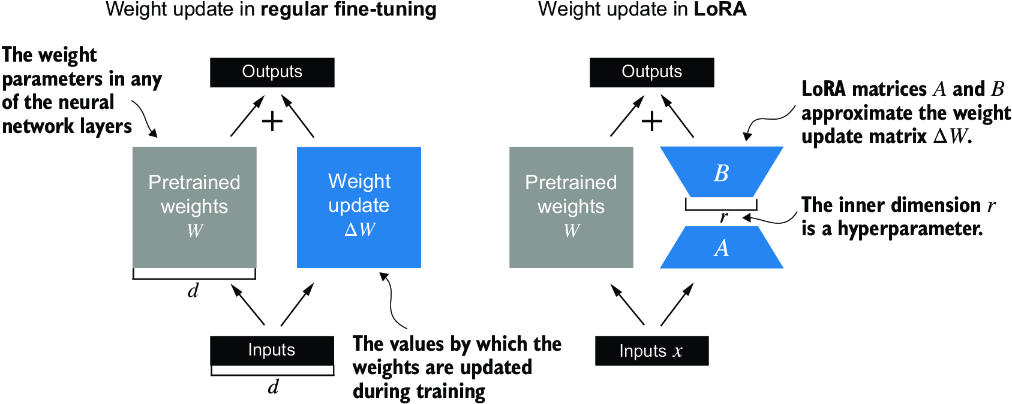 Figure E.1 A comparison between weight update methods: regular fine-tuning and LoRA. Regular fine-tuning involves updating the pretrained weight matrix W directly with DW (left). LoRA uses two smaller matrices, A and B, to approximate DW, where the product AB is added to W, and r denotes the inner dimension, a tunable hyperparameter (right).
Application in GPT Models
In the context of GPT models, parameter-efficient fine-tuning can be implemented by replacing the Linear layers with LinearWithLoRA layers. This upgrade is applied to all Linear layers found in the multihead attention, feed-forward modules, and the output layer of the GPTModel. Before applying these upgrades, the original model parameters are typically frozen to ensure that only the newly introduced parameters are trained.
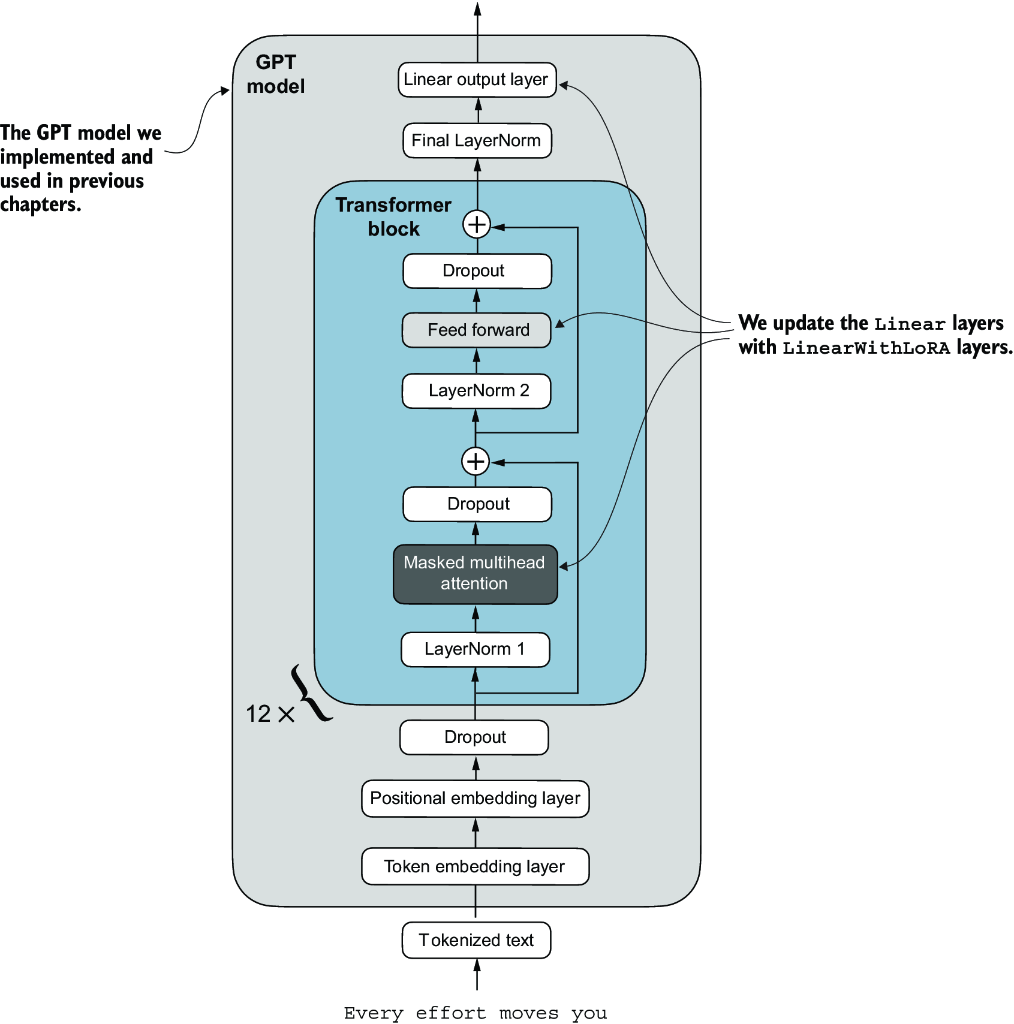 Figure E.4 The architecture of the GPT model. It highlights the parts of the model where Linear layers are upgraded to LinearWithLoRA layers for parameter-efficient fine-tuning.
By employing parameter-efficient fine-tuning techniques like LoRA, it is possible to adapt large language models to new tasks with minimal computational overhead, making it a practical approach for many real-world applications.