Pixel
A pixel is the smallest unit of a digital image or graphic that can be displayed and represented on a digital display device. It is the basic building block of any digital image, representing a single point in the image. Pixels are used in various contexts, from simple image representation to complex deep learning models.
Pixels in Digital Imaging
In digital imaging, a pixel is a color-containing cell in a grid that forms a picture. Each pixel is addressed by integer coordinates, making it a discrete unit within the image. Unlike geometric points, which are dimensionless, pixels have both width and height, allowing them to cover an area in the image grid. This is crucial for understanding how images are constructed and manipulated. For example, a pixel corresponding to the point ( a = (0.5, 1.5) ) on a 1-to-1 scale is the pixel ([0, 1]), encompassing the point ( a ) and an infinite number of other points within its area.
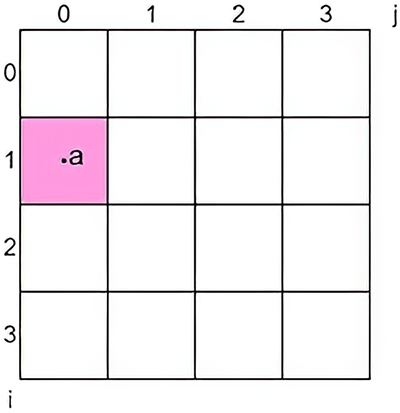 Figure 2.2 A pixel isn’t a point, but a pixel contains point a and an infinite amount of other points.
Characteristics of Pixels
-
Color Value Range: The color value of a pixel typically ranges from 0 to 255. This range allows for 256 different intensity levels for each color channel in an RGB image, enabling the representation of a wide spectrum of colors.
-
Image Representation: An image is essentially a two-dimensional array of pixels. Each element of this array, denoted as (X_{i,j}), is a pixel color value. This structure allows for the representation of complex scenes and objects in digital form.
Pixels in Deep Learning
In the context of deep learning and convolutional neural networks (CNNs), a "pixel" refers to the individual elements in the feature maps produced by the convolutional layers. These pixels are not the same as the pixels in an image but represent the processed data at each layer of the network.
Pixels in Convolutional Networks
In convolutional networks, each pixel in the output feature map is the result of a convolution operation. This operation involves applying a convolutional filter (or kernel) to a specific region of the input data. The filter slides over the input data, and at each position, it computes a weighted sum of the input values. This weighted sum becomes a single pixel in the output feature map.
-
Convolutional Filters: These are small, learnable matrices used to detect specific features in the input data. Each filter is applied across the input data to produce a feature map.
-
Weighted Sum: As the filter moves across the input data, it performs an element-wise multiplication with the input values and sums them up. This sum is then passed through an activation function to introduce non-linearity.
-
Feature Maps: The result of applying a filter across the entire input data is a feature map, where each element (or pixel) in the map corresponds to a specific region of the input data.
Understanding the role of pixels in convolutional networks is essential for designing and interpreting CNN architectures, as it directly impacts the network's ability to learn and generalize from the input data.
Pixels in 3D Imaging
While pixels are the building blocks of 2D images, 3D images use a similar concept called voxels. A voxel, or volume pixel, extends the idea of a pixel into three dimensions, forming the basic unit of a 3D image. This is analogous to how a 2D image is an array of colored squares (pixels), whereas a 3D image is an array of colored cubes (voxels).
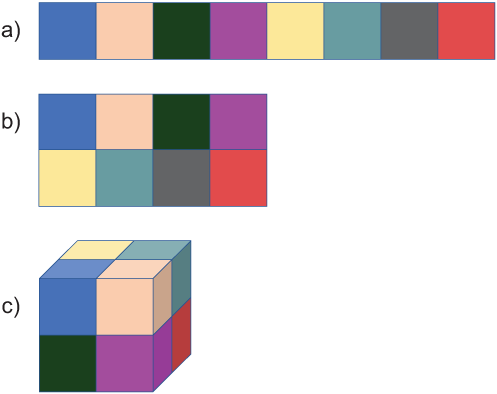 Figure 12.1 The same data (a) represented as an array of colors: a 2D 4×2 image made of pixels (b) and a 3D 2×2×2 image made of voxels (c)
Coordinate Systems
In digital imaging, the convention for addressing pixels often starts from the top-left corner of the image grid, using integer coordinates. This is different from the traditional Cartesian coordinate system, where the origin is typically at the bottom-left. In some contexts, such as screen coordinates, this top-left origin is more practical. Additionally, in matrix notation, the row-column convention is used, where the row index (i) corresponds to the vertical axis and the column index (j) corresponds to the horizontal axis, which is the inverse of the typical x-y notation.
Examples of Pixel Usage
Car-versus-Giraffe Classification
In image classification tasks, such as distinguishing between cars and giraffes, each pixel in the image matrix plays a crucial role. The matrix is composed of pixel color values, each within the range of 0 to 255. These values collectively form the image at a specific moment in time, providing the necessary data for classification algorithms to analyze and make predictions.
Entropy in Pixel Distributions
Pixels can also be used to illustrate concepts such as entropy in images. For instance, consider 4x4 pixel images with varying color distributions:
-
In one image, if the colors are equally probable, the image exhibits high entropy. This means there is a high level of disorder or unpredictability in the color distribution.
-
Conversely, in another image where one color is more frequent than others, the entropy is low, indicating a more ordered or predictable color distribution.
These examples highlight the importance of pixel analysis in understanding and processing digital images, particularly in the context of deep learning and image recognition tasks.
Here is a markdown table comparing how different 'llm' books discuss the term 'pixel':
| Book Title | Usage of Pixel | Technical Depth | Connections to Other Concepts | Examples Used | Practical Application | |------------|----------------|-----------------|-------------------------------|---------------|-----------------------| | Math and Architectures of Deep Learning | Discusses pixels as fundamental units of digital images, with a focus on color intensity values and their role in image representation. more | Explores pixel color value ranges and their representation in 2D arrays. more | Connects pixels to concepts like entropy and image classification tasks. more | Uses examples like car-versus-giraffe classification and entropy in pixel distributions. more | Highlights the importance of pixel analysis in deep learning and image recognition. more | | Geometry for Programmers | Defines pixels as color-containing cells in a grid, emphasizing their discrete nature. more | Discusses pixels as containing points, not being points, and their role in bitmap interpolation. more | Introduces the concept of voxels in 3D imaging and coordinate systems in digital imaging. more | Provides visual examples like pixel and voxel representations. more | Explains practical coordinate systems and their applications in digital imaging. more | | Deep Learning with PyTorch, Second Edition | Describes pixels in the context of CNNs as elements in feature maps, not traditional image pixels. more | Details the computation of pixels in feature maps through convolutional operations. more | Links pixels to convolutional filters and feature maps in CNNs. more | Focuses on the role of pixels in detecting features like edges and patterns. more | Emphasizes the importance of pixel understanding in designing CNN architectures. more |
This table provides a comparative overview of how each book approaches the concept of 'pixel', highlighting the unique perspectives and applications discussed in each text.
FAQ (Frequently asked questions)
What is a pixel in the context of a grid?
Is a pixel considered a single point?
How is a pixel corresponding to a point represented on a 1-to-1 scale?
What role does a pixel play in bitmap interpolation?
How is color represented in a pixel during bitmap interpolation?
What does a pixel of outputs refer to in convolutional networks?
What does each pixel represent in convolutional networks?