Polynomial Approximation
Polynomial approximation is a mathematical technique used to represent complex functions as polynomials. This approach is particularly useful in computational contexts where trading off some precision for increased performance is desirable. By approximating functions with polynomials, calculations can be simplified, leading to faster computations. This is often achieved using series expansions such as Maclaurin and Taylor series, which allow functions to be expressed as polynomials of varying degrees.
Overview
The core idea behind polynomial approximation is to rewrite functions in a polynomial form. This transformation is beneficial because polynomials are easier to compute than many other types of functions. The degree of the polynomial used in the approximation can be adjusted to balance between the accuracy of the approximation and the computational efficiency. Higher-degree polynomials can provide more accurate approximations but at the cost of increased computational complexity.
Practical Examples
One practical application of polynomial approximation is in data fitting, where the goal is to find a polynomial that best fits a set of data points. A common method used for this purpose is the least-squares method, which minimizes the sum of the squares of the differences between the observed and predicted values. For instance, a linear trend can be used to approximate rowing times, providing a simple yet effective model for the data.
Linear Approximation
Linear approximation is a specific case of polynomial approximation where the polynomial is of degree one. This means the function is approximated by a straight line. While linear approximations can be useful for short-term predictions or when the data exhibits a linear trend, they may not accurately capture the underlying complexity of the data over a larger interval.
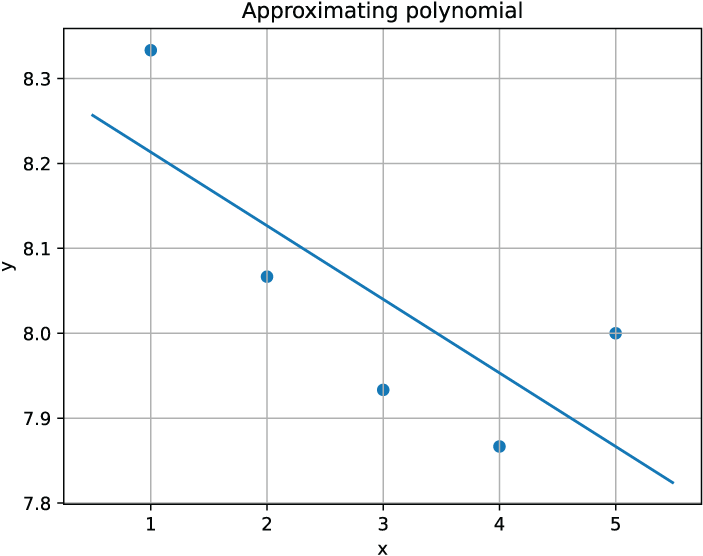 Figure 6.16 Linear approximation is a special case of polynomial approximation.
In Figure 6.16, we see an example of a linear approximation applied to a dataset. This figure illustrates how a linear polynomial can be used to approximate the data, providing a straightforward model that is easy to compute. However, it is important to note that while a linear approximation may fit the data well in the short term, it may not accurately represent the true nature of the underlying function, especially over a larger interval. As the plot suggests, the progress appears linear, but this is not always the case in reality. As one improves, the rate of improvement often decreases, making linear models less effective for long-term predictions.
FAQ (Frequently asked questions)
What is polynomial approximation?
How is polynomial approximation achieved?
What is a practical example of polynomial approximation?
How can polynomial approximation be used to show a trend?