PyTorch
PyTorch is a widely-used open-source machine learning library developed by Facebook’s AI group. It is particularly popular for applications in deep learning, such as computer vision and natural language processing. PyTorch provides a flexible and efficient platform for building and training neural network models, offering tools for tensor computation, automatic differentiation, and model building. Its dynamic computation graph feature, known as Autograd, simplifies the process of computing gradients, which are crucial for optimizing model parameters during training.
Overview
PyTorch is designed to provide flexibility and efficiency in building and training neural networks. It is built around three core components: a tensor library, automatic differentiation functions, and deep learning utilities. These components make PyTorch a cornerstone in the field of machine learning and deep learning.
Core Components of PyTorch
Tensor Library
At the heart of PyTorch is its tensor library, which serves as a fundamental building block for computing. Tensors in PyTorch are similar to NumPy arrays but come with additional capabilities, such as the ability to perform computations on GPUs, which significantly accelerates processing. Tensors can be of various dimensions: a scalar is a zero-dimensional tensor, a vector is a one-dimensional tensor, and a matrix is a two-dimensional tensor. Higher-dimensional tensors are referred to by their dimensionality, such as 3D tensors.
Creating PyTorch Tensors:
import torch

tensor0d = torch.tensor(1)     # Creates a zero-dimensional tensor (scalar)
tensor1d = torch.tensor([1, 2, 3])    # Creates a one-dimensional tensor (vector)
tensor2d = torch.tensor([[1, 2],
                         [3, 4]])     # Creates a two-dimensional tensor (matrix)
tensor3d = torch.tensor([[[1, 2], [3, 4]],
                         [[5, 6], [7, 8]]])    # Creates a three-dimensional tensor
Automatic Differentiation
PyTorch's automatic differentiation engine, known as autograd, is a powerful feature that simplifies the process of computing gradients, which are essential for optimizing models. Autograd constructs a computational graph by tracking operations on tensors, allowing for the automatic computation of gradients.
Example of a Computation Graph:
import torch.nn.functional as F

y = torch.tensor([1.0])          # True label
x1 = torch.tensor([1.1])         # Input feature
w1 = torch.tensor([2.2], requires_grad=True)  # Weight parameter
b = torch.tensor([0.0], requires_grad=True)   # Bias unit

z = x1 * w1 + b                 # Net input
a = torch.sigmoid(z)            # Activation and output
loss = F.binary_cross_entropy(a, y)

# [Compute gradients](https://livebook.manning.com/book/build-a-large-language-model-from-scratch/appendix-a/1)
from torch.autograd import grad
grad_L_w1 = grad(loss, w1, retain_graph=True)
grad_L_b = grad(loss, b, retain_graph=True)
Deep Learning Utilities
PyTorch provides a suite of utilities that make it easier to implement and train deep neural network models. These include modules for defining neural network architectures, loss functions, and optimizers.
Training a Neural Network:
import torch.nn.functional as F

torch.manual_seed(123)
model = NeuralNetwork(num_inputs=2, num_outputs=2)    # Define model
optimizer = torch.optim.SGD(model.parameters(), lr=0.5)  # Define optimizer

num_epochs = 3
for epoch in range(num_epochs):
    model.train()
    for batch_idx, (features, labels) in enumerate(train_loader):
        logits = model(features)
        loss = F.cross_entropy(logits, labels)
        optimizer.zero_grad()            # Reset gradients
        loss.backward()                  # Compute gradients
        optimizer.step()                 # Update parameters
Distributed Training
PyTorch also supports distributed training, which allows for scaling up the training process across multiple devices or nodes. This is facilitated by utilities such as DistributedDataParallel and other related modules.
Utilities for Distributed Training:
import torch.multiprocessing as mp
from torch.utils.data.distributed import DistributedSampler
from torch.nn.parallel import DistributedDataParallel as DDP
from torch.distributed import init_process_group, destroy_process_group
Figures
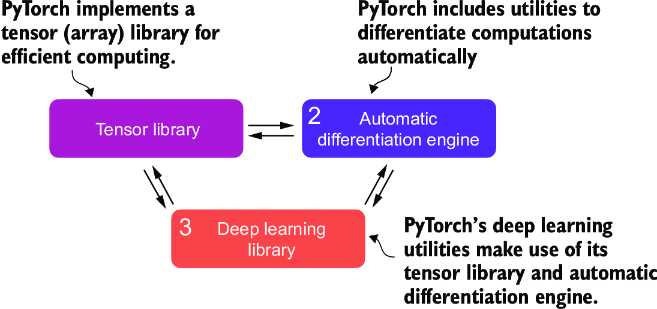 Figure A.1 PyTorch’s three main components include a tensor library as a fundamental building block for computing, automatic differentiation for model optimization, and deep learning utility functions, making it easier to implement and train deep neural network models.
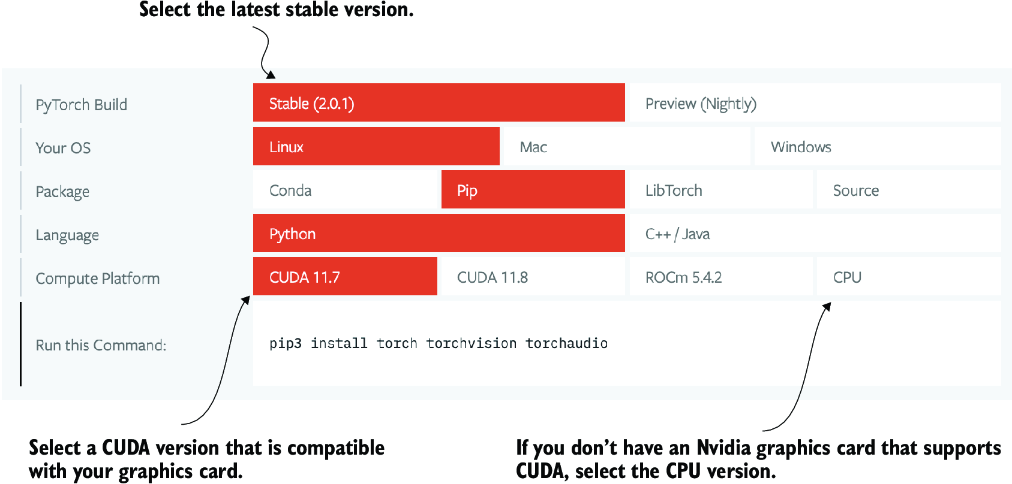 Figure A.4 Access the PyTorch installation recommendation on https://pytorch.org to customize and select the installation command for your system.
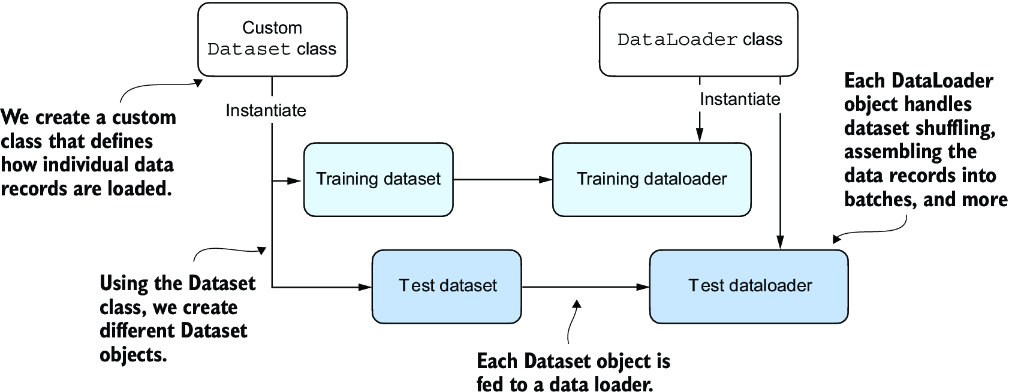 Figure A.10 PyTorch implements a Dataset and a DataLoader class. The Dataset class is used to instantiate objects that define how each data record is loaded. The DataLoader handles how the data is shuffled and assembled into batches.
In summary, PyTorch is a versatile and powerful library for deep learning, offering a wide range of functionalities from basic tensor operations to complex neural network training and matrix computations.
| Book Title | Usage of PyTorch | Technical Depth | Connections to Other Concepts | Examples Used | Practical Application |
|------------|------------------|-----------------|-------------------------------|---------------|-----------------------|
| [Math and Architectures of Deep Learning](https://www.manning.com/books/math-and-architectures-of-deep-learning) | Discusses PyTorch as a flexible platform for deep learning, emphasizing its dynamic computation graph feature, Autograd. [more](https://livebook.manning.com/book/math-and-architectures-of-deep-learning/chapter-11/110) | Covers tensor operations, matrix operations, and neural network training in detail. [more](https://livebook.manning.com/book/math-and-architectures-of-deep-learning/chapter-2/147) | Connects PyTorch to concepts like Latent Semantic Analysis and Singular Value Decomposition. [more](https://livebook.manning.com/book/math-and-architectures-of-deep-learning/chapter-4/353) | Provides examples of vector manipulations, matrix operations, and neural network training. [more](https://livebook.manning.com/book/math-and-architectures-of-deep-learning/chapter-8/1) | Includes practical applications like demand prediction using neural networks. [more](https://livebook.manning.com/book/math-and-architectures-of-deep-learning/chapter-8/1) |
| [Build a Large Language Model (From Scratch)](https://www.manning.com/books/build-a-large-language-model-from-scratch) | Highlights PyTorch's role in building and training neural networks with a focus on its core components. [more](https://livebook.manning.com/book/build-a-large-language-model-from-scratch/appendix-a/1) | Explores tensor library, automatic differentiation, and deep learning utilities. [more](https://livebook.manning.com/book/build-a-large-language-model-from-scratch/appendix-a/1) | Discusses distributed training and its utilities, connecting PyTorch to large-scale model training. [more](https://livebook.manning.com/book/build-a-large-language-model-from-scratch/appendix-a/1) | Includes examples of tensor creation, computation graphs, and neural network training. [more](https://livebook.manning.com/book/build-a-large-language-model-from-scratch/appendix-a/1) | Focuses on distributed training and scaling neural network training across devices. [more](https://livebook.manning.com/book/build-a-large-language-model-from-scratch/appendix-a/1) |