Rank in Large Language Models (LLMs)
The term "rank" is a versatile concept in the field of machine learning and large language models (LLMs), with applications ranging from matrix operations to distributed computing. Below, we explore the various contexts in which "rank" is used, synthesizing information from multiple sources.
Rank in the LoRA Method
In the LoRA (Low-Rank Adaptation) method, rank is a critical parameter that determines the inner dimensions of matrices A and B. This setting influences the number of additional parameters introduced by LoRA, affecting the model's adaptability and efficiency. By adjusting the rank, one can balance the trade-off between the model's flexibility and the computational resources required. A higher rank allows for more parameters, potentially increasing the model's capacity to learn complex patterns, while a lower rank reduces the computational load and memory usage.
Rank in Tensors
Tensors are fundamental mathematical objects used in various computational frameworks, including machine learning libraries like PyTorch. The rank of a tensor refers to the number of dimensions it possesses. This concept is illustrated in Figure A.6:
- A scalar, which is a single number, is a tensor of rank 0.
- A vector, which is a one-dimensional array, is a tensor of rank 1.
- A matrix, which is a two-dimensional array, is a tensor of rank 2.
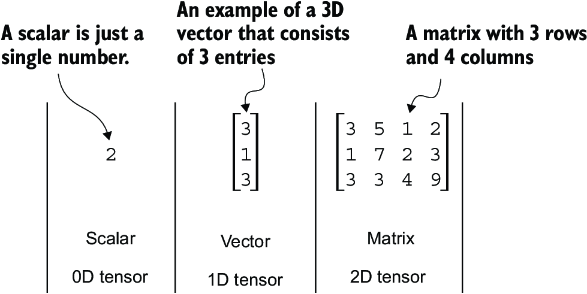 Figure A.6 Tensors with different ranks.
Tensors serve as data containers that can hold multidimensional data, with each dimension representing a different feature. Libraries like PyTorch provide efficient ways to create, manipulate, and compute with these arrays, functioning similarly to array libraries.
Rank in Distributed Data Parallel (DDP) Training
In distributed training, particularly when using the DistributedDataParallel (DDP) strategy, the term "rank" refers to the index of the process or GPU being utilized. Each process in a distributed setup is assigned a unique rank, which is used to identify and manage resources across multiple GPUs. The following listing demonstrates how rank is used in a DDP setup:
def ddp_setup(rank, world_size):
    os.environ["MASTER_ADDR"] = "localhost"
    os.environ["MASTER_PORT"] = "12345"
    init_process_group(
        backend="nccl",
        rank=rank,
        world_size=world_size
    )
    torch.cuda.set_device(rank)

def main(rank, world_size, num_epochs):
    ddp_setup(rank, world_size)
    # Additional code for model training
    destroy_process_group()

if __name__ == "__main__":
    world_size = torch.cuda.device_count()
    mp.spawn(main, args=(world_size, num_epochs), nprocs=world_size)
In this context, the rank is used to set the current GPU device and manage the distribution of data and computation across multiple devices. It is crucial for ensuring that each process operates independently while contributing to the overall training process.
Overview of Matrix Rank
The rank of a matrix is a fundamental concept in linear algebra, crucial for understanding various operations and properties of matrices. It is defined as the number of linearly independent rows or columns in the matrix, equivalent to the number of nonzero singular values. A matrix with full rank is invertible, while a matrix that does not have full rank is considered degenerate and is not invertible. Singular Value Decomposition (SVD) is a powerful tool often used to handle matrices that are not of full rank, allowing for applications such as dimensionality reduction and noise reduction.
Best Low-Rank Approximation of Matrices
In many practical applications, especially in deep learning, it is beneficial to approximate a matrix with a lower rank. The best low-rank approximation of a matrix ( A ) is achieved through its Singular Value Decomposition (SVD). If a matrix ( A ) has rank ( p ), it can be approximated by a matrix of rank ( r ) (where ( r < p )) by considering only the first ( r ) singular values and their corresponding singular vectors. This method minimizes the Frobenius norm of the difference between the original matrix ( A ) and its low-rank approximation, reducing the complexity of models and computations while preserving essential features of the data.
| Book Title | Usage of rank | Technical Depth | Connections to Other Concepts | Examples Used | Practical Application |
|------------|---------------|-----------------|-------------------------------|---------------|-----------------------|
| [Build a Large Language Model (From Scratch)](https://www.manning.com/books/build-a-large-language-model-from-scratch) | Discusses rank in the context of LoRA method, tensor mathematics, and distributed data parallel training. | Explores rank as a parameter in LoRA, dimensions in tensors, and process indexing in DDP. | Connects rank to model adaptability, tensor operations, and distributed training strategies. | Provides examples like tensor ranks and DDP setup code. | Highlights practical use in model efficiency, tensor manipulation, and distributed training. [more](https://livebook.manning.com/book/build-a-large-language-model-from-scratch/appendix-e/1) |
| [Math and Architectures of Deep Learning](https://www.manning.com/books/math-and-architectures-of-deep-learning) | Focuses on matrix rank in linear algebra and its applications in deep learning. | Delves into matrix rank, linear independence, and singular value decomposition. | Links rank to matrix invertibility, dimensionality reduction, and noise reduction. | Uses SVD for low-rank matrix approximation. | Applies rank concepts to reduce model complexity and computational load. [more](https://livebook.manning.com/book/math-and-architectures-of-deep-learning/chapter-4/268) |