Rotation
Rotation is a fundamental transformation in mathematics and computer graphics, involving the turning of objects around a specific point or axis. This operation is crucial in various applications, such as 3D modeling, animation, and data visualization. It allows for the manipulation and analysis of objects in space, making it an essential concept in fields like mathematics, physics, and computer graphics.
Mathematical Representation of Rotation
Rotation is a linear transformation that can be represented using matrices. In two-dimensional (2D) space, a rotation matrix is used to rotate points around the origin. The standard form of a 2D rotation matrix for an angle θ is:
[ R(\theta) = \begin{bmatrix} \cos \theta & -\sin \theta \ \sin \theta & \cos \theta \end{bmatrix} ]
When this matrix is multiplied by a vector representing a point's coordinates, the result is a new vector representing the coordinates of the point after being rotated by the angle θ around the origin.
In three-dimensional (3D) space, rotation involves rotating around an axis. A 3D rotation matrix can be constructed to rotate points around the x, y, or z-axis. For example, the rotation matrix for rotating around the z-axis by an angle θ is:
[ R_z(\theta) = \begin{bmatrix} \cos \theta & -\sin \theta & 0 \ \sin \theta & \cos \theta & 0 \ 0 & 0 & 1 \end{bmatrix} ]
These matrices are crucial in 3D graphics and simulations, where objects need to be rotated in space to achieve the desired orientation.
Rotation in Computer Graphics
In computer graphics, rotation is one of the three most common transformations, alongside translation and scaling. It is often used to change the orientation of objects in a scene. The mathematical formula for rotating a point in space around the zero point is given by:
[ x_r = \cos(t) \cdot x_i + \sin(t) \cdot y_i ]
[ y_r = -\sin(t) \cdot x_i + \cos(t) \cdot y_i ]
Here, (x_i) and (y_i) are the coordinates of the input point, and (x_r) and (y_r) are the coordinates of the rotated point. The parameter (t) is the angle of rotation, expressed in radians.
Examples of Rotation
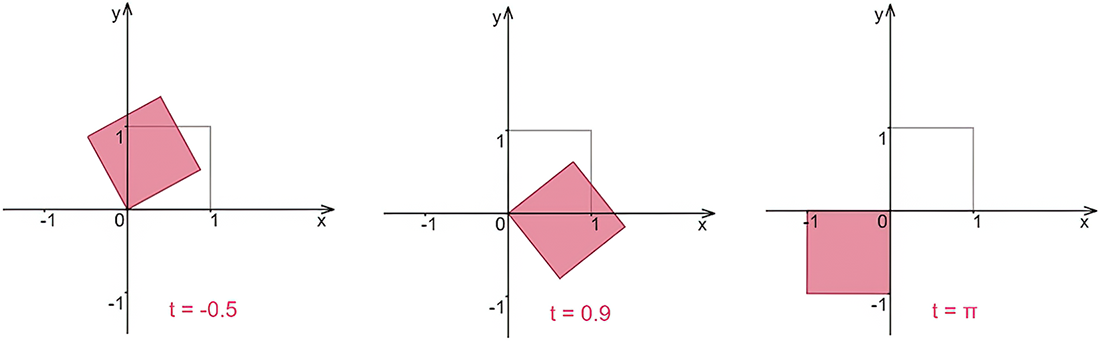
Figure 4.5 illustrates three examples of standard square rotations, all centered around the zero point (0, 0).
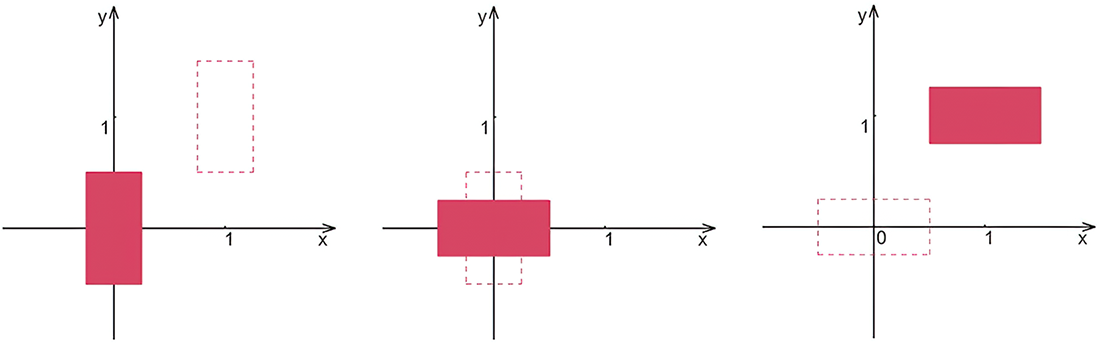
To rotate an object around its center rather than the zero point, a composition of transformations is required. This involves translating the object to the origin, performing the rotation, and then translating the object back to its original position. Figure 4.10 demonstrates this concept.
Rotating Vectors
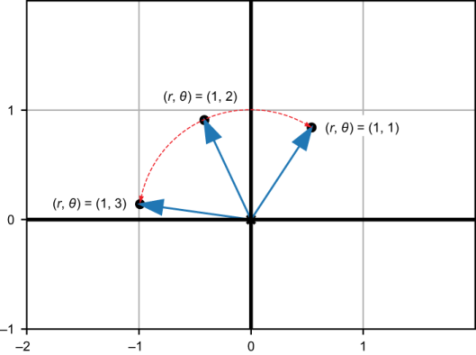
When rotating vectors, the direction of a vector is changed while maintaining its magnitude. This is typically achieved by adding or subtracting an angle from the vector's current direction. Figure 2.35 illustrates this concept.
Practical Applications
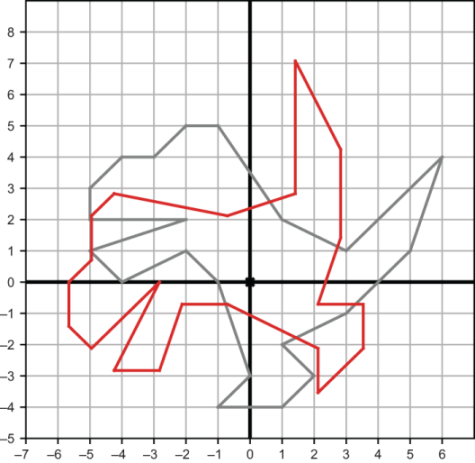
A practical example of rotation is demonstrated in Figure 2.36, where a dinosaur shape is rotated. The original dinosaur is shown in gray, and a rotated copy is superimposed in red.
To facilitate the rotation of multiple vectors, a general-purpose rotate function can be implemented. This function would take a list of vectors and a specified angle, applying the rotation uniformly to each vector. Such a function is invaluable in programming and data science, where transformations of data points or graphical objects are frequently required.
Understanding and utilizing rotation matrices is essential for tasks involving spatial transformations, such as computer graphics, robotics, and physics simulations. They provide a mathematical framework for describing how objects move and change orientation in space, making them indispensable tools in the field of deep learning and beyond.
| Book Title | Usage of Rotation | Technical Depth | Connections to Other Concepts | Examples Used | Practical Application |
|------------|-------------------|-----------------|-------------------------------|---------------|-----------------------|
| [Math and Architectures of Deep Learning](https://www.manning.com/books/math-and-architectures-of-deep-learning) | Discusses rotation as a transformation in mathematics, physics, and computer graphics, focusing on rotation matrices in 2D and 3D spaces. [more](https://livebook.manning.com/book/math-and-architectures-of-deep-learning/chapter-2/452) | Explains rotation matrices in detail, including their construction and application in 2D and 3D spaces. [more](https://livebook.manning.com/book/math-and-architectures-of-deep-learning/chapter-2/452) | Connects rotation to spatial transformations, computer graphics, robotics, and physics simulations. [more](https://livebook.manning.com/book/math-and-architectures-of-deep-learning/chapter-2/452) | Provides mathematical examples of rotation matrices and their application in 2D and 3D. [more](https://livebook.manning.com/book/math-and-architectures-of-deep-learning/chapter-2/452) | Highlights the importance of rotation in deep learning and spatial transformations. [more](https://livebook.manning.com/book/math-and-architectures-of-deep-learning/chapter-2/452) |
| [Geometry for Programmers](https://www.manning.com/books/geometry-for-programmers) | Describes rotation as a geometric transformation, emphasizing its role in computer graphics and design. [more](https://livebook.manning.com/book/geometry-for-programmers/chapter-4/112) | Covers mathematical representation and matrix transformation for rotation, including code examples. [more](https://livebook.manning.com/book/geometry-for-programmers/chapter-4/1) | Links rotation with other transformations like translation and scaling, and discusses composition of transformations. [more](https://livebook.manning.com/book/geometry-for-programmers/chapter-4/40) | Uses figures to illustrate standard square rotations and rotation around a center. [more](https://livebook.manning.com/book/geometry-for-programmers/chapter-4/45) | Discusses practical implementation of rotation in programming, including code snippets. [more](https://livebook.manning.com/book/geometry-for-programmers/chapter-10/110) |
| [Exploring Math for Programmers and Data Scientists](https://www.manning.com/books/exploring-math-for-programmers-and-data-scientists) | Focuses on rotation in mathematics and computer graphics, particularly in 3D modeling and animation. [more](https://livebook.manning.com/book/exploring-math-for-programmers-and-data-scientists/chapter-4/1) | Discusses rotating vectors and 3D rotation around principal axes, with practical examples. [more](https://livebook.manning.com/book/exploring-math-for-programmers-and-data-scientists/chapter-2/403) | Connects rotation to data visualization and programming, emphasizing its role in altering object orientation. [more](https://livebook.manning.com/book/exploring-math-for-programmers-and-data-scientists/chapter-4/1) | Provides visual examples, such as rotating a dinosaur shape, to demonstrate rotation effects. [more](https://livebook.manning.com/book/exploring-math-for-programmers-and-data-scientists/chapter-2/figure--2-36) | Offers a general-purpose `rotate` function for practical use in programming and data science. [more](https://livebook.manning.com/book/exploring-math-for-programmers-and-data-scientists/chapter-4/1) |
FAQ (Frequently asked questions)
How is a rectangle with rotation defined in code?
What is rotation in geometry?
What are the common transformations in computer graphics?
What is shown in Figure 4.5 of the book 'Geometry for Programmers'?
How is rotation around the zero point mathematically represented?
How can rotation be represented in linear algebra?
What is the mathematical representation of rotation?
How is rotation applied to an SDF?
How does adding or subtracting from the angle affect a vector?
What happens when you rotate a 3D object around the z-axis?