Scalar Field
A scalar field is a mathematical concept that assigns a scalar value, typically a real number, to every point in a given space. This concept is widely used in various fields such as physics, engineering, and computer graphics to represent quantities like temperature, pressure, or potential energy. Scalar fields are essential for modeling and understanding the distribution of these quantities across space.
Overview
A scalar field is a function that maps each point in a space to a scalar value. This mapping is particularly useful in physics and engineering, where it can represent quantities such as temperature, pressure, or potential energy. For example, in a gravitational field, a scalar field can provide the potential energy value at each point.
Definition
Formally, a scalar field is defined as a function that assigns a real number to every point in a space, typically denoted as ℝN, where N is the number of dimensions. The codomain of this function is ℝ, the set of real numbers. This means that for every point in the N-dimensional space, there is a corresponding real number value.
Importance in Geometry
In geometry, scalar fields are crucial for representing various properties of space. They allow for the association of scalar values with each point in space, making them indispensable in fields like physics, engineering, and computer graphics. Scalar fields facilitate the modeling of phenomena such as temperature distribution, pressure variations, and potential energy landscapes.
Example: Potential Energy
An example of a scalar field is the potential energy function, which assigns a scalar value representing the potential energy at each point in space. Consider the function ( U(x, y) = \frac{1}{2}(x^2 + y^2) ). This function defines a scalar field where the output is a scalar value representing the potential energy at the point ((x, y)).
Visualization
The function ( U(x, y) = \frac{1}{2}(x^2 + y^2) ) can be visualized in multiple ways:
- Heatmap: A color-coded representation where different colors indicate different scalar values.
- 3D Graph: A three-dimensional plot where the height of the surface at each point ((x, y)) corresponds to the scalar value ( U(x, y) ).
- Contour Map: A two-dimensional plot with lines connecting points of equal scalar value.
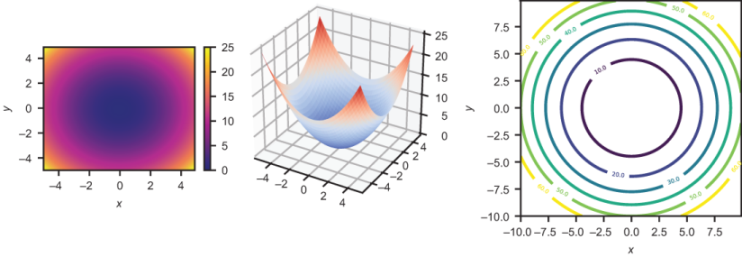 Figure 11.16 Three pictures of a scalar field: a heatmap, a graph, and a contour map
Example Calculation
To illustrate, consider the point ((x, y) = (3, 1)). The scalar field function ( U(x, y) = \frac{1}{2}(x^2 + y^2) ) produces a scalar value:
[ U(3, 1) = \frac{1}{2}(3^2 + 1^2) = \frac{1}{2}(9 + 1) = 5 ]
This calculation shows how the scalar field assigns a specific potential energy value to the point ((3, 1)).
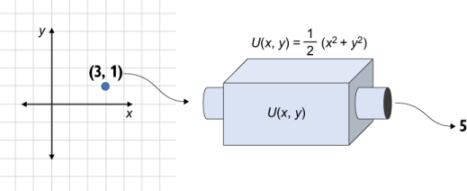 Figure 11.17 As a function, a scalar field takes a point in the plane and produces a corresponding number. In this case, where (x, y) = (3, 1), the value of U(x, y) is ½ · (32 + 12) = 5.
Graphical Representation
The graph of the potential energy scalar field ( U(x, y) = \frac{1}{2}(x^2 + y^2) ) resembles a bowl shape. This visualization helps in understanding how potential energy increases as the distance from the origin ((0, 0)) increases. In all radial directions, the height of the graph increases, indicating that the value of ( U ) increases.
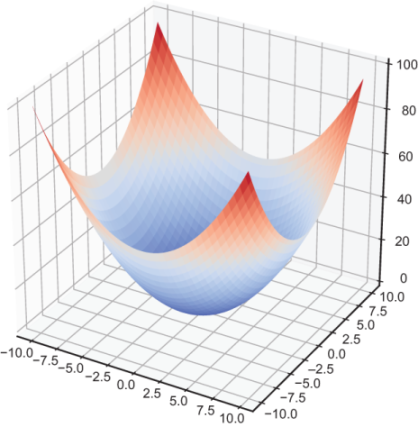 Figure 11.19 A graph of the potential energy scalar field U(x, y) = ½(x2 + y2)
Example: Signed Distance Function (SDF)
Another common example of a scalar field is the Signed Distance Function (SDF). The SDF assigns a distance value to each point in space, indicating how far that point is from a particular surface or curve. The sign of the distance value typically indicates whether the point is inside or outside the surface, with positive values representing points outside the surface and negative values for points inside. This characteristic makes SDFs particularly useful in computer graphics and computational geometry for tasks such as rendering and collision detection.
For more detailed information, refer to Exploring Math for Programmers and Data Scientists and Geometry for Programmers.
| Book Title | Usage of Scalar Field | Technical Depth | Connections to Other Concepts | Examples Used | Practical Application |
|------------|-----------------------|-----------------|-------------------------------|---------------|-----------------------|
| [Exploring Math for Programmers and Data Scientists](https://www.manning.com/books/exploring-math-for-programmers-and-data-scientists) | Discusses scalar fields in the context of physics and engineering, representing quantities like temperature and potential energy. [more](https://livebook.manning.com/book/exploring-math-for-programmers-and-data-scientists/chapter-11/205) | Provides a formal definition and visualizations such as 3D surfaces and contour maps. [more](https://livebook.manning.com/book/exploring-math-for-programmers-and-data-scientists/chapter-11/205) | Connects scalar fields to vector fields, illustrating their role in modeling physical phenomena. [more](https://livebook.manning.com/book/exploring-math-for-programmers-and-data-scientists/chapter-11/96) | Uses potential energy functions and visualizations like heatmaps and contour maps. [more](https://livebook.manning.com/book/exploring-math-for-programmers-and-data-scientists/chapter-11/102) | Demonstrates practical applications in physics, such as modeling gravitational fields. [more](https://livebook.manning.com/book/exploring-math-for-programmers-and-data-scientists/chapter-11/100) |
| [Geometry for Programmers](https://www.manning.com/books/geometry-for-programmers) | Describes scalar fields as functions assigning real numbers to points in space, crucial for geometric transformations. [more](https://livebook.manning.com/book/geometry-for-programmers/chapter-2/242) | Explains the domain and codomain of scalar fields in mathematical terms. [more](https://livebook.manning.com/book/geometry-for-programmers/chapter-2/242) | Highlights the importance of scalar fields in computer graphics and computational geometry. [more](https://livebook.manning.com/book/geometry-for-programmers/chapter-2/348) | Provides the example of Signed Distance Functions (SDF) for rendering and collision detection. [more](https://livebook.manning.com/book/geometry-for-programmers/chapter-2/214) | Focuses on applications in computer graphics, such as rendering and collision detection. [more](https://livebook.manning.com/book/geometry-for-programmers/chapter-2/214) |
FAQ (Frequently asked questions)
What is a scalar field?
What is the domain and codomain of a scalar field?
Can you give an example of a scalar field?
What is an example of a scalar field?
What does the signed distance function (SDF) do?
What is a scalar field in geometric transformations?
What is a scalar field?
How is a scalar field related to potential energy?
How does a scalar field function in a plane?
What is the value of the scalar field U(x, y) at the point (3, 1)?
What is an example of a scalar field function?
What does the scalar field function U(x, y) represent?
How can a scalar field be visualized?
What does a scalar field represent?
How is potential energy modeled in a scalar field?