Signed Distance
Overview
Signed distance is a concept used in geometry to measure the distance from a point to the nearest point on a shape's surface. The "signed" aspect of this distance indicates whether the point is inside or outside the shape. Specifically, a negative sign indicates that the point is inside the shape, while a positive sign indicates that the point is outside the shape. This concept is particularly useful in computational geometry and computer graphics for tasks such as collision detection, rendering, and shape analysis.
Calculation of Signed Distance
The signed distance from a point to a line can be calculated using geometric properties. The distance is determined by the area of a parallelogram formed by the point and the line, divided by the length of the line's base. This method provides a straightforward way to compute the signed distance in two-dimensional space.
Figure
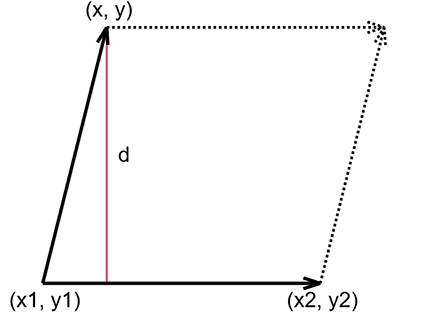 Figure 10.6 The signed distance d from the point (x, y) to the line that points (x1, y1) and (x2, y2) lie on is the parallelogram’s area divided by the base’s length.
Code Implementation
The following Python function demonstrates how to calculate the signed distance from a point to a line. The function signed_distance_p2l takes the coordinates of the point (x, y) and the coordinates of two points (x1, y1) and (x2, y2) that define the line. It uses the box2d function to calculate the area of the parallelogram and the distance_p2p function to calculate the length of the line.
def signed_distance_p2l(x, y, x1, y1, x2, y2):
    return box2d(x-x1, y-y1, x2-x1, y2-y1) / distance_p2p(x1, y1, x2, y2)
Listing: Signed distance from a point to a line
This function is a practical tool for determining the signed distance in applications that require precise geometric calculations.
FAQ (Frequently asked questions)
What is signed distance in geometry?
How is the signed distance from a point to a line calculated?
What is the Python function for calculating signed distance from a point to a line?