Softmax
The softmax function is a fundamental component in machine learning, particularly within neural networks and natural language processing. It is used to convert a vector of raw scores, or logits, into a probability distribution. This transformation is essential for tasks such as classification and attention mechanisms, where outputs need to be interpreted as probabilities.
Definition and Mathematical Expression
The softmax function transforms a vector of real numbers into a probability distribution. For a given vector ( x ), the softmax of ( x ) is a vector ( \sigma(x) ) where each element is calculated as:
[ \sigma(x)i = \frac{e^{x_i}}{\sum{j} e^{x_j}} ]
This formula ensures that the output vector is a valid probability distribution, with each element being a value between 0 and 1, and the sum of all elements equaling 1. This property is particularly useful in multi-class classification problems, where the goal is to assign probabilities to each class.
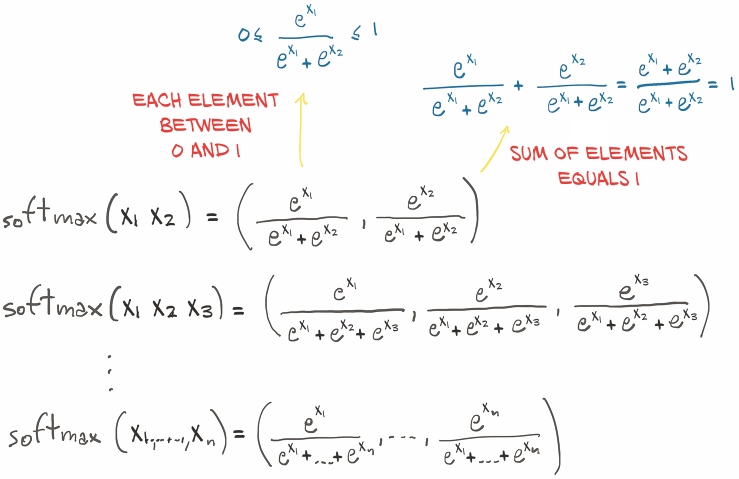 Figure 7.8 Handwritten softmax.
Implementation in PyTorch
The softmax function can be implemented in PyTorch using the torch.exp function to compute the exponentials and then normalizing by the sum of these exponentials. Here is a simple implementation:
import torch
from torch.nn.functional import softmax

# [Example scores](https://livebook.manning.com/book/math-and-architectures-of-deep-learning/chapter-9/98)
scores = torch.tensor([9.99, 10, 0.01, -10])

# [Compute softmax](https://livebook.manning.com/book/math-and-architectures-of-deep-learning/chapter-9/98)
output = softmax(scores, dim=0)
In this code snippet, the softmax function is applied to a tensor of scores, resulting in a probability distribution.
Applications
Classification Tasks
In neural networks, softmax is often used in the final layer to convert the network's output into a probability distribution over multiple classes. This allows the model to predict the likelihood of each class being the correct one for a given input.
Attention Mechanisms
In models like Transformers, softmax is used to compute attention weights, which determine the importance of different input elements when generating an output. By transforming raw scores into probabilities, softmax enables models to make interpretable predictions and decisions based on the input data.
Softmax and Cross-Entropy Loss
Softmax is frequently used in conjunction with cross-entropy (CE) loss, a popular loss function for training classifiers. The CE loss measures the difference between the predicted probability distribution and the true distribution (often represented as a one-hot vector).
Example
Consider an image classification problem where the goal is to classify images into one of four categories: cat, dog, airplane, or automobile. Suppose the true class of an image is "dog" (class 1), represented as a one-hot vector [0, 1, 0, 0]. If a classifier predicts the vector [0.498, 0.502, 0, 0], it indicates an almost equal probability for "cat" and "dog," which is a poor prediction, resulting in a high CE loss. Conversely, a prediction of [0.003, 0.997, 0, 0] shows high certainty for "dog," leading to a low CE loss. This example illustrates how softmax output and CE loss interact to evaluate the quality of predictions.
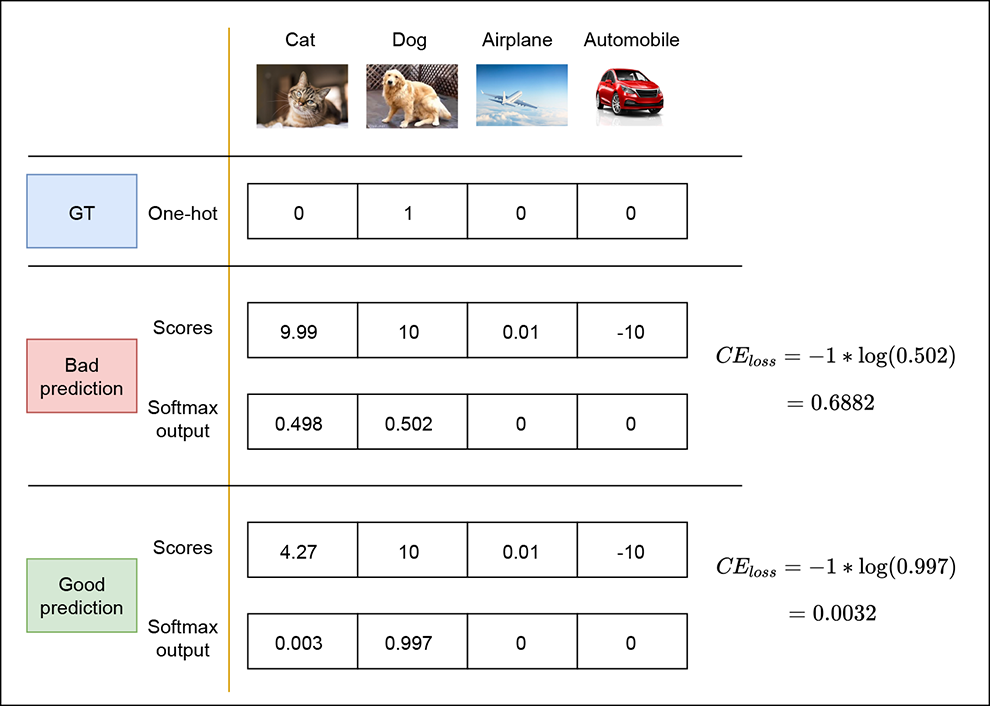 Figure 9.3 Softmax output and cross-entropy loss for good and bad output predictions.
In summary, the softmax function is a crucial tool in deep learning, providing a probabilistic interpretation of model predictions, which is essential for tasks involving classification and attention mechanisms.
Here's a markdown table comparing how different books discuss the term 'softmax':
| Book Title | Usage of Softmax | Technical Depth | Connections to Other Concepts | Examples Used | Practical Application |
|------------|------------------|-----------------|-------------------------------|---------------|-----------------------|
| Build a Large Language Model (From Scratch) | Discusses softmax in the context of neural networks and NLP, focusing on converting logits to probabilities for classification and attention mechanisms. more | Provides a naive implementation using PyTorch, explaining the transformation of input vectors into probability distributions. more | Connects softmax to classification tasks and attention mechanisms in models like Transformers. more | Includes a code snippet demonstrating softmax application to attention scores. more | Highlights applications in classification tasks and attention mechanisms. more |
| Deep Learning with PyTorch, Second Edition | Describes softmax as a function transforming vectors into probability distributions, useful in classifier output layers. more | Explains the mathematical expression and properties of softmax, including monotonicity and scale invariance. more | Discusses softmax in the context of neural network architectures and its use with PyTorch's nn module. more | Provides example usage with PyTorch, showing how to apply softmax to input vectors. more | Demonstrates softmax in model architectures for classification tasks. more |
| Math and Architectures of Deep Learning | Highlights softmax's role in transforming scores into probabilities for classification problems. more | Discusses the mathematical operation of softmax and its implementation in PyTorch. more | Links softmax with cross-entropy loss, explaining their interaction in evaluating prediction quality. more | Provides an example of softmax and cross-entropy loss in an image classification problem. more | Emphasizes softmax's importance in classification tasks, offering a probabilistic interpretation of predictions. more |
FAQ (Frequently asked questions)
What is the softmax function?
How is softmax used in classifiers?
What does Figure 7.8 in the book illustrate?
How is the softmax function implemented in PyTorch?
What is the output of the softmax function for the input tensor [1.0, 2.0, 3.0]?
What is the sum of the elements of the softmax output?
How can you generate names using a uniform distribution in PyTorch?
What does torch.multinomial do in the context of generating names?