Sound
Overview
Sound, in the context of programming and data science, refers to the audio output produced by a sequence of numbers interpreted as a sound wave. These numbers represent the intensity of the sound wave at each point in time. Using tools like PyGame, an array of numbers can be converted into sound, allowing for the creation and manipulation of audio.
Sound is fundamentally a wave created by vibrating objects and propagated through a medium, such as air. It is a form of energy that travels as a wave and can be mathematically represented using sinusoidal functions. This wave is perceived as pressure changes over time that propagate through the air to our ears. These changes can be represented as sound waves, which are functions of air pressure over time.
The Physics of Sound
Sound waves are not the air pressure itself but rather rapid changes in air pressure that cause our eardrums to vibrate. For example, when playing a violin, dragging the bow across a string causes the string to vibrate. This vibration causes the air around it to rapidly change pressure, and these changes propagate through the air as sound waves until they reach the ear. At that point, the eardrum vibrates at the same rate, and a sound is perceived.
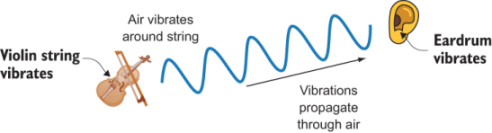 Figure 13.1 Schematic diagram of the sound of a violin reaching an eardrum
Digital Representation of Sound
A digital audio file can be thought of as a function describing a vibration over time. Audio software interprets this function and instructs speakers to vibrate accordingly, producing sound waves of a similar shape in the air around the speakers. This function can be loosely interpreted as describing air pressure over time.
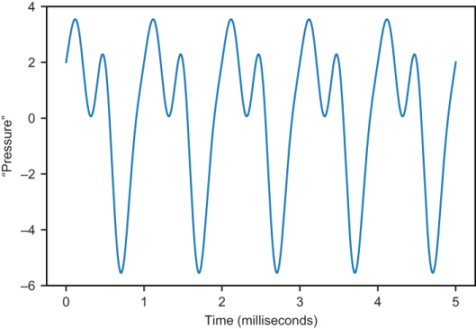 Figure 13.2 Thinking of sound waves as functions, loosely interpreted as representing pressure over time
Interesting sounds, such as musical notes, have sound waves with repeating patterns. The rate at which the function repeats itself is called the frequency, which determines how high or low the musical note sounds. The quality, or timbre, of the sound is controlled by the shape of the repeating pattern, influencing whether it sounds more like a violin, a trumpet, or a human voice.
Manipulating Sound
Sound can be manipulated by combining different sound waves to create new sounds, such as musical chords. This manipulation allows for the creation of complex audio experiences and is a fundamental aspect of music production and sound design. By understanding the mathematical representation of sound waves, programmers and data scientists can create, analyze, and modify audio in innovative ways.
FAQ (Frequently asked questions)
How can sound be produced using a sequence of numbers?
What tool can be used to convert an array of numbers into sound?
What is sound in terms of wave propagation?
How can sound be represented mathematically?
What is sound in terms of energy?
How can new sounds be created?
How is sound perceived by humans?
How can sound waves be represented?