Spam Classification
Spam classification is a crucial task in natural language processing, aimed at distinguishing between spam and non-spam messages. This process involves using a fine-tuned GPT-based model to predict whether a given text is spam or not. The model is trained to output an integer class label, which is then interpreted as either 'spam' or 'not spam'.
Overview of the Process
The spam classification process involves several key steps:
-
Preprocessing Text Data: The input text is first preprocessed to convert it into a format suitable for the model. This involves tokenizing the text to convert it into token IDs.
-
Model Inference: The preprocessed text is fed into the model, which predicts an integer class label. This label is then mapped to a human-readable class name ('spam' or 'not spam').
-
Classification Function: The
classify_reviewfunction is central to this process. It handles the preprocessing, model inference, and interpretation of results.
The classify_review Function
The classify_review function is designed to classify text as either 'spam' or 'not spam'. Below is the implementation of this function:
Listing 6.12 Using the model to classify new texts
def classify_review(
        text, model, tokenizer, device, max_length=None,
        pad_token_id=50256):
    model.eval()

    input_ids = tokenizer.encode(text)          #1
    supported_context_length = model.pos_emb.weight.shape[1]

    input_ids = input_ids[:min(              #2
        max_length, supported_context_length
    )]

    input_ids += [pad_token_id] * (max_length - len(input_ids))    #3

    input_tensor = torch.tensor(
        input_ids, device=device
    ).unsqueeze(0)              #4

    with torch.no_grad():                                #5
        logits = model(input_tensor)[:, -1, :]     #6
    predicted_label = torch.argmax(logits, dim=-1).item()

    return "spam" if predicted_label == 1 else "not spam"     #7
#1 Prepares inputs to the model
#2 Truncates sequences if they are too long
#3 Pads sequences to the longest sequence
#4 Adds batch dimension
#5 Models inference without gradient tracking
#6 Logits of the last output token
#7 Returns the classified result
Explanation of the Function
-
Input Preparation: The function begins by encoding the input text into token IDs using a tokenizer. This step is crucial for converting the text into a numerical format that the model can process.
-
Truncation and Padding: The function ensures that the input sequence is of a suitable length by truncating it if it's too long or padding it if it's too short. This is done to match the model's expected input size.
-
Model Inference: The function performs inference using the model in evaluation mode, which means it does not track gradients. This is more efficient and suitable for prediction tasks.
-
Output Interpretation: The logits from the model's output are used to determine the predicted class label. The function then returns 'spam' if the predicted label is 1, otherwise 'not spam'.
Fine-Tuning and Classification
The process of fine-tuning the model for spam classification involves several stages, as illustrated in the following figure:
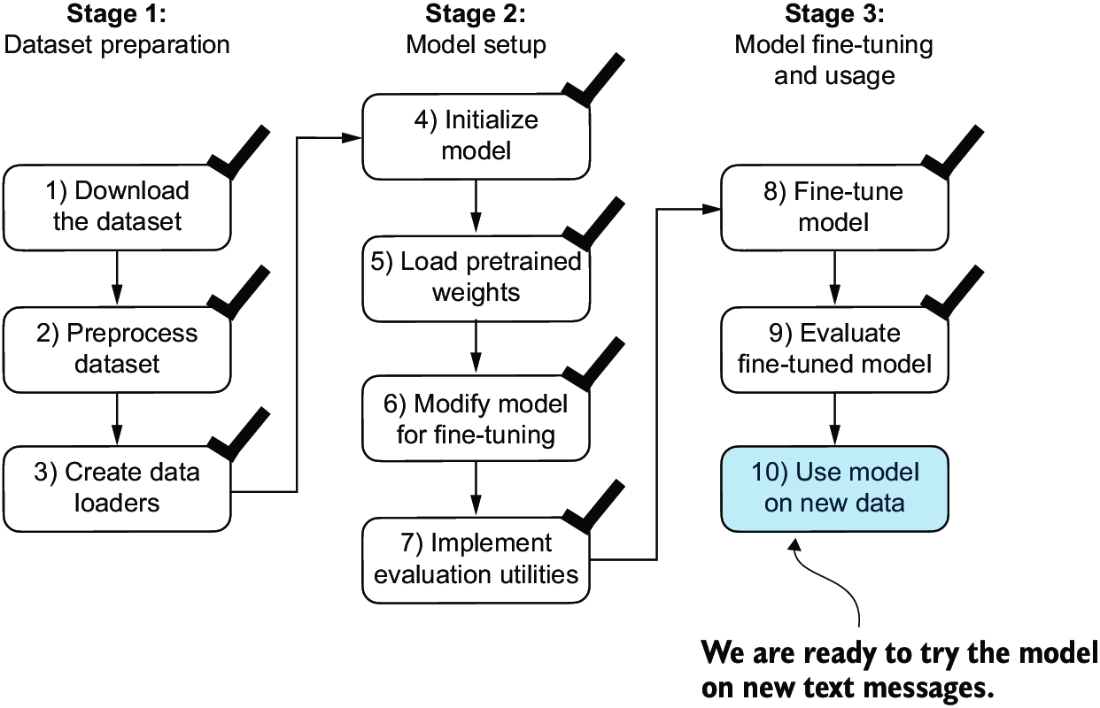 Figure 6.18 The three-stage process for classification fine-tuning our LLM. Step 10 is the final step of stage 3—using the fine-tuned model to classify new spam messages.
This figure outlines the three-stage process for fine-tuning a large language model (LLM) for classification tasks. The final step involves using the fine-tuned model to classify new spam messages, which is the focus of the classify_review function.