Subspace
Overview
A subspace is a vector space contained within another vector space. It is a subset of vectors that itself forms a vector space, meaning it is closed under linear combinations. This closure property ensures that any linear combination of vectors within the subspace remains within the subspace. The dimension of a subspace is defined by its basis, which is the number of vectors required to span the subspace. This dimension indicates the number of independent directions within the subspace.
Definition
A subspace of a vector space is a subset of vectors that satisfies the properties of a vector space. This means that for any vectors ( u ) and ( v ) in the subspace, and any scalars ( a ) and ( b ), the vector ( au + bv ) is also in the subspace. This property ensures that the subspace is closed under addition and scalar multiplication.
Examples
Lines and Planes
-
Line in ℝ²: An example of a subspace is the line where ( y = 0 ) in ℝ². This line is a 1D subspace consisting of all linear combinations of its points. For any line through the origin in 2D or 3D, the set of vectors that lie on it form a 1D subspace.
-
Plane in 3D: For any plane through the origin in 3D, the vectors that lie on it form a 2D subspace. For instance, the plane where ( z = 0 ) in 3D space is a subspace.
Vector Space Functions
Subspaces can also be formed by functions. For example, linear functions form a 2D subspace, while quadratic functions form a 3D subspace. These function spaces are subspaces of the larger space of all possible functions.
Images
In the context of images, subspaces can be formed by reducing dimensions. For example, converting a high-resolution image to a low-resolution grayscale image can form a 900-dimensional subspace, depending on the resolution.
Starting with Single Vectors
A subspace can be formed starting with a single vector by considering all scalar multiples of that vector. These multiples lie on a line through the origin, forming a 1D subspace.
Spanning Bigger Spaces
To span bigger spaces, a set of vectors is used to cover a larger vector space. For example, two non-parallel vectors can span a 2D plane. The concept of spanning is crucial in understanding how subspaces can be constructed and how they relate to the larger vector space.
Dimension Definition
The dimension of a subspace is the number of vectors in a basis for that subspace. A basis is a set of vectors that are linearly independent and span the subspace. The dimension indicates the number of independent directions in the subspace.
Finding Subspaces
Finding subspaces involves identifying subsets of a vector space that are closed under linear combinations. This process often involves checking the closure properties and ensuring that the subset satisfies the axioms of a vector space.
Visual Representation
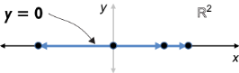 Figure 6.15 Focusing on the line where y = 0. This is a vector space, containing all linear combinations of its points.
This figure illustrates a simple example of a subspace, focusing on the line where ( y = 0 ). This line is a vector space in its own right, containing all linear combinations of its points.
FAQ (Frequently asked questions)
What is a subspace in a vector space?
What does Figure 6.15 illustrate about subspaces?
Can you give an example of a subspace in \mathbb{R}^2?
How can a subspace be formed from a single vector?
How can you span a bigger vector space?
What does the dimension of a subspace represent?
How do you find subspaces in a vector space?
What are examples of subspaces in the vector space of functions?
How can subspaces be formed in the context of images?
What is a subspace of a vector space?
What forms a 1D subspace in 2D or 3D?
What forms a 2D subspace in 3D?