Surface
The term "surface" is a versatile concept that appears in various fields such as geometry, computer graphics, machine learning, and 3D printing. It generally refers to a two-dimensional manifold that can exist in three-dimensional space or higher-dimensional spaces. Surfaces are crucial for modeling, visualization, and understanding complex structures and functions.
Surfaces in 3D Geometry
In 3D geometry, a surface is a transformation of a 2D plane into a 3D space. This transformation is typically expressed as a function of two variables, ( u ) and ( v ), which map to a 3D point ((x, y, z)). Surfaces can be either open or closed and are essential in 3D modeling for creating complex shapes by manipulating 2D planes. They are used extensively in computer graphics, animation, and virtual reality to create intricate and realistic models.
3D Modeling
Surfaces in 3D modeling are created by transforming 2D planes into 3D shapes through mathematical functions. This involves defining a function that maps points from a 2D domain ((u, v)) to a 3D space ((x, y, z)). This mapping allows for the creation of complex surfaces, which are crucial in various applications such as computer graphics, animation, and virtual reality.
Examples of Surfaces
An example of a surface is the procedurally generated landscape in digital applications, where the terrain is represented as a function graph. Another example is the creation of a mushroom shape as a surface of revolution, showcasing how surfaces can be employed to model organic and natural forms.
Surface Representation in CAD and CAE
In CAD (Computer-Aided Design) and CAE (Computer-Aided Engineering), boundary representation is the predominant method for modeling surfaces. A specific case of boundary representation is the triangle mesh, which is significant due to its compatibility with modern hardware. Triangle meshes are extensively used in applications where rendering speed is crucial, such as games, augmented and virtual reality, and computer-generated imagery.
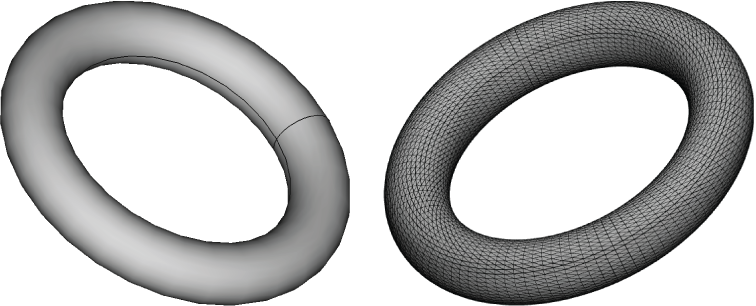 Figure 11.1 A torus described as a smooth surface (left) and as a triangle mesh of ~10,000 triangles (right)
Surfaces in 3D Printing
Traditionally, 3D printing has relied on triangle meshes, with the STL format being a prominent example. However, advancements in 3D printing technology have led to a shift towards more curve-ready printers, particularly in industrial manufacturing, where smooth-surface CAD data is becoming more prevalent.
Surfaces in Machine Learning
In machine learning, particularly in classification tasks, a surface refers to a decision boundary that delineates different classes within a high-dimensional space. This boundary can take the form of a hyperplane or a more intricate hypersurface, depending on the complexity of the classification problem. Surfaces are pivotal in understanding how different classes are separated in machine learning models, especially in deep learning where the dimensionality of data can be exceedingly high.
Convex Surfaces
A convex surface is characterized by the property that for any two points on the surface, the line segment connecting them lies above the surface itself. This property implies that the surface is always positioned above its tangent plane at any given point. Convex surfaces are significant in optimization problems, as they ensure that any local minimum is also a global minimum, simplifying the process of finding optimal solutions in machine learning models. Understanding the nature of these surfaces aids in the design of more efficient and effective learning models.
In summary, the concept of a surface is integral to various domains, providing a foundation for modeling, visualization, and analysis in both physical and abstract spaces.
| Book Title | Usage of Surface | Technical Depth | Connections to Other Concepts | Examples Used | Practical Application |
|------------|------------------|-----------------|-------------------------------|---------------|-----------------------|
| [Geometry for Programmers](https://www.manning.com/books/geometry-for-programmers) | Discusses surfaces as transformations of 2D planes into 3D space, essential for 3D modeling. [more](https://livebook.manning.com/book/geometry-for-programmers/chapter-8/1) | Explores mathematical functions for mapping 2D to 3D, boundary representation, and triangle meshes. [more](https://livebook.manning.com/book/geometry-for-programmers/chapter-8/133) | Connects to CAD, CAE, and 3D printing, emphasizing the role of surfaces in these fields. [more](https://livebook.manning.com/book/geometry-for-programmers/chapter-8/1) | Includes examples like procedurally generated landscapes and surfaces of revolution. [more](https://livebook.manning.com/book/geometry-for-programmers/chapter-8/1) | Highlights applications in computer graphics, animation, virtual reality, and 3D printing. [more](https://livebook.manning.com/book/geometry-for-programmers/chapter-8/133) |
| [Math and Architectures of Deep Learning](https://www.manning.com/books/math-and-architectures-of-deep-learning) | Defines surfaces as decision boundaries in high-dimensional spaces for classification. [more](https://livebook.manning.com/book/math-and-architectures-of-deep-learning/chapter-3/198) | Discusses hyperplanes and hypersurfaces, and the role of convex surfaces in optimization. [more](https://livebook.manning.com/book/math-and-architectures-of-deep-learning/chapter-3/199) | Relates to machine learning, particularly in understanding class separation and optimization. [more](https://livebook.manning.com/book/math-and-architectures-of-deep-learning/chapter-3/41) | Uses the concept of convex surfaces to explain optimization in learning models. [more](https://livebook.manning.com/book/math-and-architectures-of-deep-learning/chapter-3/199) | Applies to designing efficient learning models and ensuring stability in deep learning processes. [more](https://livebook.manning.com/book/math-and-architectures-of-deep-learning/chapter-3/199) |
FAQ (Frequently asked questions)
What is a surface in 3D modeling?
How are surfaces used in 3D modeling?
What types of surfaces exist in 3D modeling?
What is an example of a surface in 3D modeling?
How is a mushroom shape created in 3D modeling?
How is a surface created in 3D modeling?
What is the role of a function in creating a surface in 3D modeling?