System of Linear Equations
Overview
A system of linear equations is a collection of linear equations involving the same set of variables. The goal is to find a set of values that satisfy all the equations simultaneously. These systems are often represented in matrix notation, which allows for efficient computation and solution methods. In the context of linear algebra, solving a system of linear equations is crucial for tasks such as finding intersection points of lines, changing basis, and generalizing to higher dimensions.
Matrix Representation
Systems of linear equations can be expressed in matrix form, which is particularly useful for computational purposes. For example, a system of M linear equations with N unknowns can be written as:
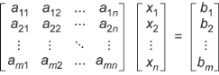 Figure 7.26 A system of M linear equations with N unknowns written in matrix form
Finding Intersection Points of Lines
One common application of systems of linear equations is finding the intersection points of lines. This involves representing the lines in standard form and solving the system of equations to find the point where the lines intersect. For example, consider the system:
- x − y = 0
- x + 2y = 8
Solving this system yields the intersection point of the two lines.
Generalizing to Higher Dimensions
Systems of linear equations can be extended to higher dimensions by increasing the number of variables and equations. In n dimensions, these systems can still be represented in matrix form, allowing for efficient solution methods. For instance, in three dimensions, a system might look like:
- x + y - z = -1
- 2y - z = 3
- x + z = 2
Solving this system involves finding the intersection point of the planes represented by these equations.
Changing Basis
Changing basis in linear algebra involves expressing a vector in terms of a new set of basis vectors. This can be achieved by solving a system of linear equations where the unknowns are the coefficients of the linear combination of the new basis vectors. For example, to express the vector (4, 2) in terms of the basis vectors u1 = (1, 1) and u2 = (−1, 1), we solve the equations:
- c - d = 4
- c + d = 2
The solution gives the coordinates (3, -1) of the vector in the new basis.
Example in 3D
An example of solving a system of linear equations in 3D involves finding the linear combination of the basis vectors (1, 0, 1), (−1, −1, 0), and (0, −1, 2) that yields the vector (1, 3, −7). Using NumPy, the solution is found to be x = 3, y = 2, and z = −5, meaning the vector (1, 3, −7) has coordinates (3, 2, -5) with respect to the given basis.
Computational Solutions
Solving systems of linear equations computationally can be efficiently done using libraries such as NumPy. For instance, NumPy's numpy.linalg.solve function can be used to solve systems of equations represented in matrix form. This is particularly useful for large systems or when precision is critical.
Visual Representation
The problem of solving a system of linear equations can be visualized as finding an input vector that yields the desired output vector:
 Figure 7.14 Framing the problem as finding an input vector that yields the desired output vector
FAQ (Frequently asked questions)
What is a system of linear equations?
How is the solution to a system of linear equations found?
How can a system of linear equations be represented?
What is the purpose of solving systems of linear equations in the chapter?
Can you provide an example of a system of linear equations?
What is the system of linear equations used for in the example?
How are intersection points of lines found?
How can a system of linear equations in 3D be represented?
What does solving a system of linear equations in 3D involve?
How can systems of linear equations be generalized to higher dimensions?
What is the role of solving systems of linear equations in changing basis?
How can every system of linear equations be thought of?
How is a system of linear equations in 3D solved in the chapter?
What are the coordinates of the vector (1, 3, -7) with respect to the given basis?
How is changing basis achieved by solving linear equations?
How can the vector (4, 2) be expressed in terms of new basis vectors?
What does solving a system of linear equations involve?
What is equivalent to solving a system of two linear equations?
What tool can be used to solve systems of linear equations?