Test Set
A test set is a fundamental component in the evaluation process of machine learning models, including large language models (LLMs). It is a distinct subset of data that is held out from the training process and is used exclusively to assess the model's performance after training. The test set provides an unbiased evaluation of the model's ability to generalize to new, unseen data, which is crucial for ensuring the model's effectiveness in real-world applications.
Role in Instruction Fine-Tuning
In the context of building and fine-tuning large language models, the test set is integral to the final stage of instruction fine-tuning. This process involves several stages, with the test set playing a critical role in the final evaluation:
- Model Training: Initially, the model is trained with a specific set of instructions and data.
- Response Collection: During the first two steps of the final stage, the model's responses are extracted and collected from the held-out test dataset. This step is crucial for analyzing how the model performs on unseen data.
- Performance Evaluation: The final step involves evaluating the model using the test set to quantify the performance of the instruction-fine-tuned LLM. This evaluation helps determine the model's accuracy, generalization capabilities, and overall effectiveness in handling the tasks it was fine-tuned for.
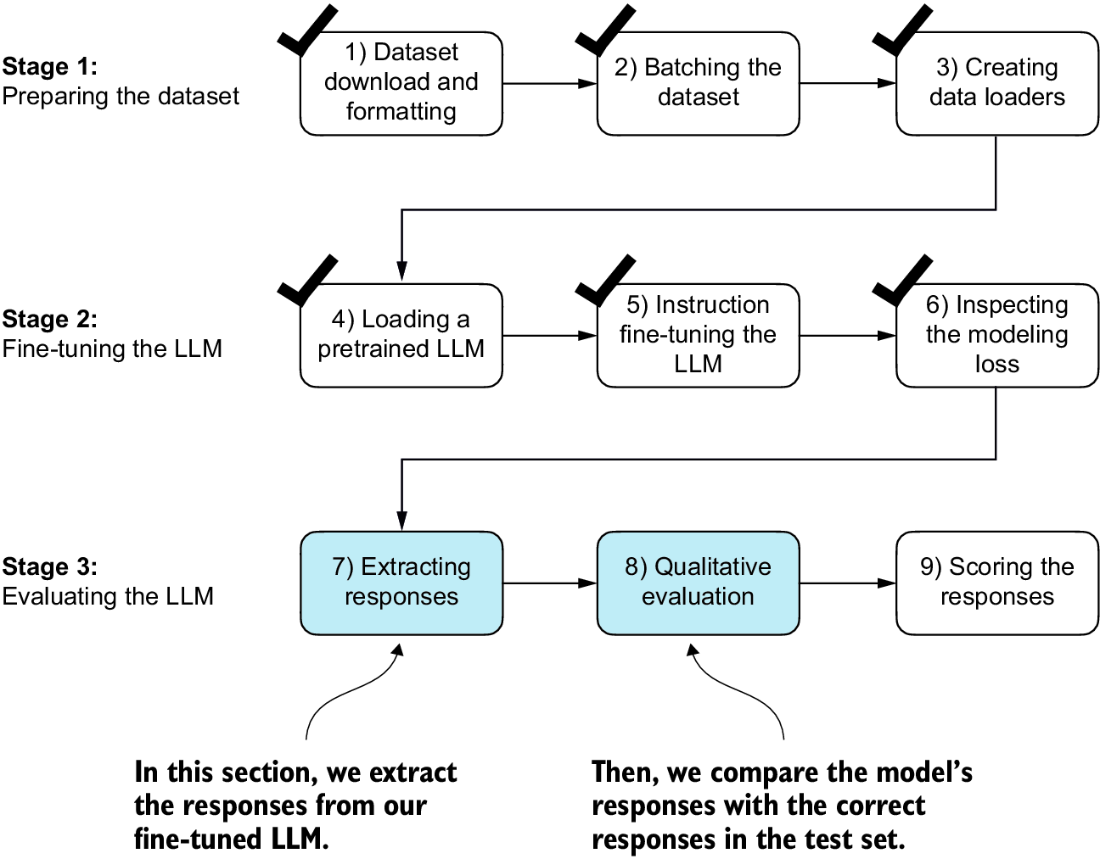 Figure 7.18 The three-stage process for instruction fine-tuning the LLM. In the first two steps of stage 3, we extract and collect the model responses on the held-out test dataset for further analysis and then evaluate the model to quantify the performance of the instruction-fine-tuned LLM.
Importance of the Test Set
The test set is essential for providing an unbiased evaluation of the model's performance. By using data that the model has not seen during training, developers can ensure that the model's performance metrics are not inflated by overfitting to the training data. This helps in assessing the true generalization ability of the model to new, unseen data.
In practice, the data is typically divided into three main subsets: the training set, the validation set, and the test set. The training set is used to fit the model, the validation set is used to fine-tune the model's hyperparameters, and the test set is used for the final evaluation. This division helps in building robust models that perform well not only on the data they were trained on but also on new, unseen data.
In summary, the test set is a critical component in the development and fine-tuning of large language models, providing a reliable means to evaluate and validate the model's performance and ensuring its readiness for deployment in real-world applications.
For more detailed information, you can refer to the following resources:
| Book Title | Usage of Test Set | Technical Depth | Connections to Other Concepts | Examples Used | Practical Application |
|------------|-------------------|-----------------|-------------------------------|---------------|-----------------------|
| [Build a Large Language Model (From Scratch)](https://www.manning.com/books/build-a-large-language-model-from-scratch) | Discusses the role of the test set in instruction fine-tuning and performance evaluation of LLMs. [more](https://livebook.manning.com/book/build-a-large-language-model-from-scratch/chapter-7/176) | Detailed explanation of the three-stage process for instruction fine-tuning, including model training, response collection, and performance evaluation. [more](https://livebook.manning.com/book/build-a-large-language-model-from-scratch/chapter-7/176) | Connects the test set to concepts like model accuracy, generalization capabilities, and overfitting. [more](https://livebook.manning.com/book/build-a-large-language-model-from-scratch/chapter-7/176) | Uses figures and stages to illustrate the process of using a test set in LLM fine-tuning. [more](https://livebook.manning.com/book/build-a-large-language-model-from-scratch/chapter-7/176) | Emphasizes the importance of the test set in ensuring model readiness for real-world applications. [more](https://livebook.manning.com/book/build-a-large-language-model-from-scratch/chapter-7/176) |
| [Deep Learning with PyTorch, Second Edition](https://www.manning.com/books/deep-learning-with-pytorch-second-edition) | Highlights the test set as a crucial component for unbiased model evaluation and generalization. [more](https://livebook.manning.com/book/deep-learning-with-pytorch-second-edition/chapter-5/237) | Explains the division of data into training, validation, and test sets, and their respective roles. [more](https://livebook.manning.com/book/deep-learning-with-pytorch-second-edition/chapter-5/237) | Discusses the test set in the context of preventing overfitting and ensuring model robustness. [more](https://livebook.manning.com/book/deep-learning-with-pytorch-second-edition/chapter-5/237) | Provides a practical framework for data division to build robust models. [more](https://livebook.manning.com/book/deep-learning-with-pytorch-second-edition/chapter-5/237) | Focuses on the test set's role in simulating real-world scenarios for model evaluation. [more](https://livebook.manning.com/book/deep-learning-with-pytorch-second-edition/chapter-5/237) |
FAQ (Frequently asked questions)
What is a test set in machine learning?
How is a test set different from training and validation sets?
What is the purpose of a test set?