Tokenization in Large Language Models (LLMs)
Tokenization is a critical preprocessing step in the development and application of large language models (LLMs) and natural language processing (NLP) tasks. It involves breaking down raw text into smaller, manageable units called tokens. These tokens can be words, subwords, or special characters like punctuation. The process of tokenization is essential for converting text into numerical representations that can be processed by machine learning models, enabling them to understand and generate human language.
Tokenization Process
Tokenization serves as the bridge between raw text and numerical data, which is necessary for machine learning models. The primary goal is to split text into units that can be easily processed by algorithms. This step is crucial because most models require numerical input, and tokenization facilitates this transformation.
Implementation Techniques
Tokenization can be effectively implemented using programming languages like Python, utilizing libraries such as regular expressions to handle various punctuation marks and whitespace characters. This ensures that the text is split into meaningful components, transforming a continuous stream of text into discrete units that a model can process.
For example, a simple tokenizer can be implemented to handle unknown words and special characters. Below is a Python class SimpleTokenizerV2 that demonstrates this:
class SimpleTokenizerV2:
    def __init__(self, vocab):
        self.str_to_int = vocab
        self.int_to_str = { i:s for s,i in vocab.items()}

    def encode(self, text):
        preprocessed = re.split(r'([,.:;?_!\"()\\']|--|\\s)', text)
        preprocessed = [
            item.strip() for item in preprocessed if item.strip()
        ]
        preprocessed = [item if item in self.str_to_int
                        else "<|unk|>" for item in preprocessed]

        ids = [self.str_to_int[s] for s in preprocessed]
        return ids

    def decode(self, ids):
        text = " ".join([self.int_to_str[i] for i in ids])

        text = re.sub(r'\\s+([,.:;?!\"()\\'])', r'\\1', text)
        return text
This class includes methods for encoding and decoding text, where the encode method splits the text into tokens, replaces unknown words with <|unk|> tokens, and converts the tokens into their corresponding IDs. The decode method reconstructs the text from token IDs, ensuring proper spacing around punctuation.
Levels of Tokenization
Tokenization can be performed at different levels of granularity, depending on the requirements of the task:
-
Word-level tokenization: Splits text into individual words. This approach is straightforward but may not handle out-of-vocabulary words or morphological variations effectively.
-
Subword-level tokenization: Breaks down words into smaller units, such as prefixes, suffixes, or even individual characters. This method is particularly useful for handling rare words and capturing morphological nuances.
The choice of tokenization strategy can significantly impact the performance of NLP models, as it influences how well the model can capture the semantics and structure of the input text.
Practical Example
To illustrate the tokenization process, consider reading a short story from a text file and tokenizing it:
with open("the-verdict.txt", "r", encoding="utf-8") as f:
    raw_text = f.read()
print("Total number of character:", len(raw_text))
print(raw_text[:99])
This code snippet reads the content of a file named "the-verdict.txt" and prints the total number of characters along with the first 99 characters of the text. This raw text can then be tokenized using a tokenizer like SimpleTokenizerV2.
Figures
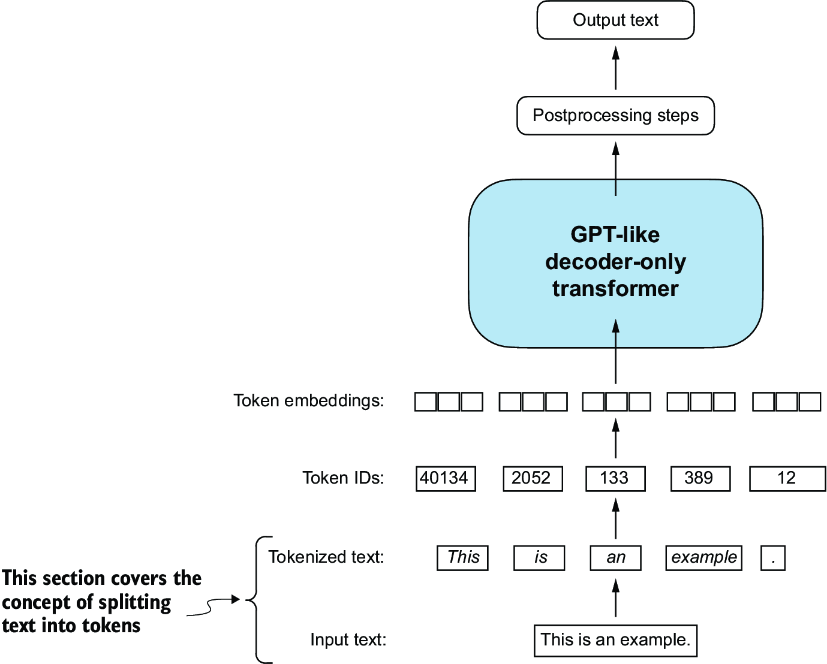 Figure 2.4 A view of the text processing steps in the context of an LLM. Here, we split an input text into individual tokens, which are either words or special characters, such as punctuation characters.
For more detailed information, you can refer to the following resources:
| Book Title | Usage of Tokenization | Technical Depth | Connections to Other Concepts | Examples Used | Practical Application |
|------------|-----------------------|-----------------|-------------------------------|---------------|-----------------------|
| [Build a Large Language Model (From Scratch)](https://www.manning.com/books/build-a-large-language-model-from-scratch) | Discusses tokenization as a preprocessing step for LLMs, focusing on splitting text into tokens for embeddings. [more](https://livebook.manning.com/book/build-a-large-language-model-from-scratch/chapter-2/24) | Provides detailed implementation using Python's regex library, including handling punctuation and whitespace. [more](https://livebook.manning.com/book/build-a-large-language-model-from-scratch/chapter-2/24) | Connects tokenization to text processing and embedding creation in LLMs. [more](https://livebook.manning.com/book/build-a-large-language-model-from-scratch/chapter-2/24) | Includes code examples for reading and tokenizing text, and implementing a simple tokenizer. [more](https://livebook.manning.com/book/build-a-large-language-model-from-scratch/chapter-2/1) | Demonstrates practical tokenization and detokenization processes with code snippets. [more](https://livebook.manning.com/book/build-a-large-language-model-from-scratch/chapter-2/24) |
| [Deep Learning with PyTorch, Second Edition](https://www.manning.com/books/deep-learning-with-pytorch-second-edition) | Describes tokenization as a process to convert text into tokens for machine learning models. [more](https://livebook.manning.com/book/deep-learning-with-pytorch-second-edition/chapter-9/158) | Explains different levels of tokenization granularity, such as word-level and subword-level. [more](https://livebook.manning.com/book/deep-learning-with-pytorch-second-edition/chapter-9/158) | Highlights the impact of tokenization strategy on NLP model performance. [more](https://livebook.manning.com/book/deep-learning-with-pytorch-second-edition/chapter-9/158) | Discusses common tokenization approaches but lacks specific code examples. [more](https://livebook.manning.com/book/deep-learning-with-pytorch-second-edition/chapter-9/158) | Focuses on the importance of tokenization in preparing data for machine learning models. [more](https://livebook.manning.com/book/deep-learning-with-pytorch-second-edition/chapter-9/158) |
FAQ (Frequently asked questions)
What is tokenization in machine learning?
Why is tokenization important for machine learning models?