Vector Field
A vector field is a fundamental concept in mathematics and physics, representing a function that assigns a vector to every point in a given space. This vector typically indicates both the direction and magnitude of a force or other quantity at that point. Vector fields are extensively used in various scientific and engineering disciplines to model phenomena such as gravitational forces, fluid dynamics, and electromagnetic fields.
Overview
A vector field can be defined in any dimensional space. In a two-dimensional space, a vector field assigns a vector to each point \((x, y)\), while in three-dimensional space, it assigns a vector to each point \((x, y, z)\). The concept can be generalized to an M-dimensional vector field in an N-dimensional space, where the domain is ℝN and the codomain is ℝM. This mathematical construct is crucial for representing directions and magnitudes at each point in space and is a key component in geometric transformations.
Examples of Vector Fields
Gravitational Field
One of the most common examples of a vector field is the gravitational field. In this context, the vector at each point in space indicates the direction and magnitude of the gravitational force experienced at that location. For instance, the gravitational field around a black hole can be visualized with vectors pointing toward the black hole, representing the gravitational pull's direction and strength.
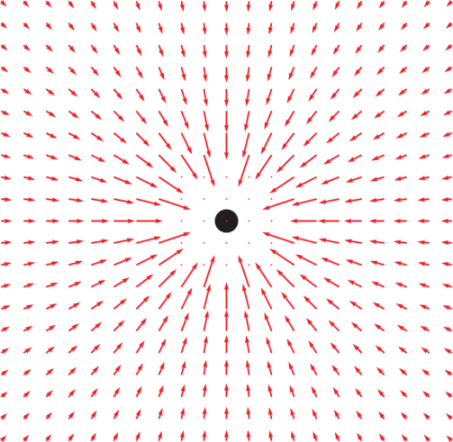 Figure 11.2 Picturing the gravitational field created by the black hole in our asteroid game
Fluid Dynamics
In fluid dynamics, vector fields are used to represent the flow rate of fluid in a reservoir. This vector field indicates the direction and rate of fluid flow at different locations within the reservoir, which is essential for modeling fluid dynamics in applications like oil extraction.
Visualization of Vector Fields
Vector fields can be visualized by plotting vectors (arrows) at various points in space. These arrows indicate the direction and magnitude of the vector field at those points. Although a vector field can be continuous, it is often depicted as discrete vectors sticking out of a plane at regular intervals. This conventional representation requires imagining the vectors that exist between the depicted ones to fully grasp the continuity of the field.
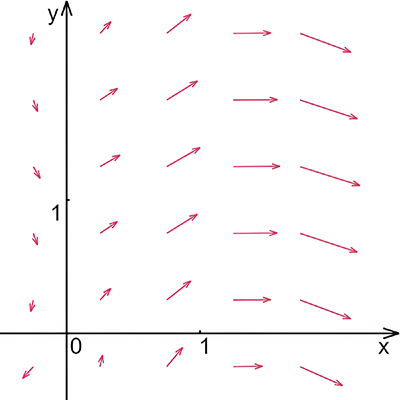 Figure 2.24 An illustration of a vector field. You have to imagine that it’s continuous.
For example, the following Python code snippet defines a simple vector field and plots it using a function plot_vector_field:
def f(x, y):
    return (-2*y, x)

plot_vector_field(f, -5, 5, -5, 5)  #1
#1 The first argument is the vector field; the next arguments are the x bounds followed by the y bounds for the plot.
This code defines a vector field where each vector is determined by the function \(f(x, y) = (-2y, x)\). The plot_vector_field function then visualizes this field over a specified range of \(x\) and \(y\) values.
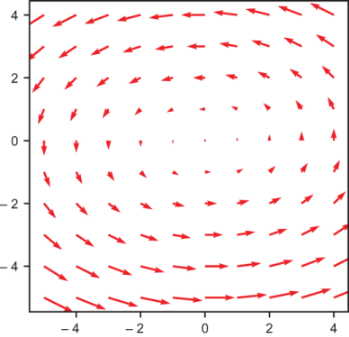 Figure 11.10 A plot of F(x, y) as vectors emanating from (x, y) points that are generated by Matplotlib
Deformation Field
A specific type of vector field used in geometric transformations is known as a deformation field. This field provides a rule for translating or moving points within a space based on their positions. It effectively describes how a space can be manipulated, such as moving, bending, or stretching objects within it.
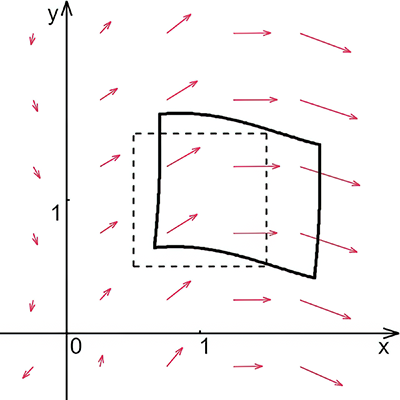 Figure 2.25 The vector field from figure 2.24 used as a deformation field. It moves, bends, and stretches the square.
In Figure 2.25, the vector field from Figure 2.24 is utilized as a deformation field, demonstrating its effect on a square. The field indicates that some points may be moved significantly, while others may remain relatively stationary. Despite the discrete representation, the field itself can be continuous, requiring an imaginative extension beyond the visible vectors.
| Book Title | Usage of Vector Field | Technical Depth | Connections to Other Concepts | Examples Used | Practical Application |
|------------|-----------------------|-----------------|-------------------------------|---------------|-----------------------|
| [Exploring Math for Programmers and Data Scientists](https://www.manning.com/books/exploring-math-for-programmers-and-data-scientists) | Discusses vector fields in the context of physics and engineering, modeling phenomena like gravitational forces and fluid dynamics. [more](https://livebook.manning.com/book/exploring-math-for-programmers-and-data-scientists/chapter-11/1) | Provides a detailed explanation of vector fields in 2D and 3D spaces, including mathematical definitions and visualizations. [more](https://livebook.manning.com/book/exploring-math-for-programmers-and-data-scientists/chapter-11/34) | Connects vector fields to concepts in physics, such as gravitational fields and fluid dynamics. [more](https://livebook.manning.com/book/exploring-math-for-programmers-and-data-scientists/chapter-11/1) | Uses examples like gravitational fields around black holes and fluid flow in reservoirs. [more](https://livebook.manning.com/book/exploring-math-for-programmers-and-data-scientists/chapter-11/1) | Includes practical applications in physics and engineering, with Python code for visualization. [more](https://livebook.manning.com/book/exploring-math-for-programmers-and-data-scientists/chapter-11/36) |
| [Geometry for Programmers](https://www.manning.com/books/geometry-for-programmers) | Describes vector fields as mathematical constructs for geometric transformations, assigning vectors to points in space. [more](https://livebook.manning.com/book/geometry-for-programmers/chapter-2/242) | Explores vector fields in M-dimensional vectors and N-dimensional spaces, emphasizing their role in geometric transformations. [more](https://livebook.manning.com/book/geometry-for-programmers/chapter-2/242) | Links vector fields to deformation fields, which are used for translating and manipulating spaces. [more](https://livebook.manning.com/book/geometry-for-programmers/chapter-2/348) | Provides visual examples of vector fields and deformation fields, illustrating their effects on geometric shapes. [more](https://livebook.manning.com/book/geometry-for-programmers/chapter-2/214) | Focuses on applications in geometric transformations, such as moving, bending, and stretching objects. [more](https://livebook.manning.com/book/geometry-for-programmers/chapter-2/348) |
FAQ (Frequently asked questions)
What is a vector field?
Why are vector fields important in geometric transformations?
How does a vector field define vectors in space?
What are the domain and codomain of a vector field?
What can a vector field represent at each point in space?
How is a vector field illustrated in Figure 2.24?
What does Figure 2.24 show about vector fields?
What is an example of a vector field in fluid dynamics?
How is the concept of a vector field used in oil extraction?
What is a vector field?
How are vector fields used in a game environment?
What is an example of a vector field in astrophysics?
How is a vector field defined in 2D space?
What are vector fields used for in physics?
How can a vector field be visualized?