Velocity
Overview
Velocity is a fundamental concept in physics and mathematics, particularly in the context of motion simulation. It is a vector quantity, meaning it has both magnitude (speed) and direction. In this context, velocity is used to simulate the motion of objects, such as asteroids, by assigning them random velocity vectors. This allows for the realistic animation of objects moving through space.
Definition
Mathematically, velocity is defined as the derivative of position with respect to time. It is a vector consisting of the derivatives of each of the position functions. In a two-dimensional space, if we have position functions x(t) and y(t), we can express the position vector as a function s(t) = (x(t), y(t)). Consequently, the velocity vector can be expressed as a function v(t) = (x '(t), y '(t)).
Application in Simulation
In simulations, such as video games, velocity is crucial for animating objects. For instance, to animate an object moving at a constant velocity, you update its position in each frame. By measuring the time between frames and multiplying it by the object’s velocity, you can determine the change in position for that frame. This method ensures smooth and realistic motion.
Example: Asteroid Motion
In the simulation of asteroid motion, each asteroid is assigned a random, constant velocity. This is achieved by setting random values for the x and y components of the velocity vector. The following Python code snippet demonstrates how this can be implemented:
class Asteroid(PolygonModel):
    def __init__(self):
        sides = randint(5,9)
        vs = [vectors.to_cartesian((uniform(0.5,1.0), 2 * pi * i / sides))
                for i in range(0,sides)]
        super().__init__(vs)              #1
        self.vx = uniform(−1,1)           #2
        self.vy = uniform(−1,1)
#1 Up to this line, the code is unchanged from chapter 7; it initializes the asteroid’s shape as a polygon with randomly positioned vertices.
#2 In the last two lines, the x and y velocities are set to random values between −1 and 1.
In this code, an Asteroid class is defined, inheriting from PolygonModel. The asteroid's shape is initialized as a polygon with randomly positioned vertices. The x and y components of the velocity (vx and vy) are set to random values between -1 and 1, giving each asteroid a unique trajectory.
Visual Representation
The following figure illustrates how each asteroid moves with a random, constant velocity:
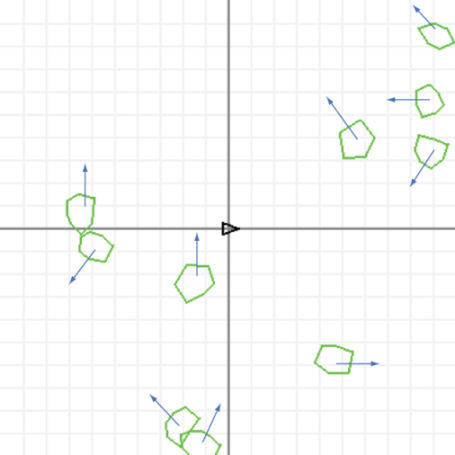 Figure 9.2 With the preceding code included, each asteroid moves with a random, constant velocity.
This visual representation helps in understanding how velocity vectors influence the motion of objects in a simulated environment.
FAQ (Frequently asked questions)
What is velocity in the context of simulating motion?
How do asteroids move in the simulation?
How are velocities added to asteroids in the simulation?
What is the mathematical definition of velocity?
How is velocity represented in 2D motion?
How can you animate an object moving at a constant velocity in a video game?