Word Embedding
Overview
Word embeddings are a powerful technique in natural language processing (NLP) that map words to continuous vector spaces. This transformation allows neural networks to process text more effectively by capturing semantic relationships between words. In the embedding space, words with similar meanings or contexts tend to appear closer together. This property is particularly useful for tasks such as sentiment analysis, machine translation, and information retrieval.
Word embeddings can vary in dimensionality, ranging from a single dimension to thousands. The choice of dimensionality can impact the balance between capturing nuanced relationships and maintaining computational efficiency. Large Language Models (LLMs) often generate their own embeddings, which are optimized for specific tasks and datasets.
Algorithms and Techniques
Several algorithms and frameworks have been developed to generate word embeddings. One of the most notable and widely used is the Word2Vec approach. Word2Vec employs a neural network architecture to create word embeddings by predicting the context of a word given a target word, or vice versa. The underlying principle of Word2Vec is that words appearing in similar contexts tend to have similar meanings. This results in similar terms being clustered together in the embedding space.
Visualization
Word embeddings can be visualized by projecting them into a two-dimensional space. This visualization helps to illustrate the semantic relationships captured by the embeddings. For example, when using techniques like Word2Vec, words corresponding to similar concepts often appear close to each other in the embedding space. Figure 2.3 demonstrates this by showing how different types of birds are positioned closer to each other compared to countries and cities.
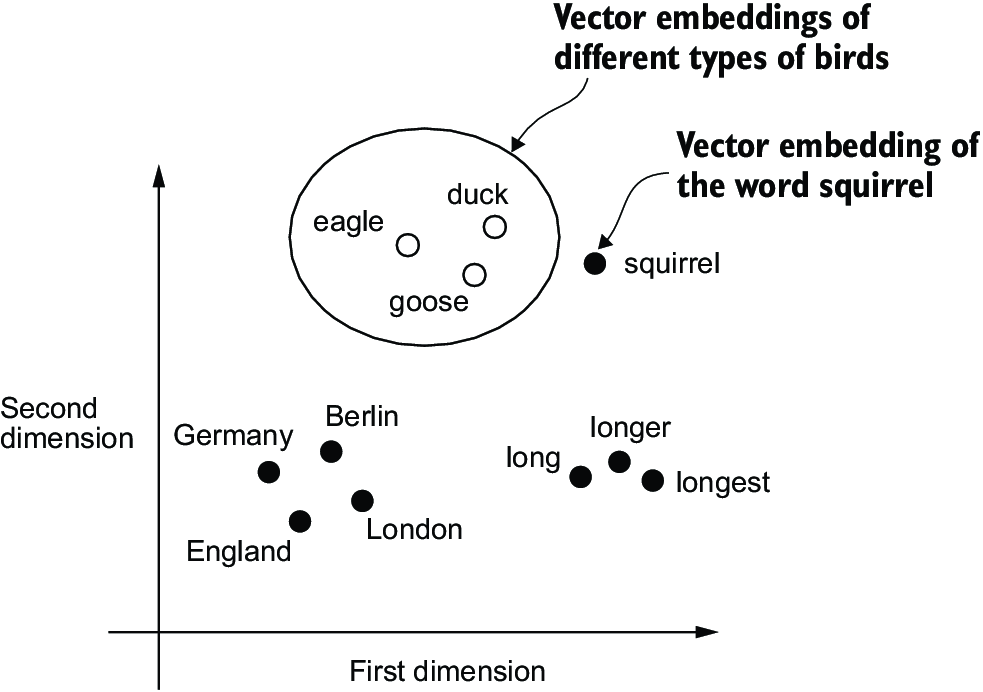 Figure 2.3 If word embeddings are two-dimensional, we can plot them in a two-dimensional scatterplot for visualization purposes as shown here. When using word embedding techniques, such as Word2Vec, words corresponding to similar concepts often appear close to each other in the embedding space. For instance, different types of birds appear closer to each other in the embedding space than in countries and cities.