Understanding __init__ in Python
The __init__ method in Python is a cornerstone of object-oriented programming. It is a special method that is automatically called when a new instance of a class is created. Its primary role is to initialize the newly created object, setting up its initial state by assigning values to its attributes. This method can also accept arguments, allowing for the customization of the object upon creation.
The Role of __init__
The __init__ method is crucial for setting up the initial conditions of an object. It is defined within a class and typically includes parameters that allow for the customization of the object's initial state. This method is automatically invoked after an object is created, ensuring that the object is ready for use immediately after its instantiation.
Definition
The __init__ method is defined as follows:
class ClassName:
    def __init__(self, parameters):
        # Initialization code
Here, parameters can be any number of arguments that you want to pass to the method to initialize the object's attributes.
Instantiation Process
When you create an instance of a class, the instantiation process involves several steps. Initially, the __new__ method is called to create the instance object. Once the object is created, it is passed to the __init__ method to complete the initialization process, where the instance's attributes are set.
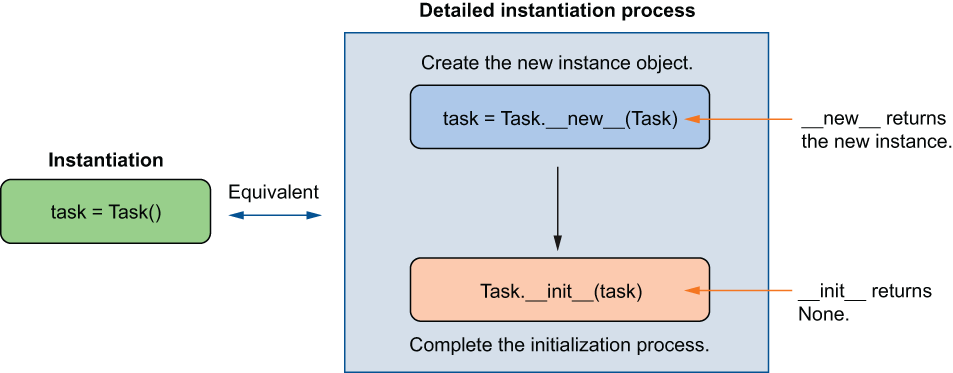 Figure 8.1 The detailed instantiation process behind the scenes.
Examples of __init__ Usage
Basic Initialization
In its simplest form, the __init__ method can be used to print a message when an instance is created:
class Task:
   def __init__(self):
       print("Creating an instance of Task class")

task = Task()
# [Output: Creating an instance of Task class](https://livebook.manning.com/book/python-how-to/chapter-8/11)
Setting Attributes
A more practical use of the __init__ method is to set the attributes of an object. Consider the following example where a Task class is defined with several attributes:
class Task:
   def __init__(self, title, desc, urgency):
       self.title = title
       self.desc = desc
       self.urgency = urgency
       self.status = "created"
       self.tags = []

   def complete(self):
       self.status = "completed"

   def add_tag(self, tag):
       self.tags.append(tag)
In this example, the __init__ method initializes the Task object with a title, description, and urgency level. It also sets default values for the status and tags attributes.
Complex Initialization
The __init__ method can also perform more complex initialization tasks, such as fetching data from a server. The following example demonstrates this with a User class:
class User:
   def __init__(self, username):
       self.username = username
       self.profile_data = self._get_profile_data()
       print(f"### User {username} created")

   def _get_profile_data(self):
       # get the data from the server and load it into memory
       print("*** Run the expensive operation")
       fetched_data = " Extensive data, including thumbnail, followers, etc."
       return fetched_data
In this example, the User class's __init__ method initializes the username and fetches profile data, simulating an expensive operation.
The __init__.py File
Apart from the __init__ method, Python also uses a special file named __init__.py. This file serves two main purposes:
- Package Recognition: It allows Python to recognize a directory as a package.
- Package Initialization: It is automatically executed the first time a package or subpackage is loaded, allowing for any necessary initialization.
Example of __init__.py
Here is an example of an __init__.py file:
print("Hello from mathproj init")
__all__ = ['comp']
version = 1.03
In this example, the __init__.py file prints a message when the package is loaded, defines the __all__ variable to specify which modules should be accessible when the package is imported, and sets a version number for the package.
Conclusion
The __init__ method is an essential part of Python's object-oriented programming, providing a way to set up new objects with the necessary initial state. By understanding and utilizing this method, you can create robust and flexible classes that are ready for use immediately upon instantiation.
| Book Title | Usage of __init__ | Technical Depth | Connections to Other Concepts | Examples Used | Practical Application |
|------------|-------------------|-----------------|-------------------------------|---------------|-----------------------|
| [Python How-To](https://www.manning.com/books/python-how-to) | Discusses `__init__` as a fundamental concept for initializing new objects, setting up initial state. [more](https://livebook.manning.com/book/python-how-to/chapter-8/13) | Explains the instantiation process, including `__new__` and `__init__`. [more](https://livebook.manning.com/book/python-how-to/chapter-8/32) | Connects `__init__` to object creation and attribute setting. [more](https://livebook.manning.com/book/python-how-to/chapter-10/74) | Provides examples from basic to complex initialization, including setting attributes and fetching data. [more](https://livebook.manning.com/book/python-how-to/chapter-8/13) | Emphasizes setting up objects for immediate use, with practical examples like a `Task` class. [more](https://livebook.manning.com/book/python-how-to/chapter-8/11) |
| [The Quick Python Book, Fourth Edition](https://www.manning.com/books/the-quick-python-book-fourth-edition) | Highlights `__init__` for initializing instance variables and customizing objects. [more](https://livebook.manning.com/book/the-quick-python-book-fourth-edition/chapter-15/93) | Discusses overriding `__init__` for enforcing constraints and type checking. [more](https://livebook.manning.com/book/the-quick-python-book-fourth-edition/chapter-17/95) | Links `__init__` to `__init__.py` for package recognition and initialization. [more](https://livebook.manning.com/book/the-quick-python-book-fourth-edition/chapter-18/46) | Uses examples like `TypedList` to demonstrate type checking and constraints. [more](https://livebook.manning.com/book/the-quick-python-book-fourth-edition/chapter-17/99) | Focuses on ensuring correct object setup and package initialization. [more](https://livebook.manning.com/book/the-quick-python-book-fourth-edition/chapter-18/32) |
FAQ (Frequently asked questions)
What is the purpose of the init method in Python?
When is the init method called in Python?
Why is the init method considered essential in a custom class?
What happens during the instantiation process in Python?
How do you define the init method for a class in Python?
What attributes are set in the init method of the Task class?
What does the init method do in the User class?
How does the User class handle expensive operations during initialization?
What is the role of the init method when instantiating an object?
What is the purpose of the init method in Python?
When is the init method called in Python?
What does the init method do in Python?
How is the init method used in the TypedList class?
How does the init method work in the StringDict class?
What checks does the init method perform in the provided code snippet?
What is the purpose of an init.py file in a Python package?
What does the init.py file do in the mathproj package?