Composition in Python
Composition is a fundamental design principle in Python and object-oriented programming that emphasizes building complex systems by combining simpler, reusable components. This approach allows for more flexible and modular code by creating a HAS-A relationship, as opposed to the IS-A relationship established through inheritance. By using composition, developers can build classes that incorporate attributes and functionalities from other classes without the need for inheritance, leading to more logical and adaptable class structures.
Definition of Composition
Composition involves assembling various pieces of functionality to create a complete concept. This approach contrasts with using a rigid inheritance hierarchy, where a class is derived from another class, inheriting its properties and behaviors. Composition allows for more flexible and modular code by enabling a class to be composed of one or more objects from other classes. This method provides a way to construct classes that are not tightly coupled to a specific hierarchy, thus promoting code reuse and reducing redundancy.
Overview of Composition
In the context of software design, composition is a powerful tool that allows developers to build complex systems by combining simpler, reusable components. This method is particularly useful in applications where composition is used alongside inheritance to create a robust system. In such systems, commands can be composed of different functionalities, providing a more adaptable and maintainable codebase.
Composition vs. Inheritance
The preference in modern software design has shifted towards composing behaviors into an object rather than relying solely on inheritance. Composition is essentially the opposite of decomposition; it involves bringing together various pieces of functionality to form a complete concept.
[Figure 3.6: Inheritance versus Composition](https://livebook.manning.com/practices-of-the-python-pro/chapter-3/figure--3-6): Inheritance versus Composition](https://livebook.manning.com/book/practices-of-the-python-pro/chapter-3/124)
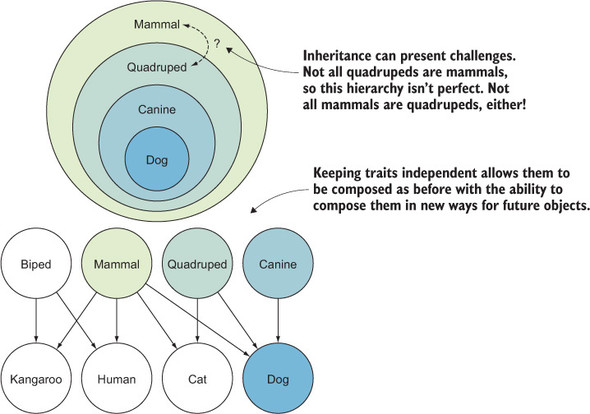
Figure 3.6 illustrates the difference between a rigid inheritance structure and a more flexible composition approach. For example, consider a dog, which is a quadruped, a mammal, and a canine. With inheritance, you would need to create a hierarchy where all canines are mammals, which is logical, but not all mammals are quadrupeds. Composition allows you to avoid the limitations of such a hierarchy while still maintaining the concept of relatedness between different entities.
Implementing Composition with Interfaces
Composition is often implemented through a language feature known as an interface. Interfaces provide formal definitions of methods and data that a class must implement. By implementing multiple interfaces, a class can exhibit the combined behaviors of those interfaces. This approach allows for greater flexibility and reusability in software design, as a class can easily adapt to new requirements by composing different interfaces.
Example of Composition
To illustrate the concept of composition, consider the Color class, which is used as an attribute within the Shape class. This setup allows the Shape class to manage color properties without inheriting from a Color class, thereby establishing a HAS-A relationship. Here is a simple example to demonstrate this:
class Color:
    def __init__(self, name):
        self.name = name

class Shape:
    def __init__(self, color):
        self.color = color

# [Usage](https://livebook.manning.com/book/the-well-grounded-python-developer/chapter-4/1)
red = Color("red")
circle = Shape(red)

print(circle.color.name)  # Output: red
In this example, the Shape class has a Color attribute, which is an instance of the Color class. This composition allows the Shape class to utilize the properties of the Color class without forming an inheritance relationship. This design choice enhances the flexibility and modularity of the code, making it easier to extend and maintain.
For more detailed discussions on composition, you can refer to Practices of the Python Pro and The Well-Grounded Python Developer: How the pros use Python and Flask.
| Book Title | Usage of Composition | Technical Depth | Connections to Other Concepts | Examples Used | Practical Application |
|------------|----------------------|-----------------|-------------------------------|---------------|-----------------------|
| [Practices of the Python Pro](https://www.manning.com/books/practices-of-the-python-pro) | Discusses composition as a design principle that contrasts with inheritance, emphasizing flexibility and modularity. [more](https://livebook.manning.com/book/practices-of-the-python-pro/chapter-8/134) | Explores composition in the context of software design, highlighting its role in building complex systems. [more](https://livebook.manning.com/book/practices-of-the-python-pro/chapter-8/134) | Connects composition with inheritance, illustrating the shift towards composing behaviors. [more](https://livebook.manning.com/book/practices-of-the-python-pro/chapter-3/1) | Uses the example of a dog to explain the limitations of inheritance and the benefits of composition. [more](https://livebook.manning.com/book/practices-of-the-python-pro/chapter-3/figure--3-6) | Highlights the use of interfaces to implement composition, enhancing flexibility and reusability. [more](https://livebook.manning.com/book/practices-of-the-python-pro/chapter-3/1) |
| [The Well-Grounded Python Developer: How the pros use Python and Flask](https://www.manning.com/books/the-well-grounded-python-developer) | Defines composition as a method to build complex types by combining objects, promoting a HAS-A relationship. [more](https://livebook.manning.com/book/the-well-grounded-python-developer/chapter-4/154) | Provides a fundamental overview of composition in object-oriented programming, focusing on flexibility and modularity. [more](https://livebook.manning.com/book/the-well-grounded-python-developer/chapter-4/154) | Emphasizes the distinction between HAS-A and IS-A relationships, promoting code reuse and adaptability. [more](https://livebook.manning.com/book/the-well-grounded-python-developer/chapter-4/1) | Demonstrates composition with a `Color` and `Shape` class example, showing a HAS-A relationship. [more](https://livebook.manning.com/book/the-well-grounded-python-developer/chapter-4/1) | Illustrates how composition enhances code flexibility and maintainability, making it easier to extend. [more](https://livebook.manning.com/book/the-well-grounded-python-developer/chapter-4/1) |
FAQ (Frequently asked questions)
What is composition in object-oriented design?
What type of relationship does composition create?
How is the Color class used in the Shape class?
What relationship does the Shape class have with the Color class?
Why doesn't the Shape class inherit from the Color class?
How does composition add attributes and functionality to a class?
Why is composition considered a flexible design principle?
What is composition in programming?
What does Figure 3.6 illustrate?
How is composition used in the Bark application?
What is the benefit of using composition in programming?