Decomposition in Python
Decomposition is a crucial concept in software development, particularly in Python programming. It involves breaking down complex systems or problems into smaller, more manageable parts. This approach facilitates easier management, understanding, and development of software systems. In Python, decomposition often involves dividing code into functions, classes, or modules, each responsible for handling a specific task or concern.
Decomposition in Software Design
Decomposition in Software Design is about simplifying the complexity of a system by focusing on individual components. By breaking down a large software system into smaller, manageable components or functions, developers can better understand and maintain the system. This method reduces cognitive load and enhances the maintainability of the code.
The value of decomposition lies in its ability to allow developers to tackle big ideas in small increments. By separating sections of code that perform a single task into distinct functions, the overall system becomes more organized and easier to manage. This approach is akin to organizing each room of a house into small boxes rather than trying to pack the entire house into a single shipping container.
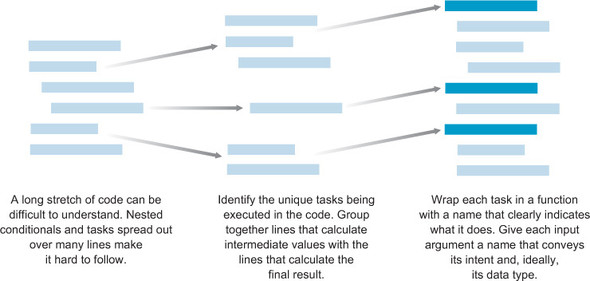 Figure 2.2. The value of decomposition
Examples of decomposition in practice include breaking down a function that introduces a group of names into smaller functions, such as introduce and join_names. Each function handles a different part of the task separately, making the code more modular and easier to understand.
 Figure 3.4. Decomposition into granular components eases understanding.
Decomposition in Python Package Development
In the context of Python package development, decomposition is about breaking down code into smaller, more manageable pieces. This approach not only makes the code easier to understand and maintain but also allows for greater flexibility and reusability. By separating code into distinct components, developers can achieve loose coupling, which is essential for creating modular and adaptable software systems.
Benefits of Decomposition
- Manageability: Smaller code segments are easier to manage, debug, and test, making the development process more efficient and less error-prone.
- Reusability: Decomposed code can be reused across different parts of a project or even in different projects, reducing redundancy and promoting the use of well-tested components.
- Flexibility: With loosely coupled components, developers can easily modify or replace parts of the system without affecting the entire codebase.
- Collaboration: Decomposition allows multiple developers to work on different parts of a project simultaneously, facilitating better collaboration and parallel development.
Implementing Decomposition
To effectively implement decomposition in Python packages, developers should focus on creating clear interfaces and ensuring that each component has a single responsibility. This can be achieved through:
- Modular Design: Organizing code into modules and packages that encapsulate specific functionality.
- Function and Class Design: Writing functions and classes that perform distinct tasks and can be easily combined with others.
- Interface Definition: Clearly defining how different components interact with each other, ensuring that changes in one part do not adversely affect others.
By adhering to these principles, developers can create Python packages that are robust, scalable, and easy to maintain. Decomposition is not just a technical strategy but a mindset that encourages thoughtful design and efficient coding practices.
| Book Title | Usage of Decomposition | Technical Depth | Connections to Other Concepts | Examples Used | Practical Application |
|------------|------------------------|-----------------|-------------------------------|---------------|-----------------------|
| [Practices of the Python Pro](https://www.manning.com/books/practices-of-the-python-pro) | Decomposition is used to break down complex systems into manageable parts, focusing on individual components to simplify complexity. [more](https://livebook.manning.com/book/practices-of-the-python-pro/chapter-1/70) | Discusses the cognitive benefits and maintainability improvements of decomposition. [more](https://livebook.manning.com/book/practices-of-the-python-pro/chapter-3/43) | Connects decomposition to modularity and maintainability, emphasizing its role in reducing cognitive load. [more](https://livebook.manning.com/book/practices-of-the-python-pro/chapter-2/84) | Provides examples like breaking down functions into smaller tasks, such as `introduce` and `join_names`. [more](https://livebook.manning.com/book/practices-of-the-python-pro/chapter-2/79) | Highlights practical benefits in software design, making systems more understandable and maintainable. [more](https://livebook.manning.com/book/practices-of-the-python-pro/chapter-1/70) |
| [Publishing Python Packages: Test, share, and automate your projects](https://www.manning.com/books/publishing-python-packages) | Decomposition is used to break down code into smaller, manageable pieces for flexibility and reusability. [more](https://livebook.manning.com/book/publishing-python-packages/chapter-1/82) | Focuses on modular design, function and class design, and interface definition for effective decomposition. [more](https://livebook.manning.com/book/publishing-python-packages/chapter-1/82) | Links decomposition to loose coupling, modularity, and adaptability in software systems. [more](https://livebook.manning.com/book/publishing-python-packages/chapter-1/82) | Emphasizes creating clear interfaces and single responsibility components. [more](https://livebook.manning.com/book/publishing-python-packages/chapter-1/82) | Applies decomposition to Python package development, enhancing manageability, reusability, and collaboration. [more](https://livebook.manning.com/book/publishing-python-packages/chapter-1/82) |
FAQ (Frequently asked questions)
What is decomposition in programming?
Why is decomposition important in software development?
How does decomposition contribute to code flexibility and reusability?
What is decomposition in software design?
How is decomposition used in programming?
What is the purpose of decomposition in solving complex problems?
What does Figure 2.2 illustrate about decomposition?
Can you give an example of decomposition in programming?
Why is decomposition important in software development?
What does decomposition involve in software?
What does Figure 3.4 demonstrate about decomposition?
How does decomposition make a software system easier to manage?
What is an example of decomposition in software systems?