Dictionary Comprehension in Python
Dictionary comprehension is a powerful feature in Python that allows for the creation of dictionaries in a concise and readable manner. By using a single line of code, you can generate key-value pairs from an iterable, making your code more efficient and less prone to errors. This technique is particularly useful for transforming data and embedding logic directly within the dictionary's definition.
Overview
Dictionary comprehension enables the construction of dictionaries by specifying an expression pair (key: value) followed by a for statement, all enclosed within curly braces. This approach can also incorporate an optional condition to filter items, making it a versatile tool for dictionary creation. The general syntax is:
{expression1: expression2 for variable in iterable if condition}
expression1is the key expression.expression2is the value expression.variableis the loop variable.iterableis the collection being iterated over.conditionis an optional filter that determines which items are included in the dictionary.
Example of Dictionary Comprehension
Example 1: File Processing
Consider a scenario where you need to create a dictionary from a file, gashlycrumb.txt, where each line is processed to form a key-value pair. The key is the first character of the line (converted to uppercase), and the value is the entire line with the trailing newline character removed:
>>> fh = open('gashlycrumb.txt')
>>> lookup = { line[0].upper(): line.rstrip() for line in fh }
This dictionary comprehension efficiently constructs the lookup dictionary in a single line, equivalent to a multi-line for loop.
Example 2: Squaring Numbers
Another example demonstrates creating a dictionary where the keys are numbers and the values are their squares:
x = [1, 2, 3, 4]
x_squared_dict = {item: item * item for item in x}
x_squared_dict
This code snippet produces the dictionary:
{1: 1, 2: 4, 3: 9, 4: 16}
Here, the list x is iterated over, and for each item, its square is calculated and used as the value, with the item itself as the key.
Example 3: Task Mapping
In a more practical application, dictionary comprehension can be used to map task titles to their descriptions:
title_dict1 = {task.title: task.description for task in tasks}
This example iterates over a collection of tasks, using each task.title as the key and task.description as the value, transforming a list of task objects into a dictionary.
Visual Representation
The transformation from a traditional for loop to a dictionary comprehension can be visualized in the following figure:
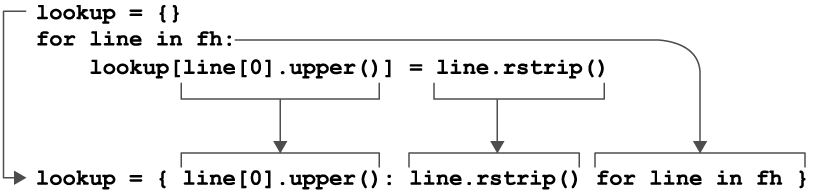 Table 7.5 The for loop we used to build a dictionary can be written using a dictionary comprehension.
As shown in Figure 7.5, the three lines of a typical for loop can be condensed into a single line using dictionary comprehension. This not only simplifies the code but also adheres to Python's idiomatic practices, promoting cleaner and more maintainable code.
By adopting dictionary comprehension, you can achieve the same functionality with less code, reducing the potential for errors and enhancing the overall readability of your code.
| Book Title | Usage of Dictionary Comprehension | Technical Depth | Connections to Other Concepts | Examples Used | Practical Application |
|------------|-----------------------------------|-----------------|------------------------------|---------------|-----------------------|
| [Tiny Python Projects: Learn coding and testing with puzzles and games](https://www.manning.com/books/tiny-python-projects) | Discusses dictionary comprehension as a method to create dictionaries efficiently, transforming multi-line loops into single lines. [more](https://livebook.manning.com/book/tiny-python-projects/chapter-7/79) | Provides a visual representation of transforming loops into comprehensions. [more](https://livebook.manning.com/book/tiny-python-projects/chapter-7/83) | Emphasizes code readability and efficiency. [more](https://livebook.manning.com/book/tiny-python-projects/chapter-7/79) | Uses a file processing example to demonstrate comprehension. [more](https://livebook.manning.com/book/tiny-python-projects/chapter-7/61) | Highlights reduction of potential errors and enhanced readability. [more](https://livebook.manning.com/book/tiny-python-projects/chapter-7/79) |
| [The Quick Python Book, Fourth Edition](https://www.manning.com/books/the-quick-python-book-fourth-edition) | Describes dictionary comprehension with optional conditions for filtering items. [more](https://livebook.manning.com/book/the-quick-python-book-fourth-edition/chapter-8/76) | Explains the syntax and components of dictionary comprehension. [more](https://livebook.manning.com/book/the-quick-python-book-fourth-edition/chapter-8/76) | Connects to list comprehensions and filtering. [more](https://livebook.manning.com/book/the-quick-python-book-fourth-edition/chapter-8/76) | Demonstrates with a number squaring example. [more](https://livebook.manning.com/book/the-quick-python-book-fourth-edition/chapter-8/1) | Shows how to create dictionaries with conditions. [more](https://livebook.manning.com/book/the-quick-python-book-fourth-edition/chapter-8/76) |
| [Python How-To](https://www.manning.com/books/python-how-to) | Highlights the efficiency and readability of dictionary comprehension. [more](https://livebook.manning.com/book/python-how-to/chapter-5/96) | Focuses on the concise nature of dictionary comprehension. [more](https://livebook.manning.com/book/python-how-to/chapter-5/96) | Discusses performance improvements due to concise syntax. [more](https://livebook.manning.com/book/python-how-to/chapter-5/96) | Provides an example with task objects. [more](https://livebook.manning.com/book/python-how-to/chapter-5/81) | Emphasizes transformation of data into key-value pairs. [more](https://livebook.manning.com/book/python-how-to/chapter-5/96) |
FAQ (Frequently asked questions)
What is dictionary comprehension in Python?
What is the syntax for dictionary comprehension in Python?
How does dictionary comprehension transform data?
How can you create a dictionary from a list of tasks using dictionary comprehension?
What is a dictionary comprehension in Python?
How does dictionary comprehension help in Python coding?
Can a for loop used to build a dictionary be written using a dictionary comprehension?
How can you create a dictionary from a file using dictionary comprehension?
What is a dictionary comprehension in Python?
How do you create a dictionary using dictionary comprehension?
Can dictionary comprehensions include conditions?
How can you create a dictionary of squared numbers using dictionary comprehension?
What is the result of the dictionary comprehension {item: item * item for item in [1, 2, 3, 4]}?