Encoding in Python
Encoding in Python refers to the process of transforming data from one format to another, particularly in the context of text data. It is a fundamental concept in programming that ensures data is accurately represented, stored, and transmitted across different systems and platforms. Encoding is crucial for handling diverse character sets and ensuring that text data is processed correctly.
Character Substitution Encoding
One method of encoding involves substituting each character in a string with another character. This is achieved using a dictionary that acts as a substitution table. Each character in the original string is replaced with a corresponding character from the dictionary, effectively transforming the string into a new encoded form. This type of encoding is often used in simple encryption techniques where the goal is to obscure the original message. For more details, refer to the Tiny Python Projects.
Numeric Encoding
Numeric encoding involves converting words into numeric values by summing the ordinal values of the characters in a word. The process includes several steps:
- Cleaning the Word: Remove any non-alphanumeric characters from the word to ensure that only valid characters are processed.
- Converting Characters to ASCII Values: Use the
ord()function to convert each character in the cleaned word to its corresponding ASCII value. - Summing the Values: Add up all the ASCII values to produce a single numeric value that represents the word.
This method is particularly useful in applications where a numeric representation of text is required, such as in certain cryptographic algorithms or data processing tasks. A visual representation of this process can be found in Figure 18.1 from the Tiny Python Projects.
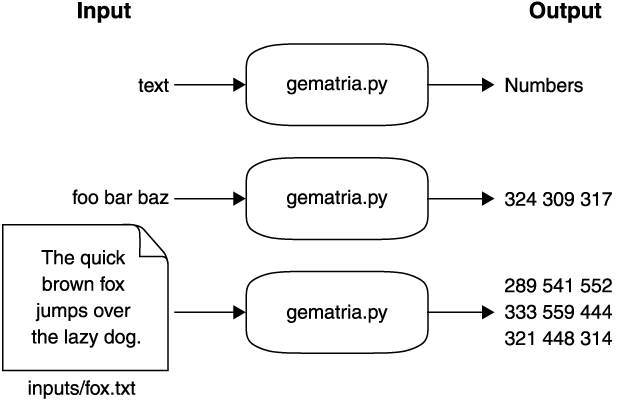 Figure 18.1 The gematria program will accept input text and will produce a numeric encoding for each word.
Common Encodings
Encoding is also about how characters are represented in files. Two common encodings are:
-
ASCII: An early character encoding using 7 bits to represent characters, including basic English letters, digits, and some control characters. It is limited to 128 characters, which is insufficient for representing characters from other languages or special symbols.
-
Unicode (UTF-8): A comprehensive encoding standard that covers all characters from all writing systems. UTF-8 is a popular implementation of Unicode that uses one to four bytes for each character, allowing for efficient storage of text while supporting a vast array of characters. It is backward compatible with ASCII, making it a versatile choice for encoding text files. More information can be found in The Quick Python Book, Fourth Edition.
Importance of Proper Encoding
When reading or writing text files, especially those containing non-ASCII characters, it is essential to specify the correct encoding. Failing to do so can lead to errors such as:
- Mojibake: Occurs when text is decoded using the wrong encoding, resulting in garbled or unreadable characters.
- Data Loss: Incorrect encoding can lead to loss of information, especially if characters are not represented in the chosen encoding scheme.
By understanding and correctly implementing encoding, developers can ensure that text data is handled accurately and efficiently across different systems and languages.
| Book Title | Usage of Encoding | Technical Depth | Connections to Other Concepts | Examples Used | Practical Application |
|------------|-------------------|-----------------|-------------------------------|---------------|-----------------------|
| [Tiny Python Projects: Learn coding and testing with puzzles and games](https://www.manning.com/books/tiny-python-projects) | Discusses encoding as a process of transforming data, focusing on character substitution and numeric encoding. [more](https://livebook.manning.com/book/tiny-python-projects/chapter-18/1) | Explains character substitution using dictionaries and numeric encoding by summing ASCII values. [more](https://livebook.manning.com/book/tiny-python-projects/chapter-18/1) | Connects encoding to cryptographic algorithms and data processing tasks. [more](https://livebook.manning.com/book/tiny-python-projects/chapter-18/1) | Provides visual representation of numeric encoding with a gematria program. [more](https://livebook.manning.com/book/tiny-python-projects/chapter-18/1) | Highlights practical use in cryptography and data processing. [more](https://livebook.manning.com/book/tiny-python-projects/chapter-18/1) |
| [The Quick Python Book, Fourth Edition](https://www.manning.com/books/the-quick-python-book-fourth-edition) | Focuses on character representation in files, emphasizing the importance of proper encoding. [more](https://livebook.manning.com/book/the-quick-python-book-fourth-edition/chapter-21/12) | Discusses ASCII and Unicode (UTF-8) encodings, highlighting their differences and uses. [more](https://livebook.manning.com/book/the-quick-python-book-fourth-edition/chapter-21/12) | Links encoding to error prevention in text data handling, such as avoiding mojibake and data loss. [more](https://livebook.manning.com/book/the-quick-python-book-fourth-edition/chapter-21/12) | Illustrates common encoding errors and their impact on data integrity. [more](https://livebook.manning.com/book/the-quick-python-book-fourth-edition/chapter-21/12) | Emphasizes the necessity of correct encoding in multilingual text processing. [more](https://livebook.manning.com/book/the-quick-python-book-fourth-edition/chapter-21/12) |
FAQ (Frequently asked questions)
How is encoding done using a dictionary?
What does encoding refer to in the context of Gematria?
How are words converted into numeric values in Gematria?
What is encoding in text files?
What are some common text encodings?
Why is proper handling of encoding important?