Finally Clause in Python
The finally clause in Python is a crucial component of the try...except...else...finally statement, used for exception handling. Its primary role is to ensure that specific code is executed after the try block, regardless of whether an exception was raised. This makes it particularly useful for cleanup actions, such as closing files or releasing resources, which need to be performed to maintain the program's integrity.
Overview
In a complete try...except...else...finally statement, the finally clause is executed after the except or else clause, depending on whether an exception was raised. The try block contains the code that might raise an exception, the except block handles the exception if one is raised, and the else block runs if no exceptions are raised. The finally clause, however, runs in all cases, making it ideal for tasks that need to be completed regardless of the outcome of the try block.
Placement of the Finally Clause
The finally clause should be placed at the end of the try...except... statement. If an else clause is used, the finally clause should follow it; otherwise, it follows the except clause. This ensures that the code within the finally block is executed after all other exception handling has been completed.
Example Usage
Consider the following example, which demonstrates the use of the finally clause in a try...except statement:
def process_task_string8(text):
   title, urgency_str = text.split(",")
   try:
       urgency = int(urgency_str)
   except ValueError as ex:
       print(f"Couldn't cast the number. Description: {ex}")
       return None
   else:
       task = Task(title, urgency)
       return task
   finally:
       print(f"Done processing text: {text}")
In this example, the function process_task_string8 attempts to process a string containing task data. The try block attempts to convert a string to an integer, which may raise a ValueError if the conversion fails. If an exception is raised, the except block handles it by printing an error message. If no exception is raised, the else block creates and returns a Task object. Regardless of whether an exception occurs, the finally block executes, printing a message indicating that the processing is complete.
Visual Representation
To better understand the flow of a complete try...except...else...finally statement, refer to the following figure:
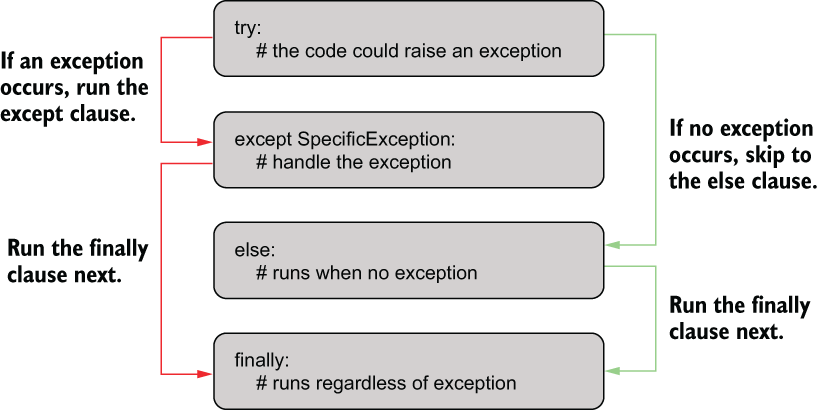 Figure 12.5 The four clauses in a complete try...except...else...finally... statement. The try clause includes the code that could raise an exception. The except clause includes the code that handles the possible exception. The else clause runs only if no exceptions are raised. The finally clause runs after the except clause or the else clause.
This figure illustrates the sequence in which the clauses are executed, highlighting the role of the finally clause in ensuring that certain code is always run, regardless of the exception status.
Syntax
The basic syntax for exception handling in Python, incorporating the finally clause, is as follows:
try:
    body
except exception_type1 as var1:
    exception_code1
except exception_type2 as var2:
    exception_code2
except (exception_type3, exception_type4) as var3:
    exception_code3
    .
except:
    default_exception_code
else:
    else_body
finally:
    finally_body
Explanation
tryblock: This is where you place the code that might throw an exception. If the code executes without any exceptions, theelseblock (if present) is executed next.exceptblocks: These blocks handle specific exceptions that might be raised in thetryblock. Eachexceptblock can handle different types of exceptions, and you can also use a tuple to catch multiple exceptions in a single block.elseblock: This block is optional and is executed only if thetryblock does not raise an exception.finallyblock: This block is executed after thetry,except, andelseblocks, regardless of whether an exception was raised or not. It is used for cleanup actions that must be executed under all circumstances.
The finally clause ensures that the finally_body is executed, making it a reliable way to perform necessary cleanup actions, such as closing files or releasing network resources, which are crucial for maintaining the stability and reliability of your applications.
| Book Title | Usage of finally clause | Technical Depth | Connections to Other Concepts | Examples Used | Practical Application |
|------------|-------------------------|-----------------|-------------------------------|---------------|-----------------------|
| [Python How-To](https://www.manning.com/books/python-how-to) | Discusses the `finally` clause as part of exception handling, ensuring code execution regardless of exceptions. Useful for cleanup actions like closing files. [more](https://livebook.manning.com/book/python-how-to/chapter-12/182) | Explains the placement and execution order of `finally` in `try...except...else...finally` statements. [more](https://livebook.manning.com/book/python-how-to/chapter-12/182) | Connects `finally` with `try`, `except`, and `else` clauses, emphasizing its role in the complete exception handling process. [more](https://livebook.manning.com/book/python-how-to/chapter-12/184) | Provides a code example demonstrating `finally` in a `try...except` statement, showing its role in cleanup. [more](https://livebook.manning.com/book/python-how-to/chapter-12/186) | Highlights practical use in ensuring cleanup actions are performed, regardless of exceptions. [more](https://livebook.manning.com/book/python-how-to/chapter-12/182) |
| [The Quick Python Book, Fourth Edition](https://www.manning.com/books/the-quick-python-book-fourth-edition) | Describes `finally` as integral to `try-except-else-finally`, ensuring code execution at block end for cleanup. [more](https://livebook.manning.com/book/the-quick-python-book-fourth-edition/chapter-3/90) | Details syntax and execution order, emphasizing `finally` for resource management and cleanup. [more](https://livebook.manning.com/book/the-quick-python-book-fourth-edition/chapter-14/57) | Links `finally` with `try`, `except`, and `else`, focusing on its role in resource management. [more](https://livebook.manning.com/book/the-quick-python-book-fourth-edition/chapter-14/57) | Provides syntax example showing `finally` in exception handling, highlighting its necessity for cleanup. [more](https://livebook.manning.com/book/the-quick-python-book-fourth-edition/chapter-3/90) | Emphasizes `finally` for maintaining application stability through reliable cleanup actions. [more](https://livebook.manning.com/book/the-quick-python-book-fourth-edition/chapter-14/57) |
FAQ (Frequently asked questions)
What is the purpose of the finally clause in Python?
When is the finally clause executed in a try...except...finally statement?
Why is the finally clause important in exception handling?
What are the four clauses in a complete try...except...else...finally statement?
What does the try clause do in a try...except...else...finally statement?
What is the role of the except clause in exception handling?
When does the else clause run in a try...except...else...finally statement?
When is the finally clause executed in a try...except...else...finally statement?
How is the finally clause used in a try...except statement?
What happens in the finally clause in the provided code example?
What is the function of the finally clause in Python?
For what purpose is the finally clause often used?
What is the purpose of the 'finally' clause in Python?
When is the 'finally' clause executed in a try-except-else-finally statement?
What role does the 'finally' clause play in exception handling?
Why is the 'finally' clause important in a try statement?