Generators in Python
Generators in Python are a powerful feature that allows for the creation of iterators using a function with a yield statement. They enable lazy evaluation, meaning values are generated on-the-fly without the need to store the entire sequence in memory. This is particularly useful for efficiently handling large datasets or streams of data.
Overview
Generators are a type of iterable, similar to lists or tuples. However, unlike lists, they do not store their contents in memory. Instead, they generate items on-the-fly, which makes them more memory efficient. This characteristic is particularly useful when dealing with large datasets or streams of data where storing all items in memory would be impractical.
Creating Generators
Generator Functions
A generator function is defined like a regular function but uses the yield keyword to yield items one at a time. When the function is called, it returns a generator object that can be iterated over. The function's execution is paused at each yield statement and can be resumed later, allowing it to produce a sequence of values over time.
Example: Creating a Generator to Calculate the Sum of Perfect Squares
def perfect_squares(limit):
    n = 1
    while n <= limit:
        yield n * n
        n += 1

squares_gen = perfect_squares(upper_limit)

sum_gen = sum(squares_gen)

assert sum_gen == sum_list == 333333833333500000
In this example, the perfect_squares function is a generator function. By calling this function with upper_limit, we create a generator named squares_gen. This generator yields perfect squares: (1^2, 2^2, 3^2, 4^2, \ldots) until (1,000,000^2).
Generator Expressions
Generators can also be created using generator expressions, which are similar to list comprehensions but use parentheses instead of square brackets. This allows for concise and efficient data processing.
How Generators Work
The key feature of a generator function is the yield keyword. When the function execution reaches a yield statement, it provides the current item and pauses execution, remembering the state of the function. This allows the generator to resume from where it left off when the next item is requested.
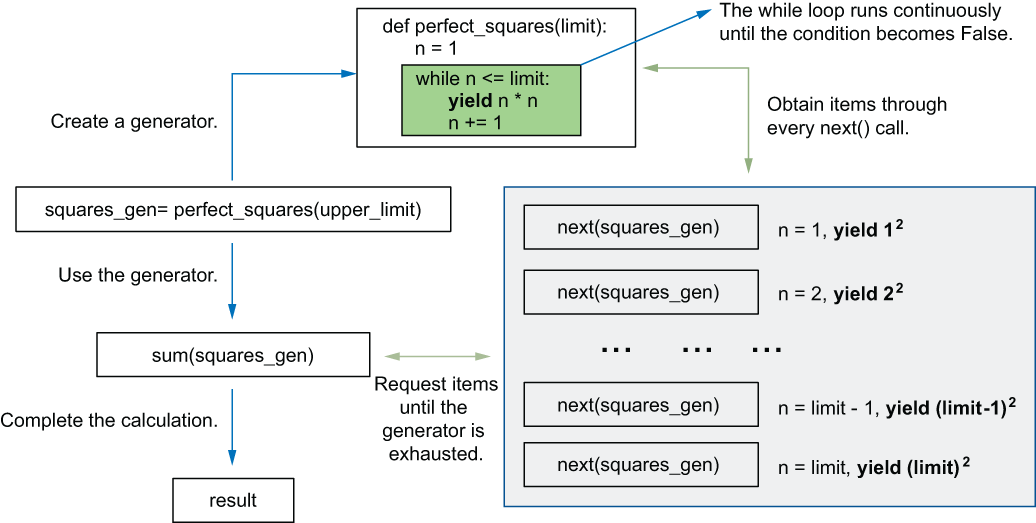 Figure 7.4 The flow of creating and using a generator.
Generators as Memory-Efficient Data Providers
Generators are particularly memory-efficient because they yield items one at a time, only when requested. This makes them ideal for processing large datasets or files, as they do not require all data to be loaded into memory at once.
Reading Lines as a Generator
When reading lines from a file, using a generator can be advantageous. By treating the file object as an iterator in a for loop, each line is yielded one at a time, which is memory-efficient for processing large files.
Example: Reading a File as a Generator
from collections import namedtuple

Task = namedtuple("Task", "task_id title urgency")

with open("tasks.txt") as file:
    for line in file:
        stripped_line = line.strip()
        task_id, title, urgency = stripped_line.split(",")
        task = Task(task_id, title, urgency)
        print(f"{stripped_line}: {task}")
In this example, each line from the file tasks.txt is processed one at a time, creating a Task named tuple for each line. This approach is efficient for handling large files without loading the entire file into memory.
Synchronous and Asynchronous Generators
Synchronous Generators
A synchronous generator is a simple form of a generator that yields values one at a time. Below is an example of a synchronous generator that generates positive integers up to a specified limit:
def positive_integers(until: int):
    for integer in range(until):
        yield integer

positive_iterator = positive_integers(2)

print(next(positive_iterator))
print(next(positive_iterator))
Asynchronous Generators
An asynchronous generator is a type of generator that allows for asynchronous iteration over a sequence of values. It uses the async for syntax and can await coroutines, making it suitable for scenarios where data is fetched or processed asynchronously, such as streaming database results.
Conclusion
Using generators can significantly reduce memory usage and improve performance, especially when dealing with large datasets. They provide a powerful tool for writing efficient and clean code in Python.
| Book Title | Usage of generator | Technical Depth | Connections to Other Concepts | Examples Used | Practical Application |
|------------|--------------------|-----------------|-------------------------------|---------------|-----------------------|
| [Python How-To](https://www.manning.com/books/python-how-to) | Discusses generators as memory-efficient data providers, useful for large datasets. [more](https://livebook.manning.com/book/python-how-to/chapter-7/195) | Explains generator functions and expressions, and how they work with `yield`. [more](https://livebook.manning.com/book/python-how-to/chapter-7/205) | Connects to iterators and memory management. [more](https://livebook.manning.com/book/python-how-to/chapter-7/196) | Includes examples like calculating the sum of perfect squares and reading files. [more](https://livebook.manning.com/book/python-how-to/chapter-11/36) | Emphasizes practical use in handling large files and datasets. [more](https://livebook.manning.com/book/python-how-to/chapter-11/36) |
| [Python Concurrency with asyncio](https://www.manning.com/books/python-concurrency-with-asyncio) | Highlights generators for lazy evaluation and asynchronous programming. [more](https://livebook.manning.com/book/python-concurrency-with-asyncio/chapter-5/112) | Covers synchronous and asynchronous generators, and interleaving execution. [more](https://livebook.manning.com/book/python-concurrency-with-asyncio/chapter-5/120) | Links to coroutines and async programming. [more](https://livebook.manning.com/book/python-concurrency-with-asyncio/chapter-5/113) | Provides examples of synchronous and asynchronous generators. [more](https://livebook.manning.com/book/python-concurrency-with-asyncio/chapter-5/120) | Focuses on concurrency and efficient data handling. [more](https://livebook.manning.com/book/python-concurrency-with-asyncio/chapter-14/55) |
| [Python Workout](https://www.manning.com/books/python-workout) | Describes generators as memory-efficient iterables. [more](https://livebook.manning.com/book/python-workout/chapter-10/1) | Basic explanation of generator functions and expressions. [more](https://livebook.manning.com/book/python-workout/chapter-10/1) | Discusses efficiency in handling large datasets. [more](https://livebook.manning.com/book/python-workout/chapter-10/1) | No specific examples provided. [more](https://livebook.manning.com/book/python-workout/chapter-10/1) | Highlights memory efficiency for large data. [more](https://livebook.manning.com/book/python-workout/chapter-10/1) |
| [The Quick Python Book, Fourth Edition](https://www.manning.com/books/the-quick-python-book-fourth-edition) | Explains generators as special iterators for memory efficiency. [more](https://livebook.manning.com/book/the-quick-python-book-fourth-edition/chapter-9/120) | Details on `yield` and `yield from`, and generator functions. [more](https://livebook.manning.com/book/the-quick-python-book-fourth-edition/chapter-8/92) | Connects to iterators and sequence handling. [more](https://livebook.manning.com/book/the-quick-python-book-fourth-edition/chapter-8/92) | Includes examples like a simple generator function. [more](https://livebook.manning.com/book/the-quick-python-book-fourth-edition/chapter-8/92) | Practical use in iterating over large datasets. [more](https://livebook.manning.com/book/the-quick-python-book-fourth-edition/chapter-9/126) |
| [Practices of the Python Pro](https://www.manning.com/books/practices-of-the-python-pro) | Focuses on generators for memory efficiency and clean code. [more](https://livebook.manning.com/book/practices-of-the-python-pro/chapter-4/73) | Discusses generator behavior and memory usage. [more](https://livebook.manning.com/book/practices-of-the-python-pro/chapter-4/73) | Relates to file reading and data streaming. [more](https://livebook.manning.com/book/practices-of-the-python-pro/chapter-4/73) | Example of squaring numbers with a generator. [more](https://livebook.manning.com/book/practices-of-the-python-pro/chapter-4/90) | Emphasizes memory savings and performance. [more](https://livebook.manning.com/book/practices-of-the-python-pro/chapter-4/73) |
| [Classic Computer Science Problems in Python](https://www.manning.com/books/classic-computer-science-problems-in-python) | Uses generators for iterating sequences without memory overhead. [more](https://livebook.manning.com/book/classic-computer-science-problems-in-python/chapter-1/50) | Basic explanation of generator functions. [more](https://livebook.manning.com/book/classic-computer-science-problems-in-python/chapter-1/50) | Connects to sequence generation and iteration. [more](https://livebook.manning.com/book/classic-computer-science-problems-in-python/chapter-1/50) | Example of a Fibonacci sequence generator. [more](https://livebook.manning.com/book/classic-computer-science-problems-in-python/chapter-1/50) | Demonstrates efficient sequence generation. [more](https://livebook.manning.com/book/classic-computer-science-problems-in-python/chapter-1/50) |
FAQ (Frequently asked questions)
What is a generator in Python?
How is a generator created in Python?
How can you create a generator to yield perfect squares?
What is the purpose of the yield keyword in a generator function?
How do you calculate the sum of perfect squares using a generator?
Why are generators considered memory-efficient?
When are generators ideal to use?
How do generators yield items in Python?
What makes generators memory-efficient?
What are generator expressions in Python?
How do generator expressions differ from list comprehensions?
How can you read data from a file using a generator in Python?
What is the benefit of reading a file as a generator?
What does reading lines as a generator involve?
Why is reading lines as a generator memory-efficient?
What are generators in Python?
Why are generators useful?
How do you create a synchronous generator in Python?
What is an example of using a synchronous generator?
What is an asynchronous generator in Python?
When should you use asynchronous generators?
How do generators relate to coroutines in Python?
How can you interleave execution of multiple generators?
What is the purpose of the run_generator_step function in the example?
How were generators used before async and await in Python?
What is the status of generator-based coroutines in Python?
What are generators in Python?
How do generators differ from lists in Python?
How can generators be created in Python?
Why are generators considered memory efficient?
What are generators in Python?
How do generators help in saving memory?
How do generators save space in Python?
How can you create a generator that yields squared numbers in Python?
What does the 'yield' keyword do in a generator function?
What is a generator in Python?
How does a generator differ from a regular function in Python?
What is the advantage of using a generator in Python?
What is a generator in Python?
Why are generators memory efficient?
How are generators used in Python?
What is a generator function in Python?
How do generators yield values?
Why are generators efficient for large datasets?
What is the purpose of the yield keyword in Python?
What does the yield from keyword do in Python?