Keywords in Python
In Python, a keyword is a reserved word that holds a special meaning and purpose within the language's syntax. These keywords are integral to the structure of Python code and are used to define the language's syntax and grammar. Because of their predefined roles, keywords cannot be used as identifiers, which means they cannot be used as names for variables, functions, classes, or any other user-defined items. This restriction ensures that the code remains clear and unambiguous, as the keywords always perform their intended function.
Overview
Keywords are essential for defining the language's syntax and structure, allowing developers to write clear and concise code. Examples of Python keywords include def, class, and lambda. They are integral to the language's syntax and structure, ensuring that the code is both readable and maintainable. For more details, refer to the Python How-To and The Quick Python Book, Fourth Edition.
Keywords in Function Definitions
Keywords play a crucial role in Python function definitions, particularly through the use of keyword arguments. Keyword arguments are arguments passed to a function with an identifier, making function calls more readable and flexible. This approach allows developers to specify which arguments correspond to which parameters, enhancing code clarity and reducing the likelihood of errors. For example:
def example_function(param1, param2, param3):
    print(param1, param2, param3)

example_function(param2='value2', param1='value1', param3='value3')
In this call, the order of the arguments does not matter because each argument is explicitly associated with a parameter name. This feature of Python enhances the flexibility and clarity of function calls, making it easier to understand and modify code. More information can be found in The Quick Python Book, Fourth Edition.
Keyword-Only Arguments
Python also supports keyword-only arguments, which are specified in a function definition using the * symbol. This indicates that any arguments following the * must be passed as keyword arguments. By enforcing the use of explicit names for these arguments, keyword-only arguments further improve code clarity and maintainability. For more details, see Python How-To.
Checking for Keywords
Python provides a built-in module named keyword that can be used to check if a word is a keyword. The following example demonstrates how to use this module to verify whether certain words are keywords:
import keyword

words_to_check = ["def", "class", "self", "lambda"]
for word in words_to_check:
   print(f"Is {word:^8} a keyword? {keyword.iskeyword(word)}")
The output confirms that def, class, and lambda are keywords, while self is not. This example is detailed in Python How-To.
Positional and Keyword Arguments
When defining functions, Python allows the use of both positional and keyword arguments. Positional arguments are those that are passed to a function in the order in which they are defined, without any identifiers. In contrast, keyword arguments are passed with identifiers, allowing for more flexibility in the order of arguments.
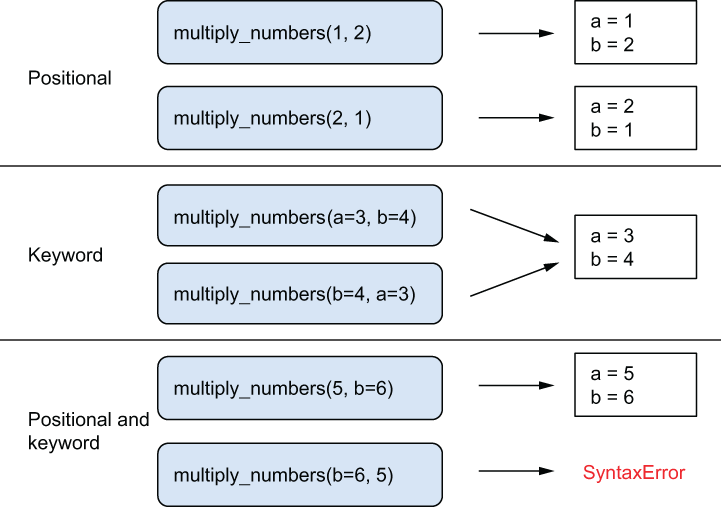 Figure 6.6 Using positional and keyword arguments in function calls. If the arguments have identifiers preceding the arguments, they’re keyword arguments. If the arguments have no identifiers, they’re positional arguments.
This flexibility allows developers to write more readable and maintainable code by clearly indicating which values correspond to which parameters. For more information, see Python How-To.
| Book Title | Usage of keyword | Technical Depth | Connections to Other Concepts | Examples Used | Practical Application |
|------------|------------------|-----------------|-------------------------------|---------------|-----------------------|
| [Python How-To](https://www.manning.com/books/python-how-to) | Discusses keywords as reserved words integral to Python's syntax, including their role in function definitions and keyword-only arguments. [more](https://livebook.manning.com/book/python-how-to/chapter-8/13) | Explores keyword arguments and keyword-only arguments, emphasizing their importance in function definitions. [more](https://livebook.manning.com/book/python-how-to/chapter-6/212) | Connects keywords to function definitions, positional and keyword arguments, and the `keyword` module for checking keywords. [more](https://livebook.manning.com/book/python-how-to/chapter-8/38) | Provides examples of using the `keyword` module to check for keywords and demonstrates function calls with positional and keyword arguments. [more](https://livebook.manning.com/book/python-how-to/chapter-8/38) | Highlights practical use in writing clear and maintainable code through keyword arguments and keyword-only arguments. [more](https://livebook.manning.com/book/python-how-to/chapter-6/225) |
| [The Quick Python Book, Fourth Edition](https://www.manning.com/books/the-quick-python-book-fourth-edition) | Defines keywords as reserved words with special meaning, emphasizing their role in maintaining clear and unambiguous code. [more](https://livebook.manning.com/book/the-quick-python-book-fourth-edition/chapter-3/123) | Focuses on keyword arguments, explaining their flexibility and how they enhance code readability and maintainability. [more](https://livebook.manning.com/book/the-quick-python-book-fourth-edition/chapter-9/55) | Discusses keyword arguments in the context of function calls, highlighting their role in making argument order irrelevant. [more](https://livebook.manning.com/book/the-quick-python-book-fourth-edition/chapter-9/55) | Includes examples of function calls using keyword arguments to demonstrate flexibility and clarity. [more](https://livebook.manning.com/book/the-quick-python-book-fourth-edition/chapter-9/55) | Emphasizes the practical benefits of keyword arguments in enhancing the flexibility and clarity of function calls. [more](https://livebook.manning.com/book/the-quick-python-book-fourth-edition/chapter-9/55) |
FAQ (Frequently asked questions)
What are keyword arguments in Python?
How do keyword arguments improve function calls?
What are keyword-only arguments in Python?
Why use keyword-only arguments in Python?
What are keywords in Python?
Can you give examples of Python keywords?
What is the role of keywords in Python?
How can you check if a word is a keyword in Python?
Is 'self' a keyword in Python?
What is the output of checking if 'def', 'class', 'self', and 'lambda' are keywords?
What is a keyword in Python?
Can keywords be used as identifiers in Python?
What are keyword arguments in Python?