Range in Python
In Python, the range function is a built-in utility that generates a sequence of numbers. It is widely used in loops, particularly for loops, to iterate over a series of indices or a specific range of numbers. The range function is known for its memory efficiency, as it generates numbers on demand rather than storing them all in memory. This makes it particularly useful for iterating over large sequences.
Overview
The range function can take up to three arguments: start, stop, and step. These parameters define the beginning, end, and increment of the sequence, respectively. The function is versatile and can be used in various scenarios where a sequence of numbers is needed.
range(stop): Generates numbers from 0 up to, but not including,stop.range(start, stop): Generates numbers fromstartup to, but not including,stop.range(start, stop, step): Generates numbers fromstartup to, but not including,stop, incrementing bystep.
Basic Usage
The simplest form of the range function is range(n), which generates a sequence of numbers starting from 0 up to, but not including, n. This is particularly useful when you need to iterate over the indices of a list.
x = [1, 3, -7, 4, 9, -5, 4]
for i in range(len(x)):
    if x[i] < 0:
        print("Found a negative number at index ", i)
In this code, range(len(x)) generates a sequence of indices for the list x, allowing the loop to check each element and print the index of any negative numbers found.
Specifying Start and End Values
The range function can also take two arguments, allowing you to specify both a starting value and an ending value (exclusive) for the sequence. This provides more control over where the sequence begins and ends.
list(range(3, 7))  # [3, 4, 5, 6]
list(range(2, 10)) # [2, 3, 4, 5, 6, 7, 8, 9]
list(range(5, 3))  # []
In these examples, list() is used to convert the range object into a list for display purposes. Note that if the starting point is greater than the ending point, as in range(5, 3), the result is an empty list because the sequence cannot count backward without a step value.
Using Step Values
To count by increments other than 1, or to count backward, you can use an optional third argument in the range function, which specifies the step value.
list(range(0, 10, 2))  # [0, 2, 4, 6, 8]
list(range(5, 0, -1))  # [5, 4, 3, 2, 1]
The step value allows for more flexible sequences, such as counting by twos or counting downwards. The sequences generated by range always include the starting value and exclude the ending value.
Memory Efficiency
One of the significant benefits of using range is its memory efficiency. Unlike a list, which stores all its elements in memory, a range object generates numbers on demand. This is particularly useful for iterating over large sequences. For instance, range(10000000) does not create a list with 10 million elements; instead, it generates each number as needed, using minimal memory.
Understanding range with yield
The range function can be understood more deeply by examining how it might be implemented using Python's yield statement. The yield statement allows a function to return a value and pause its execution, which can be resumed later. This is particularly useful for creating iterators and generators.
def range(*args):
    if len(args) == 1:
        start = 0
        stop = args[0]
    else:
        start = args[0]
        stop = args[1]

    current = start

    while current < stop:
        yield current
        current += 1
This pattern of using yield is common in generator functions, allowing for efficient iteration over potentially large datasets without the need to store the entire sequence in memory at once.
Differences Between Range and Slice
While both range and slice objects share a similar constructor pattern and attributes, they serve different purposes in Python:
-
Range:
- Is an iterable, meaning it can be used in loops to iterate over a sequence of numbers.
- Cannot be used as a subscript to retrieve items from a sequence.
-
Slice:
- Is not an iterable.
- Can be used as a subscript to retrieve items from a sequence.
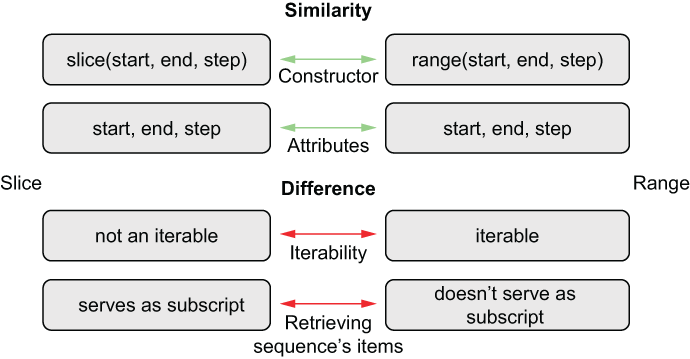 Figure 4.2 The similarities and differences between slice and range objects. They have a similar constructor pattern and attributes. Ranges, but not slices, are iterables, whereas slices, but not ranges, serve as subscripts for retrieving items from a sequence.
In summary, the range function is a versatile and efficient way to generate sequences of numbers in Python, with options to specify start, end, and step values, making it suitable for a wide range of applications.
Here's a markdown table comparing how different Python books discuss the term 'range':
| Book Title | Usage of range | Technical Depth | Connections to Other Concepts | Examples Used | Practical Application |
|------------|----------------|-----------------|-------------------------------|---------------|-----------------------|
| Python How-To | Discusses range as an iterable for generating sequences, highlighting its use in loops and list creation. more | Explains parameters start, stop, and step, and compares range with slice. more | Compares range with slice, emphasizing their different purposes. more | Provides examples of creating range objects and their outputs. more | Highlights memory efficiency and use in loops. more |
| The Quick Python Book, Fourth Edition | Describes range as a tool for generating sequences, especially in for loops. more | Details memory efficiency and the use of range with start, end, and step values. more | Focuses on range in the context of list indices and loop control. more | Includes examples of range with different parameters and their outputs. more | Emphasizes practical use in loops and memory efficiency. more |
| Tiny Python Projects: Learn coding and testing with puzzles and games | Highlights range for controlling loop iterations in programs. more | Basic explanation of range syntax and its parameters. more | Uses range to demonstrate loop control in programmatic tasks. more | Provides simple loop examples using range. more | Demonstrates use in repetitive tasks like generating outputs. more |
| Practices of the Python Pro | Explores range as a sequence generator in loops. more | Delves into range implementation using yield for deeper understanding. more | Connects range to generator functions and memory efficiency. more | Example of range implementation with yield. more | Highlights efficient iteration over large datasets. more |
This table provides a comparative overview of how each book approaches the concept of 'range' in Python, focusing on different aspects such as usage, technical depth, and practical applications.
FAQ (Frequently asked questions)
What is a range in Python?
How is a range defined in Python?
Can ranges be used in loops in Python?
Can ranges be used to create lists in Python?
What is the difference between slices and ranges in Python?
What are the similarities between slice and range objects in Python?
Are ranges in Python iterables?
Can slices be used as subscripts in Python?
Can ranges be used as subscripts in Python?
How do you define a range object in Python?
What are the start, stop, and step values of the range object 'range(1, 10, 2)'?
How is the range() function used in a program?
What does the range() function do in Python?
How does the custom range function determine the start and stop values?
What does the yield statement do in the custom range function?
How does the custom range function prepare for the next value?
What does the range function do in Python?
Why is the range function memory efficient?
How can you use the range function to find negative numbers in a list?
What is an example of using range in a for loop?
How can you control the step value in the range function?
Can the range function count backwards?
How do you specify a starting and ending value in the range function?
What does it mean that the ending value in range is exclusive?