Understanding self in Python
In Python, self is a convention used within class definitions to refer to the instance of the class. It is a fundamental concept in object-oriented programming, allowing each object to maintain its own state and behavior. The self parameter is automatically passed to instance methods and is used to access attributes and methods of the class.
The Role of self in Instance Methods
When defining instance methods in a class, self is used to refer to the instance on which the method is being called. This allows the method to access and modify the instance's attributes and call other methods within the same instance. For example:
class Task:
    def __init__(self):
        print(f"Memory address (self): {id(self)}")

task = Task()
task_address = f"Memory address (task): {id(task)}"
print(task_address)
In this example, the __init__ method prints the memory address of the instance, demonstrating that self refers to the instance itself.
Instantiation and Initialization
Creating an instance of a class is known as instantiation. This process involves calling the class's constructor, which in turn calls the __init__ method to initialize the instance. The __init__ method is crucial for setting the initial state of an instance:
class Task:
   def __init__(self):
       print("Creating an instance of Task class")

task = Task()
In this example, the Task class is instantiated, and the __init__ method is called, printing a message to indicate the creation of a new instance.
Customizing Instance Initialization
The __init__ method can be customized to accept parameters, allowing for more flexible initialization of instance attributes:
class Task:
   def __init__(self, title, desc, urgency, tags=None):
       self.title = title
       self.desc = desc
       self.urgency = urgency
       self.tags = [] if tags is None else tags
In this example, the tags attribute is initialized with an empty list if no tags are provided, using a ternary expression for conciseness.
Using self to Access Attributes
self is used to access and modify attributes within a class. Consider a simple Rock-Paper-Scissors simulator:
import random

OPTIONS = ['rock', 'paper', 'scissors']

class RockPaperScissorsSimulator:
    def __init__(self):
        self.computer_choice = None
        self.human_choice = None

    def get_computer_choice(self):
        self.computer_choice = random.choice(OPTIONS)

    def get_human_choice(self):
        choice_number = int(input('Enter the number of your choice: '))
        self.human_choice = OPTIONS[choice_number - 1]

    def print_choices(self):
        print(f'You chose {self.human_choice}')
        print(f'The computer chose {self.computer_choice}')

    def simulate(self):
        self.get_human_choice()
        self.get_computer_choice()
        self.print_choices()
In this example, self is used to set and access the computer_choice and human_choice attributes.
Visualizing self with Variable Namespaces
Each instance of a class has its own namespace, which is accessed through the self reference. This means that variables defined within a class method using self are unique to each instance, allowing for encapsulation and modularity in your code.
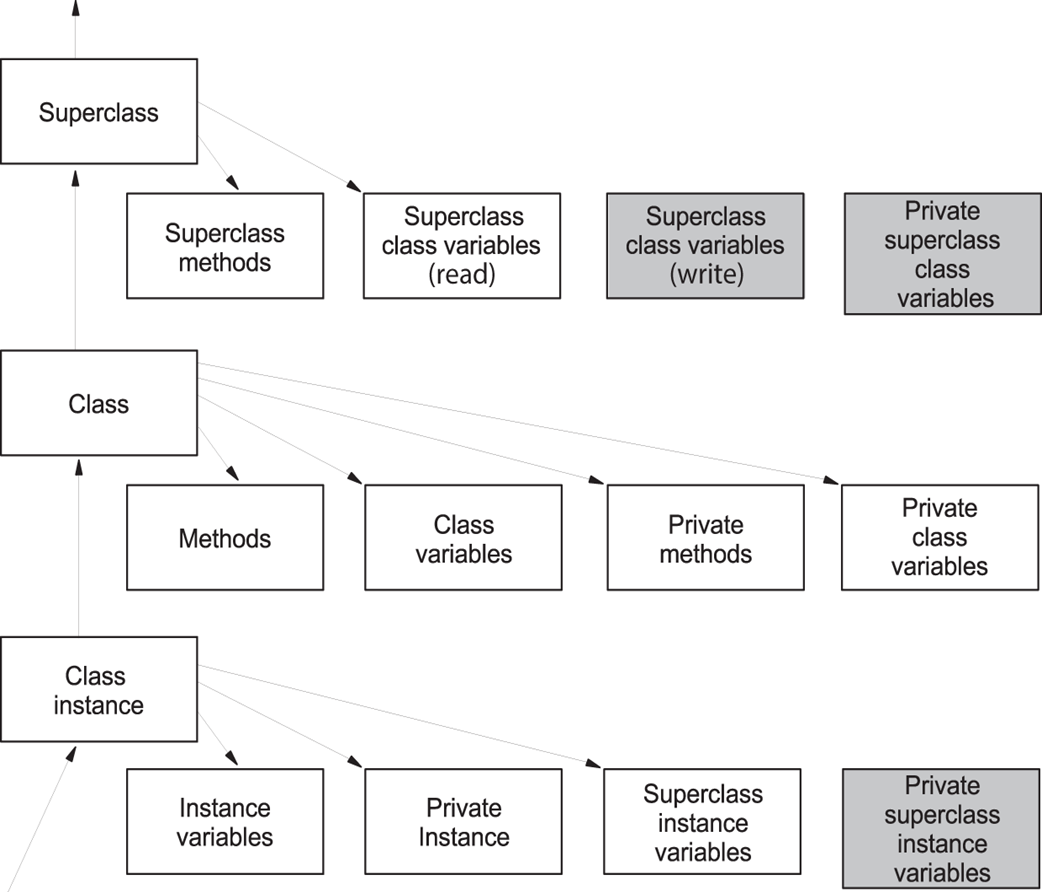 Figure 15.2 self variable namespaces
Method Chaining with self
Methods can return self to allow for method chaining, enabling multiple method calls to be linked together in a single line of code:
class Rectangle:
    def set_pen_color(self, color: tuple):
        self.pen_color = color
        return self

    def set_fill_color(self, color: tuple):
        self.fill_color = color
        return self
In this example, the set_pen_color() and set_fill_color() methods return self, allowing for method chaining.
Getter and Setter Methods
To encapsulate the attributes of a class, getter and setter methods can be defined using self:
def get_x(self):
    return self.x

def set_x(self, value):
    self.x = value
These methods provide controlled access to the attributes, allowing for validation or additional processing when getting or setting values.
In summary, self is a powerful tool in Python that allows for the creation of flexible and reusable class instances, enabling each instance to maintain its own state and behavior.
| Book Title | Usage of self | Technical Depth | Connections to Other Concepts | Examples Used | Practical Application |
|------------|---------------|-----------------|-------------------------------|---------------|-----------------------|
| [Python How-To](https://www.manning.com/books/python-how-to) | Discusses `self` as a convention for instance methods, emphasizing its role in accessing instance attributes and methods. [more](https://livebook.manning.com/book/python-how-to/chapter-8/13) | Explains `self` in the context of instance methods and initialization, with a focus on code readability and maintainability. [more](https://livebook.manning.com/book/python-how-to/appendix-f) | Connects `self` to concepts like instantiation, initialization, and comparability of class instances. [more](https://livebook.manning.com/book/python-how-to/chapter-8/11) | Provides examples of class instantiation and method definitions using `self`. [more](https://livebook.manning.com/book/python-how-to/chapter-8/11) | Demonstrates practical use of `self` in creating and comparing class instances. [more](https://livebook.manning.com/book/python-how-to/chapter-8/11) |
| [Practices of the Python Pro](https://www.manning.com/books/practices-of-the-python-pro) | Highlights `self` as a reference to the current instance, used to access and modify attributes. [more](https://livebook.manning.com/book/practices-of-the-python-pro/chapter-2/111) | Discusses `self` in the context of encapsulation and maintaining instance state. [more](https://livebook.manning.com/book/practices-of-the-python-pro/chapter-2/120) | Links `self` to encapsulation and state management within classes. [more](https://livebook.manning.com/book/practices-of-the-python-pro/chapter-2/120) | Uses a Rock-Paper-Scissors simulator to illustrate `self` in action. [more](https://livebook.manning.com/book/practices-of-the-python-pro/chapter-2/120) | Shows how `self` enables flexible and reusable class instances. [more](https://livebook.manning.com/book/practices-of-the-python-pro/chapter-2/120) |
| [The Quick Python Book, Fourth Edition](https://www.manning.com/books/the-quick-python-book-fourth-edition) | Describes `self` as a reference to the current instance, crucial for object-oriented programming. [more](https://livebook.manning.com/book/the-quick-python-book-fourth-edition/chapter-15/176) | Explains `self` in terms of variable namespaces and instance-specific data. [more](https://livebook.manning.com/book/the-quick-python-book-fourth-edition/chapter-15/181) | Connects `self` to the concept of variable namespaces and encapsulation. [more](https://livebook.manning.com/book/the-quick-python-book-fourth-edition/chapter-15/181) | Visual aids and examples to illustrate `self` and its role in class instances. [more](https://livebook.manning.com/book/the-quick-python-book-fourth-edition/chapter-15/181) | Emphasizes managing and manipulating object state using `self`. [more](https://livebook.manning.com/book/the-quick-python-book-fourth-edition/chapter-15/181) |
| [The Well-Grounded Python Developer](https://www.manning.com/books/the-well-grounded-python-developer) | Explores `self` as a reference to the current instance, used for accessing and modifying attributes. [more](https://livebook.manning.com/book/the-well-grounded-python-developer/chapter-4/15) | Discusses `self` in the context of method chaining and graphical applications. [more](https://livebook.manning.com/book/the-well-grounded-python-developer/chapter-4/15) | Links `self` to method chaining, encapsulation, and graphical updates. [more](https://livebook.manning.com/book/the-well-grounded-python-developer/chapter-4/15) | Provides examples of a `Rectangle` class and graphical updates using `self`. [more](https://livebook.manning.com/book/the-well-grounded-python-developer/chapter-4/15) | Demonstrates `self` in graphical applications and method chaining. [more](https://livebook.manning.com/book/the-well-grounded-python-developer/chapter-4/15) |
FAQ (Frequently asked questions)
What is the 'self' parameter in Python?
How is 'self' used in Python classes?
What is 'self' in Python?
Is 'self' a keyword in Python?
How do you define the initialization method for a class in Python?
What does 'self' represent in the 'init' method?
Do 'self' and the instance variable have the same memory address?
What is the purpose of 'self' in instance methods?
What is 'self' in Python classes?
How is 'self' used in Python class methods?
Is 'self' automatically passed to instance methods in Python?
Why is 'self' a convention in Python?
How is 'self' used to access attributes in a Python class?
Can methods set attributes on 'self' in Python?
Do methods need to take attributes as parameters in Python classes?
How do methods read attributes from 'self' in Python?
What does 'self' refer to in Python classes?
How is 'self' used in Python classes?
What does Figure 15.2 illustrate in the context of Python classes?